




You are here
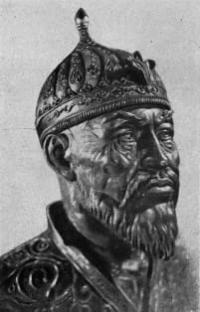
Portrait of Tamerlane.
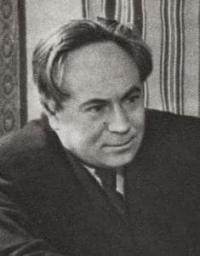
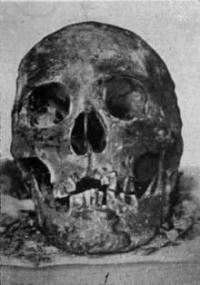
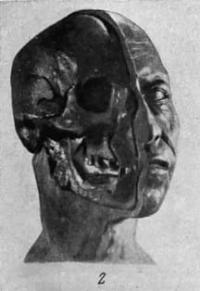
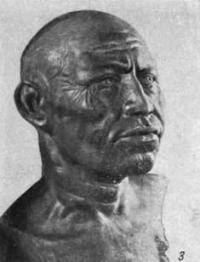
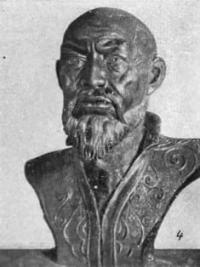
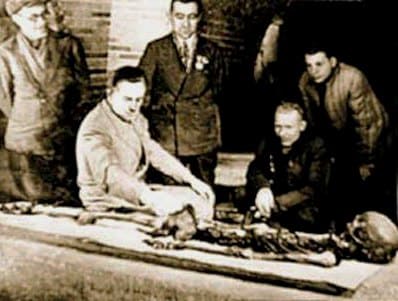
Excavations at Gur-Emir mausoleum in 1941.
"Timur was well built, tall, with an open forehead, a large head, a strong voice, and his strength matched his courage; a bright flush enlivened the whiteness of his face. He had broad shoulders, thick fingers, long thighs, and strong muscles. He wore a long beard; his right arm and leg were mutilated. His gaze was quite kind. He disdained death, and although he was just short of 70 when he died, he had not yet lost either his genius or his fearlessness. He was an enemy of lies; jokes did not amuse him. ... He loved to hear the truth, no matter how cruel. Successes, good or bad, had no effect on his spirit. A friend of brave soldiers, himself full of courage, he knew how to command respect and obedience."
"Aja'ib al-maqdur fi nawa'ib (fi akhbar) Taymur" ("Miracles of Predestination in Vicissitudes of Fate (in News) of Timur"). 1436.
Son of Targai, of Barlas family.
(An Experiment in Sculptural Reproduction Based on Craniology).
The study of the physical appearance of people from the distant past is undoubtedly one element of historical research. Anthropological study of people whose genealogy is known helps us understand the nature of the hereditary transmission of certain traits, and from this perspective, it will be of interest not only to historians, but to biologists.
The new method of creating a sculptural portrait of a historical figure based on craniology not only unites the common interests of biological and historical sciences but also makes this mute skeletal material accessible to everyone, not just specialist anthropologists.
In May and June 1941, excavations were conducted at the Gur-Emir mausoleum, the burial place of the Timurid dynasty. The expedition uncovered five tombs: those of Timur, his sons Shahrukh and Miranshah, and his grandsons Ulugh Beg and Muhammad Sultan.
The purpose of this article is to describe the process of reconstructing Timur's documentary portrait. Timur's tomb occupied a central position in the mausoleum's basement; its tombstone consists of a massive, roughly hewn slab of gray limestone, over which a thin slab of onyx, covered with a delicately carved dedicatory inscription, was attached with ganch mortar.
Beneath the slab, a thick layer of ganch was discovered, covering massive transverse limestone blocks that served as the roof of the burial chamber. The burial chamber, constructed of massive limestone blocks, tightly fitted together, was rectangular, measuring three meters by one meter, and about a meter deep.
Inside this chamber was a wooden coffin, identical in shape to those used today. Remnants of a dark blue, almost black, brocade cover, with verses from the Koran woven into it in silver thread, remained on top of the coffin. The juniper coffin was nailed together with massive, square-sectioned iron nails with large heads.
All the nails were completely corroded. Upon opening the coffin, a very pungent, intoxicating odor of camphor and other substances, likely preservatives, was detected. A skeleton was found lying on its back, with its arms extended and clasped at the wrists, its legs extended, and its head resting on its right cheek, facing Mecca.
The bones were covered in places with small shreds of fabric. Remnants of mummified muscle and skin were found near the head, neck, and inner thighs. The hands and small bones of the feet were jumbled and tangled. All the bones were covered in a fine, elutriated loess; in some places, fine, needle-like gypsum druses, precipitated from the aqueous solution, were observed on the bones.
The skull, carefully removed, was dried in the shade for three hours in the open air, after which it was possible to perform preliminary conservation, i.e., fix it by impregnation with wax. Before impregnation, the remaining hair from the scalp, eyebrows, mustache, and beard was removed from the skull.
One of the expedition's main goals was to document the authenticity of Timur's burial. The dedicatory inscription on the tombstone alone did not resolve this issue. Only a study of the skeleton could provide a definitive answer. The peoples of the East have preserved hundreds of legendary tales about the greatest conqueror of the XVth century.
Not only Central Asia, but also distant China and India, trembled before the name of the Iron Lame, and the fame of his power and fabulous wealth reached as far as Europe. Biographers lavished vivid descriptions of his great campaigns, but unfortunately, they left very little information about his appearance; the information is contradictory and unclear.
According to Ibn Arab Shah, Timur, son of Targai, from the Barlas clan (a Turkified Mongol family), was born in 1334 near the city of Kesh, in the village of Haji-Ilgar. Written sources indicate that in 1362, in a battle with the Turkmens near Seistan, Timur was wounded by arrows; as a result, he remained lame in his right leg and with a withered right hand for the rest of his life.
Moreover, it was probably here, according to Clavikho, that Ti The left shoulder was lopsided, so that his left shoulder was significantly higher than his right, but this did not affect the proud carriage of his head. All of the aforementioned pathological phenomena are long-standing, but can certainly be attributed to adulthood, which is somewhat at odds with written sources, which indicate that Timur's lameness was the result of severe bruises in his youth.
But despite the long-standing nature of the pathological processes that so significantly altered Timur's skeletal structure, it should be noted that, despite his 72 years of age, the actual signs of senility associated with decrepitude are almost nonexistent.
The relatively insignificant formation of osteophytes, relative to his age, emphasizes the tonality of the entire skeleton. Timur loved horseback riding and would sit in the saddle for days at a time. Could this explain the degree of flexion of his injured leg? It is highly likely that on horseback, Timur was less aware of his physical limitations, maintaining a majestic posture.
The massiveness of his healthy bones, their well-developed contours and density, the breadth of his shoulders, the volume of his chest, and his relatively tall stature all suggest Timur had an exceptionally robust build. His strong, athletic musculature was likely distinguished by a somewhat austere appearance, which is natural: a life spent on military campaigns, with their difficulties and hardships, and almost constant time in the saddle, could hardly have contributed to his obesity.
In the author's work on Timur's portrait reconstruction, the most important document is his original skull. Naturally, in this regard, it deserves a more complete description. However, it would be a mistake to assume that this article will provide a craniological analysis of this skull.
This work will describe Timur's skull from the perspective of reconstructing his appearance, focusing more on descriptive features than on absolute dimensions. Before describing the skull's shape, I consider it necessary to point out that most of the left parietal bone was destroyed by gypsum salts, but this did not prevent a full understanding of the cranial vault's shape.
Timur's skull, in horizontal projection, occupies an intermediate position between spheroidal and sphenoidal forms. Some vagueness in the image is explained by significant natural deformation associated with uneven fusion of the coronal suture.
This is a typical form of so-called left-sided plagicephaly, resulting in an overgrowth of the skull to the right. The cranial vault is regularly rounded, with a non-protruding occiput but a slightly depressed occipital ridge. The forehead is steep, with well-defined frontal eminences.
The moderately developed superciliary ridges barely extend beyond the midpoint of the orbit. Characteristically, they do not lie parallel to the orbital rim, but taper upward at their outer edges toward the frontal eminences. The face is a regular ovoid shape, with slightly prominent cheekbones.
The orbits are large and rounded, with strongly protruding, relatively thin, but blunted edges. The zygomatic process of the maxilla, together with the adjacent anterior part of the zygomatic bone, form the lower edge of the orbit, projecting strongly forward.
Despite the relatively weak development of the superciliary arch, the bridge of the nose itself projects strongly forward. The root of the nose is high, its bridge is slightly wavy, and the arch is rounded and blunted. The nasal bones have a distinct constriction in their middle part.
The wide pyriform aperture is heart-shaped. The subnasal spine is weakly developed and slightly elevated. The sharp subnasal margin of the pyriform aperture is similarly elevated. The ends of the nasal bones, as well as the entire edge of the pyriform aperture, are refined, slightly blunt, and slightly inwardly turned.
The upper jaw is very wide, as is the lower jaw. Its ascending branch is strong. The chin is steep, prominent, and highly sculpted. The early loss of the upper incisors and the resulting atrophy of the alveolar sockets have resulted in the slightly protruding nasal spine forming a ridge along the intermaxillary suture.
The strongly swollen, protruding alveolar portions of the canines indicate a significant prognathism of the incisors in youth. Despite the weakly defined maxillary notch (canine fossa), the sharp relief of the zygomatic bones in their frontal portion creates the impression of a less flat face than is actually the case.
The teeth are heavily worn, with traces of obvious caries. Many teeth were lost long before death. It doesn't take much insight to see typical Mongoloid features in Timur's skull: pronounced brachyphaly, an apparently flattened face, and its considerable width and height.
All of this ties in perfectly with written documents attesting to Timur's descent from the Barlas clan. Despite Timur's advanced age (70-72 AD), his skull, as well as his skeleton, lack any pronounced, specifically senile features. On the contrary, the delayed formation of the saddle.
The skull, slight obliteration of the sutures, the presence of most teeth, clear bone relief, and the almost complete absence of osteophytes all suggest that the skull and skeleton belonged to a vigorous and healthy individual, whose biological age did not exceed 50 years.
The relief of the occiput, the strong, large cervical vertebrae with a distinctive, proud head carriage, and the large clavicles and scapulae indicate the strength of the cervical and thoracic muscles. All this allowed us to select the maximum thickness for the soft tissue standard, adjusting for increased bone density in areas of greater bone relief.
The density of the bone structure and the distinct ridges of the facial skeleton indicate a relatively weak subcutaneous fat layer. Timur's large face was strong and muscular, but not overly fatty. His steep, wide forehead with prominent ridges defines the direction of a series of deep horizontal wrinkles.
The prominent protrusion of the glabella, reinforced by the convexity of the short, upwardly tapering brow ridges, forms a knobby expansion above the nasofrontal suture, defining the character of the vertical folds between the eyebrows. The brow ridge itself serves as a direct support for the short but thick, tufted Mongolian eyebrows, the hairs of which have been preserved.
The refined rims of the orbits, their size and roundness, the strongly protruding lower edge of the orbit, and the wide interorbital distance determine the Mongoloid structure of the eyes, emphasized by their slightly slanted slant. However, the significant protrusion of the nasal root and the relief of the middle portion of the brow ridge indicate that the Mongolian eyelid fold itself is relatively weakly expressed.
The pronounced microrelief of the frontal portion of the zygomatic arches, their massiveness, and the enhanced relief of the ascending branch of the mandible indicate the development of the masticatory muscles and their somewhat dry appearance.
The wide piriform aperture and the rounded nasal vault suggest a somewhat flattened nose, the nostrils of which, in keeping with the structure of the lower portion of the piriform aperture, extend slightly beyond it and are clearly defined. The blurring of the philtrum and the slight recession of the middle portion of the upper lip are directly related to the deformation of the anterior portion of the maxilla, which arose due to the loss of the incisors.
The width of the palate, the strong relief of the alveolar ridge, the size of the teeth, and their occlusion indicate that Timur's mouth was wide, with thick but strong, vigorously defined lips. A certain sensuality in the mouth is determined by the significant protrusion of the lower lip and the accentuated, sharply defined, and vigorous chin.
The angle of the ascending branch of the mandible determines the upright position of the small, strong, typically Mongoloid ears. The configuration of the outer portion of the zygomatic arches, the distinct contours of the auditory canal, and the slight relief of the small mammillary processes, with their calm, somewhat rounded shapes and inward-facing apices - all this confirms that the auricle was firmly pressed to the head.
The size of the ear, judging from the size of the nose, is small. The clearly defined nostrils, with their pattern, suggest the relief of the auricle, with a clearly defined helix and a well-sculpted, small lobe. All this was confirmed by the later discovery of a fragment of a preserved ear among the mummified remains of muscle tissue.
This descriptive data exhausts our observations, but it is sufficient to reconstruct the features of the great conqueror of Central Asia using the skull. This documentary reproduction of the head is achieved using a specific, well-tested technique.
First, the primary chewing muscles and ridges, whose attachments are clearly visible, are reconstructed on the skull. Then, based on the structure of the skull base and the shape of the cervical vertebrae, the head's position is determined. A wooden frame is constructed accordingly, and the neck muscles are then reproduced on it, taking into account the specific structural features of Timur's neck and shoulders.
To achieve complete objectivity in the facial reconstruction, the thickness of the soft tissues was applied mechanically. For this purpose, in accordance with the accepted standard for thickness marks, height marks were applied to the authentic skull, sculpted as truncated pyramids from dense wax.
The height of each pyramid determined the thickness of the soft tissues at a given point. According to the accepted scale of soft tissue thickness on Timur's head, the following height marks were placed on his skull (only the main ones are given, in mm):
1. Coronal suture at the intersection of the segittals... 6
2. Coronal suture on the linea temporalis inferior... 7
3. Midpoint of the frontal bone... 6
4. Midpoint of the superciliary arch... 1
5. Nasofrontal suture... 10
6. Middle of the upper edge of the orbit 0
7. Outer edge of the orbit .. 7
8. Middle of the nasal bones .. 6
9. End of the nasal bones .. 3
10. Lower edge of the orbit in the middle .. 9
11. Middle of the cheek .. 15
12. Immediately lateral to the subnasal spine .. 1
13. Middle of the zygomatic
14. Anterior edge of the zygomatic .. 1
15. In front of the ear on the zygomatic .. 6
16. Lower edge of the maxilla .. 14
17. Thickness of the lower lip .. 15
18. Middle of the mandible along the groove .. 11
19. Maximum protrusion of the chin 9
20. Lomboidal suture along Segitals... 9
21. Against Protuberantia occipitalis externa... 13
These elevation marks were combined into horizontal and vertical profiles using thin ridges of dense wax. A profile was sculpted from the post-segital section of the skull. Reconstructing this profile across the entire vault of the head is not particularly difficult, but creating the profile of the nose and mouth is one of the most complex and challenging tasks of the entire reconstruction.
I developed a technique for constructing the profile of the soft nose. Using it when reconstructing Timur's head, I sculpted a ridge deliberately exceeding the profile of the nose. Then, along this ridge, I drew a line tangent to the last third of the nasal bones.
Next, a second line was marked, representing a direct continuation of the main direction of the subnasal spine. The apex of the angle formed by these two imaginary lines, as always, corresponded to the apex of the soft nose. The upper profile of the nasal dorsum is subordinated to the profile of the nasal bones, while the lower profile is constructed based on the relief of the lateral walls of the pyriform aperture.
In this case, the wide, heart-shaped pyriform aperture, with slight undulations on the sides, corresponded to the slight undulations of the soft nasal dorsum. The wide base of the pyriform aperture with its soft contours indicated a soft, somewhat flattened profile at the end of the nose.
The overall flattening of the nose, associated with the wide flare of the pyriform aperture, with blunted edges at the bottom, clearly demonstrated that Timur's nasal alae were wide, thick, but clearly defined. Reconstructing the mouth profile is significantly simpler.
The characteristic bite and the absence of upper incisors ensured the simplicity of constructing the mouth profile. The chin profile is reproduced in complete subordination to the bony relief of the lower jaw. Once all the ridges had been rendered, the voids between them were filled with wax.
This ensured the objectivity of the facial reconstruction. After the head was modeled, the eyeballs were inserted into their sockets, and the eyelids were modeled based on the shape of the orbital rims. For continuous control, one half of the face was sculpted first, then the other.
Throughout the entire process of creating Timur's portrait, all key features were photographed, and after one half of the face was completed, a cast was made, documenting that moment in the process. A second cast was made upon completion of the entire head.
Under normal circumstances, the documentary work ends at this stage. Further design of the costume and hairstyle is usually a matter of more or less conjecture. The very special conditions in which Timur's ashes were preserved made it possible to create a documented version of his hairstyle.
Chronicle sources indicate that Timur died at the end of winter (February 18), during a military campaign. This probably explains why, contrary to the accepted custom of shaving his head, Timur had relatively long hair at the time of his death. On his temples and behind his ears, it reached 3 cm, while on the top of his head it was no longer than 1.5 cm.
Timur's hair was thick, straight, gray-red in color, with a predominance of dark brown or red. The eyebrow hair was less well preserved, but still, from these remains, it was not difficult to imagine and reproduce the general shape of the eyebrow.
Well-preserved individual hairs reached from 12 to 14 mm in length, and they were strongly curled, thin Their color was dark chestnut. The mustache itself was not preserved, but a decayed stain, representing the remains of a mustache, was discovered on the right side of the skull, on the alveolar region.
This stain, with small fragments of hair, clearly conveyed the entire external shape of the mustache. Careful analysis of this stain allowed us to accurately reconstruct not only the general shape of the mustache but also to identify one distinctive feature of Timur's mustache. It turns out that Timur wore a long mustache, not trimmed above the lip, as was customary for devout followers of Sharia.
It was discovered that there was a rule allowing the upper military class to wear a mustache without trimming it above the lip, and Timur, in accordance with this rule, did not trim his mustache, and it hung freely above the lip. On the lower jaw, on the left side, clung beard hairs were preserved.
These strands of hair were completely in situ, so the line where the beard began was clearly visible. The lower lip down to the chin groove and the upper part of the cheek were completely free of hair. Timur's small, thick beard was wedge-shaped.
The hair was coarse, almost straight, thick, and bright brown (red), with significant graying. Even a preliminary examination of the beard hairs under a binocular microscope confirms that this reddish-red color is natural, and not dyed with henna, as historians have described.
Many hairs are only partially bleached, while others are completely white and gray. All this made it possible to reconstruct Timur's hairstyle with sufficient accuracy. The costume and headdress were created based on an analysis of miniatures and authentic objects from the Timurid dynasty.
Notes.
1 Twenty years ago, when I began my work on reconstructions, I did not foresee the possibility of reconstructing a face from a skull. My task at that time was limited to solving an ethnic portrait. Only later, while conducting control experiments, did I become convinced of the feasibility of formulating and resolving the problem of facial portrait reconstruction from a skull.
In 1940, I was able to conduct a series of well-designed control experiments, conducted with the assistance of Professor A.D. Grigoriev at the Lefortovo Morgue. Finally, in early 1941, two forensic cases, one after the other, eloquently documented the authenticity of the portrait reconstruction.
This enabled me to raise the question of reproducing sculptural portraits of historical figures. Thus, documentary portraits of Yaroslav the Wise, Andrei Bogolyubsky, and others were created (KSIIMK, 1940, issue VII, p. 72 and KSIIMK, 1945, issue XI, p. 88).
- Kpat.me communications of the IIMK, issue XVII.
Authority:
Excerpt from M. Gerasimov's article "Portrait of Tamerlane," 1947. Brief Communications of the Institute of the History of Material Culture. Publishing House of the USSR Academy of Sciences. Moscow, 1947. Leningrad. Issue 17 of the N. Ya. Marr Culture Collection