




You are here
B. Veyrman on Shir-Dor Madrasah.
A walk through Registan at night.
"It is remarkable that the dying antiquity has once again gathered its strength, once again exerted itself, to leave posterity a series of beautiful monuments in Bukhara and Samarkand, the finest of which is the Shir-Dor. In its inherent technical qualities, it is far inferior to the Timurid Madrasah, but for its time, it is a high standard. In its ornamentation, we find echoes of distant antiquity, elements of artistic wealth accumulated over centuries, the results of research and craftsmanship, but this is only a flash, soon extinguished."
V. L. Vyatkin. "Antiquities of Samarkand." 1930.
Guided tours of Shir-Dor Madrasah.
The first madrasah, built by Yalangtush-bahadur in the Samarkand Registan, was founded in 1619 and completed only in 1635-1636. These dates are given in the inscriptions adorning the entrance to the madrasah. One of the inscriptions is inlaid in colorful mosaic, the other is carved in stone.
The madrasah building was erected on the site of the ruins of Ulugh Beg's khanaka. During the madrasah's construction, the khanaka was apparently completely dismantled. There is no evidence to suggest that any of the khanaka's rooms survived and were incorporated into the madrasah.
What is certain is that the ruins of the khanaka provided abundant construction and, possibly, decorative material for the new structure. The architect's brief called for a building that would reproduce the appearance of the Ulugh Beg Madrasah as it existed in the XVIIth century, before the destruction of the second floor.
This task was carried out with particular precision in relation to the main façade of the new structure. Entering the square, we see a huge pointed arch inscribed within the rectangle of a powerful portal. On either side of the portal are blank walls, broken by shallow decorative niches.
At the corners of the building are tall round minarets, crowned with a stalactite cornice. Between the portal and the minarets, two beautifully ribbed, slightly pointed domes rise above the wall, resting on large cylindrical drums. This is what the façade of the Ulugh Beg Madrasah looked like before its destruction.
The only difference is in the proportions. Over two centuries, the level of Registan Square rose somewhat, and the Ulugh Beg Madrasah seemed to have sunk into the ground. The builders of the Shir-Dor Madrasah, however, failed to account for the distortions created by time and made the arches on the façade somewhat squatter in proportions than those of the Ulugh Beg Madrasah in their original form.
The Shir-Dor Madrasah differs more significantly from the Ulugh Beg Madrasah on the inside. The rectangle underlying the plan is proportionally shorter than that of the Ulugh Beg Madrasah, as the Shir-Dor Madrasah lacks a large auditorium-mosque along the rear façade. One of the cross-shaped, domed auditoriums in the corner of the building served as a mosque.
The hujras are simpler in design: they are single-room. The minarets on the eastern façade have been replaced by three-quarter towers, erected flush with the height of the walls. Overall, the building's architecture follows this model throughout, albeit with a tendency toward some simplification.
The noted traits of imitation do not deprive the building of its high artistic qualities, owing, of course, primarily to the perfection of the model on which it was built, but also to the great taste of the master builders, who superbly preserved ancient architectural traditions.
Especially now, when the original appearance of the Ulugbek Madrasah can only be fully reconstructed in the mind, its superb replica - the Yalangtush building - provides an opportunity to experience the uniqueness and grandeur of Central Asian architectural monuments.
The massive building block with its minarets and towers at the corners is particularly striking from Registan Street, just before the entrance to the square. The smooth wall of the side façade, dotted with a large pattern and pierced only by narrow windows here and there, involuntarily evokes memories of the ancient Central Asian fortresses that remain to this day on the banks of the great waterways – the Amu Darya and Syr Darya – protecting Maverannagr from the south and north.
From century to century, the monumental buildings of Central Asia retained their fortress-like appearance and rectangular plan with towers at the corners. Even here, amid the bustling streets of a commercial and craft city, the large madrasah buildings rise like fortified citadels, isolated and protected from the outside world.
This demonstrates the strength and tenacity of ancient building traditions. The Timurid era brought increased decorativeness to monumental architecture. The Registan Madrasah features numerous architectural decorative forms: enormous pishtaqs, minarets, and domes built significantly higher than the roofs of the interior spaces.
But the Central Asian architect, both in Timurid buildings and in their later iterations, always combined all these elements, rising, often even vigorously, above the main mass of the building, into a solid, stable composition, as if cemented by the monolithic wall of the main lower part of the structure.
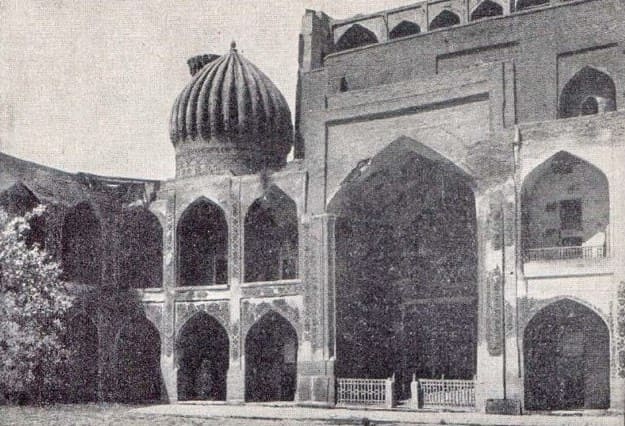
Through the powerful and deep niche of the portal, through the curving corridors, as in the Ulugh Beg Madrasah, one enters the square courtyard. Here one clearly senses the monumentality of medieval Eastern architecture. This is evident in the spatial enclosure of the courtyard, surrounded by two stories of hujras, in the ornamental rhythm of the two-tiered arcade of the walls, and in the varying scale of the arches, which has served as a favorite technique in the East since ancient times, emphasizing (sometimes illusory) the height of the wall.
The niches of the iwans, located in the center of the courtyard's sides, are designed in an interesting way: the deep part of the niche is vaulted in the form of a multifaceted semi-dome - a motif not found in the architecture of the Ulugh Beg Madrasah.
We see much originality in the building's decorative finish, testifying to the independent creativity of the master builders of the Yalangtush Madrasah. First and foremost, we must point out the two paired, enormous mosaic figures of lions placed in the tympanums of the entrance portal arch.
These figures gave the madrasah its modern name - Shir-Dor (in Persian: shir - lion, dor - having). Each tympanum depicted a huge predatory beast (a lion or tiger) against a blue background, its body entirely covered in black, white, and yellow stripes.
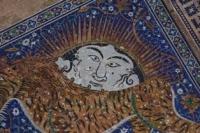
The predator's jaws are open, poised to pounce on a goitered gazelle, whose figure is rendered in white and green mosaic. Behind the lion is a half-hidden white sun with rays. The sun's disk is given the features of a human face; the nose, mouth, and hair are rendered in black.
This mosaic composition is unique and among the rarest works of art. Unfortunately, a significant portion of the mosaic has fallen out, and the image is now difficult to discern. Original mosaic panels are executed in some niches of the courtyard.
They depict vases with bouquets of flowers. Green dominates the color scheme. The drums are beautifully tiled, covered with large colored Arabic inscriptions. The dark blue and light blue masses of the domes loom over the drums. Inside, the decorative finish of the mosque is particularly interesting. Here, the steps and vaults are painted with small, multicolored, stylized floral patterns.
The paintings on the dome and vaults are very beautiful, with the patterns arranged into complex arabesque medallions. The Shir-Dor Madrasah's beautifully detailed decorative finish is nevertheless significantly inferior to that of the Ulugh Beg Madrasah, both in the artistic quality of its execution and in its sense of harmony with the building's architecture.
The glaze in the mosaics is not as pure in color. Apparently, the secrets of its production had already been forgotten by this time. Even the laying of the unglazed brick and tile facings reveals less skill and a desire to simplify the process. In all aspects - both in architecture and decoration - the Shir-Dor Madrasah is a good, but still not superior, replica of Ulugh Beg's remarkable structure.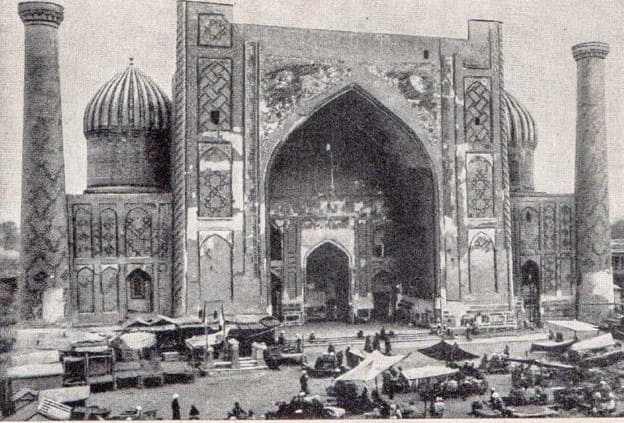


Authority and photographs by:
B. Veyrman. "Registan in Samarkand."
USSR Academy of Architecture. Institute of the History and Theory of Architecture. Architectural Treasures of the Peoples of the USSR. Edited by Academician V. A. Vesnin. 1946.