



You are here
Yakov Polferov. Hunting Kulan (Asiatic Wild Asses).
A trip from settlement of Torgay to settlement of Shili.
«The book now presented to the reader was written at the behest of the Turgai Regional Statistical Committee. The Committee deemed it appropriate to include an account of hunting methods in the Turgai region alongside the exhibits for the hunting section at the All-Russian Exhibition, scheduled to take place in Nizhny Novgorod in 1896. It is not for me to judge how satisfactorily I have fulfilled this task; I offer my apologies in advance for any shortcomings the book may contain and ask for the reader’s indulgence. Some of the hunting methods described here - such as hunting with birds of prey, or hunting geese, saiga antelopes, corsac foxes, wolves, wild goats, and black grouse—were previously published by me in various periodicals between 1893 and 1896; the rest appear in print here for the first time. This book is the result of my own personal observations of hunting life, supplemented by accounts from several Kyrgyz individuals who are well-regarded among their own people for their experience and profound knowledge of local life. I am particularly indebted to my constant companion, Safa Arungazyev, who provided invaluable insights on the subject, and to whom I extend my deepest gratitude».
Yakov Yakovlevich Polferov. Orenburg, April 1896.
Landmarks of Turgai Steppe.
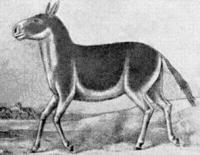
The kulan, or wild ass, is one of the primary representatives of the fauna of the Central Asian steppes and, incidentally, a prized quarry for Kyrgyz hunters.
"If one accepts the validity of Darwin’s theory," writes Brehm, "it is reasonable to suppose that the kulan is the progenitor of our own horse a species refined by millennia of domestication."
The renowned naturalist himself was firmly convinced of this hypothesis; he dismissed as highly tenuous the view held by some zoologists - who identified the tarpan (a type of feral horse) as the true wild ancestor of the modern horse. To support his theory, Brehm offers a series of valuable observations on the life and habits of the kulan, drawing parallels with those of the domestic horse to clearly demonstrate the close kinship between the two.
It is worth noting a few of these observations here. Horses and kulans can coexist quite harmoniously; during his travels across the steppe, the famous explorer once encountered a pair of kulans. "As we approached, one of the animals broke away and trotted toward the mountains, while the other remained where it stood seemingly puzzled, as if weighing its options.
It tossed its head a few times, then suddenly broke into a run - straight toward us." It turned out that this was not a kulan at all, but an ordinary Kyrgyz horse. Its coat color resembled that of a kulan, and - having likely become lost - it had been grazing peacefully alongside one.
Yet, the moment it spotted its own kind, it did not hesitate to abandon its newfound companion in the face of potential danger. Kulans always stay in herds, led by a dominant stallion who guides the group to pasture. When fleeing, he courageously defends the herd against enemies; he tolerates no disputes or rivalry among his subordinates and, in fact, will not allow any other mature stallion into the herd.
The kulan is among the proudest, most self-assured, magnificent, powerful, and headstrong of animals. Upon spotting a rider attempting to approach, it moves away with effortless ease seemingly mocking its pursuer while playfully flicking its tail against its own flanks.
If the pursuit continues and the rider spurs his steed into a gallop, the kulan races across the steppe with the speed of the wind, vanishing from sight in an instant. In such moments, the herd follows its leader, obeying his every command. "It is a magnificent sight to behold an entire herd running in orderly ranks as if following a leader’s command turning in unison, coming to a sudden halt, and then darting off once more."
The Kyrgyz people have their own legend regarding the origin of the kulan:
"Once, there lived a Kyrgyz man named Karger-Bey, who was as wealthy as he was stingy. He died without leaving any heirs, yet his riches fell to no one; instead, as a cautionary lesson to his countrymen, all his livestock were transformed into wild steppe animals his sheep became saiga antelopes, and his horses became kulans."
Ever since, both species have inhabited the wilderness. The preferred habitats of the kulan are mountainous and sandy-saline areas covered with bitter-tasting grasses. In the Turgay region, such places include the slopes of the Ustyurt Plateau, the shores of the Aral Sea, and the spurs of the Uly-Tau mountains, in the area to the south the eastern part of the Irgiz and Turgai districts.
Occasionally, individual herds may venture further north toward the foothills of the Mugodzhar Mountains; however, this happens quite rarely typically only during droughts or when there is a failure of the grass crop. Under favorable conditions, the kulan (Asiatic wild ass) consistently remains within the same grazing grounds.
In the summer, the herds move up into the mountains, while in the winter, they migrate to the valleys. There, they forage for food beneath the snow a behavior known as *tebenyevaniye* until the spring sun clears the snow from the upland pastures and the green grass begins to emerge.
The strength of the kulan’s attachment to its traditional haunts is evident from the fact that even when herds are driven hundreds of versts away from their usual pastures by hunger, or are persistently pursued by hunters in a given area, they invariably seek to return once these adverse conditions have passed regardless of how lush or safe their new, temporary grazing grounds might be.
Furthermore, unlike many other animals that might alter their migratory routes as a precautionary measure, the kulan tends to follow the exact same paths even when traveling to a watering hole. If a threat arises, the animal does not dart off to the side (even if doing so were possible); instead, it instantly turns back and flees at breakneck speed.
As we shall see later, hunters take full advantage of this, skillfully exploiting this peculiar habit of the kulan to their own benefit. Hunting the kulan is, in every respect, an exceptionally difficult endeavor. On one hand, nature itself places all manner of obstacles in the hunter’s path: crags, rushing torrents, vast lakes, hills, shifting sands, endless dunes along the seacoast, and desolate salt flats.
The climate, too, is highly capricious a deathly silence can suddenly give way to a terrifying sandstorm, piling up mountains of sand so that a flat plain is transformed into a chain of dunes, while areas that were once hilly become level ground. On the other hand, the kulan is an exceptionally cautious and keen-sensed animal; the slightest suspicion or hint of danger sends it fleeing. Like a bolt of lightning, it streaks away from any suspicious noise or rustle. When these two formidable forces nature and animal instinct work in tandem, the hunter faces a daunting challenge.
To emerge victorious, he must invest a great deal of effort, energy, and patience, employing ingenuity and cunning to outsmart the animal’s innate caution and sharp senses. The Kyrgyz people hunt the kulan in the autumn, when the herds begin to descend from the valleys, the sun’s heat grows more moderate, and the fierce storms give way to gentle breezes.
The most common and, at the same time, the most difficult method of hunting kulans is the "encirclement" approach. Armed with rifles, the Kyrgyz hunters set out early in the morning on their finest *argamak* steeds, quietly approaching a chain of hills where, according to their observations, a herd of kulans is likely to be grazing.
At the foot of the hills, the hunters split into several groups, each attempting to approach the summit cautiously and without making a sound. The objective is to prevent the animals from escaping deeper into the hills and instead drive them down into the valley a place where the hunters can truly test their marksmanship and see if their own mounts can match the speed of the kulans (wild asses).
Upon reaching the crest, the hunters scan the pastures; the moment their sharp eyes catch even the faintest outline of a herd in the distance, they immediately retreat slightly down the slope and gallop around to flank the animals, stationing a single rider along every potential path.
Moving swiftly to the rear, they ascend to the summit once more and charge directly toward the herd, maintaining a loose, semi-circular formation. The *kulans* are taken aback for a fleeting moment, they seem unable to grasp what is happening but that moment passes all too quickly...
With their tails held high, the proud creatures bolt like arrows across the high ground, racing along the trails only to find themselves blocked by the cunning ambush and the hunters, who relentlessly drive them toward the valley. The herd plunges down the slope, kicking up thick clouds of saline dust, but the hunters stay right on their heels; undeterred by the steep descent, they urge their mounts on with even more vigorous lashes of their whips.
And now, the valley... The herd comes to a halt, the animals turning their heads as if on command but to their horror and astonishment, the riders have not fallen behind; they are still thundering along right behind them. A stallion struck the ground sharply with its hoof, its neigh rang out, and with the speed of lightning, it bolted across the level steppe the entire herd following in its wake.
The hunters closed their ranks, forming a tighter line as they relentlessly pursued the herd. The distance between them gradually narrowed; foals began to fall behind, and the adult horses, loath to leave them, slowed their pace but the riders, showing no mercy to their own mounts, drove them on with countless blows, forcing them to gallop at full stretch, low to the ground.
Eventually, the herd broke apart into smaller bands that scattered in different directions across the steppe. The hunters, in turn, broke their line, each group setting off in pursuit of a chosen band. An hour into this frantic chase, the distance between the lead riders and the animals shrank to within gunshot range; dropping their reins, the hunters rose in their stirrups, deftly shifted their rifles into their hands, and at full gallop fired at the herd.
Here it is not important to kill or wound, but the main thing is to ensure that the kulan hears the sounds of shots, from which they instantly stop and seem to figure out where they came from. At this time, the hunters also deftly stop their argamaks and shoot at the school at sight.
The last one shys away, but soon stops again and looks in surprise at his brother who has fallen on the spot, which gives the hunters the opportunity to take aim again and knock down one or two kulans. If the school consists of only young queens and foals, then sometimes it is possible to kill it all.
Where hunters do not hope to catch up with the kulan, or if the topographic conditions of the area do not allow it, then an ambush is set up. In most cases, kulans converge on a watering hole along the same path, trodden exclusively by them.
Knowing this, the hunters look for the “kulan-zhol” (kulan-path), line them with small bushes of tree branches, approximately a hundred paces from one another, and hide behind them. Several people remain on the heights and give conventional signs about the approach of the herd.
As soon as the latter reaches the middle, shots are heard, from which the animals rush back to the sides, but the shots thunder, they knock down the kulans one after another, and the animals rush in fear along the path, and sometimes rush into the sea, river, lake, where they swim until exhaustion, and then wash up on the shore and fall alive into the prey of hunters.
Instead of bushes, sometimes they set up another method of ambush: near a watering hole chosen by the kulan, hunters dig holes and sit in them at night. The kulan approaches cautiously, stops several times, rushes headlong back at the slightest breath of wind, fearfully snorts, and sucks in air.
This moment is called “tang-danu” among the Kyrgyz, which means fear, surprise. Having done the “tang-dana” several times, the kulan finally decides to approach the watering hole; At the same time, hunters attack him and the result is the same as in an ambush on the path.
Recently, the Aral Kyrgyz people have adopted the method of hunting kulans, common in eastern Siberia. It consists of the fact that the hunter, having spotted the kulan, quietly drives up to it just enough for the latter to pay attention. Once this has been achieved, the hunter ties his horse to the tail, which, by the way, must be the same color as the kulan - light red, takes it to an elevated place, lets it onto the grass, and he lies down a few steps away.
Kulan, mistaking this horse for a mare of his own breed, heads towards her, but soon, puzzled, he stops in place and gives the hunter the opportunity to take aim with his unsightly rifle. Sometimes the Kirghiz, in order to deceive the kulan, drive a camel in front of them, which the kulan allows close to them, and the hunter kills the game because of the animal. (Radde).
Kulan is considered by the Kyrgyz to be one of the most valuable and favorite hunting trophies, since in addition to pleasure, hunting kulan is also profitable. Kulan meat is considered the most delicious dish among nomads and is highly valued, so a carcass can cost up to 15 rubles.
Ergaki are made from leather, and the skin removed from the croup and thighs is sold separately to traders for making morocco. In addition, kulan leather is used for “zhaina-maz” and replaces a prayer carpet. Every year, the development of hunting for kulans is noticed, the export of products from the latter is increasing, and therefore there is reason to assume that the Kyrgyz will create a very profitable trade from hunting kulans.
Authority:
Yakov Yakovlevich Polferov. “Hunting in Turgai region” (with drawings). Publication of Turgai Statistical Committee. Orenburg. Typo-lithography by N. N. Zharinov. 1896.