




You are here
Description of Ural River in 1890.
Travel advice on Aral Sea Kazakhstan.
“Nature is wise. You can learn everywhere and from everything”
Leonardo da Vinci.
Popular destinations on Aral Sea Kazakhstan.
"The Ural River's course serves as a continuation of the Ural Mountains, forming the border between Europe and Asia. This is the ancient Yaik, a name that was forbidden and, as it were, cursed for the fame previously associated with the Cossack rebellion led by Pugachev. This is why the ancient name was forgotten. In terms of length, the Ural is one of the great rivers of Europe, but not in terms of the abundance of its waters. Originating on the Asian side of the mountains in the Kalganau Gorge, the Ural receives its first tributaries from gorges protected from rain-bearing winds. The average precipitation in the form of rain and snow in the upper Ural basin probably does not exceed 40 cm, decreasing gradually from north to south; Upon entering the plain, the river cuts through regions where annual rainfall is less than 25 cm, and most of the water evaporates. Its bed, formed by clay sediments, is almost everywhere more than 100 meters wide, sometimes reaching 175 meters."
M.V. Malakhov. XIXth century.
"The Yaik River is usually home to sturgeon, beluga, thornback sturgeon (a special kind of sturgeon, so named for its smoothness and sharp nose), stellate sturgeon, sterlet, catfish, carp, and whitefish. Small and common fish include pike, pike-perch, bershik, bream, chub, sabrefish, and a host of other small fish... All these fish swim in schools, and the Yaik is especially rich in stellate sturgeon, so numerous that near Guryev, you can clearly see their numbers in the water. All the Cossacks claim that before this, near the town of Yaitsky, the strong pressure of the fish caused breaches in the uchug or weir built across the river, forcing them to place cannons on the bank to drive the fish away with gunfire."
P.S. Pallas. XVIIIth century.
Ural is a river in the Caspian basin. In its lower reaches, it forms the border between Europe and Asia. It flows from the Ural Range and, to the south, separates it from its natural extension, the Mugodzhar Mountains.
The Ural, with its tributaries, irrigates the Orenburg Governorate, the Ural Region, and part of the Turgai Region. Until 1775, this river was called the Yaika (Tatar "Dzhaik"), and this name has persisted to this day in the folk songs and local dialect of the Ural Cossacks; Officially, after the "Pugachev Rebellion," by decree of Catherine II on January 15, 1775, the Yaik River was renamed the Ural River.
On old maps, the Ural is called Rhymnus fluvius. Its summit lies in the southern spurs of Karatysh, Troitsky District, Orenburg Province, and originates from the summit of Mount Kalgan-Tau (i.e., the last, outermost peak of the Ural Range), at an altitude of 2082 feet, at 54°42' N and 59°25' E. d.
At its beginning, the Ural flows from north to south. Upon encountering the elevated plateau of the Kirghiz steppe near Orsk, it turns sharply east. Beyond Orenburg, it changes direction to the southwest. It enters the Ural Host lands to the west between the village of Rassypnaya in the Orenburg district and the village of Mukhranovsky in the Ural Host.
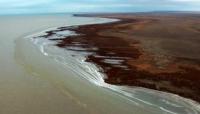
Near Uralsk, the river makes another sharp bend to the south and, following this main direction, meandering sometimes west, sometimes east, it flows into the Caspian Sea from the north at 46°18' N. The mouth of the Ural divides into several branches and gradually becomes shallower.
In 1769, Pallas counted 19 branches, some of which were separated by the Ural River 80 versts (50 miles) above its mouth. In 1821, there were only nine, and in 1846, only three: Yaitskoye, Zolotinskoye, and Peretasknoye. By the late 1850s and early 1860s, no branches with a constant current separated from the Ural River as far as Guryev.
The first branch to separate from the main channel on the left, 4 versts below Guryev, was the Peretask, which divided into the Peretasknoy and Aleksashkin channels. Further downstream, the Ural River divided into two branches, the Zolotinsky and Yaitsky, and both the former and the latter, before flowing into the sea, divided into two mouths: the Bolshoe and Maloe Yaitskoye, and the Bolshoe and Staroe Zolotinskoye.
From the Zolotinsky branch, another branch, the Bukharka, branched off to the east, flowing into the sea between Peretask and Zolotoy. The current state of the Ural branches is as follows: the Yaitskoye River mouth, flowing into the sea, faces northwest, toward Kamenny Island.
Its depth is two feet, not within the shores, but between two underwater coastal spits. The Bolshoe Yaitskoye River, at its entrance to the sea, flows due south, but opposite its outlet, a spit has formed, from which the furrow (banks) of the mouth also turns west. Its depth, according to Pushchino's map, is three feet.
The Zolotinsky estuary, which faces southwest upon entering the sea, further along the coast divides into two separate mouths, one facing west, the other southwest; the latter has a depth of 1-2 feet. The old Zolotinsky estuary is almost completely overgrown with reeds during the summer.
The Bukharka and Peretask, compared to the others, are narrower and quite deep at their mouths. According to Klykov's soundings, the depth at the mouth of the Bukharka is 2 1/2 feet, and the Peretask 1 1/4 feet; both face south and southeast upon entering the sea.
The Aleksashkin branch has become shallow and has become a channel, only spilling over the "White Ilmen" into the sea in the spring. The Ural basin is the sixth largest among Russian rivers, covering 193,239 square miles, or 219,910 square kilometers. km.
The length of the river itself is estimated at 2,230 versts (2,379 km), with the rafting section being 910 versts long and the non-rafting section being 1,379 versts. The water table is at the following absolute heights: at the source 2,082 feet, at the Banny spur 619 feet, at Orsk 590 feet, at the village of Ilyinskaya 479 feet, at the village of Verkhne-Ozernaya 420 feet, at the Ostrovny spur 327 feet, at Orenburg 263 feet, and at Uralsk 162 feet./
The fall of the Ural's water is not particularly great; from the upper reaches to Orsk it is about 3 feet per verst, from Orsk to Uralsk no more than 1 foot, and further downstream – even less. The width of the channel is generally insignificant, but variable; Near the town of Verkhne-Uralsk, up to 20 fathoms; the maximum width of the Ural within the villages located above the town of Uralsk fluctuates between 55-97 and 15-37 fathoms; in the lower reaches, 50-100 fathoms.
The depth, according to measurements taken in 1879, for the upstream villages ranges from over 6 fathoms to 3/4 of an arshin; throughout the entire length of the Ural, there are numerous riffles, which are waded through in summer and autumn and used for driving cattle.
The Ural River's bed is rocky in its upper reaches, but clayey and sandy throughout most of its course. Within the Uralsk region (A.P.'s West Kazakhstan region), rocky ridges are found: 22 miles above the city of Uralsk, near the village of Trekinsky, near the village of Dar'insky ("Brusyanoy" - from the bar-shaped stones), near Yanvartsevo, and near the village of Gorsky in the lower part of the Ural, where the Inder Mountains approach.
Below the city of Uralsk, the riverbed is lined with small pebbles, which are found in somewhat larger sizes near the "White Hills"; special pebbles made of dense clay are also found in some places along the lower reaches of the Ural (in the "Burned Bow").
The Ural's course is quite winding and forms a large number of "bows," or loops. With its bed of rather loose clay-salt-sandy soil, the Ural, when the water level is low, frequently changes its main channel throughout its length, carving out new passages, leaving deep pools, or "oxbow lakes," in all directions.
Thanks to the Ural's variable flow, many Cossack villages that once stood along the river subsequently found themselves on oxbow lakes. Residents of other villages were forced to resettle to new locations only because their old ruins were gradually undermined and washed away by the river.
At the point where the Ural River juts into the steppe, the banks are steep and precipitous ("ravine"), and from the opposite bank, sandbanks ("sand") almost always extend far into the river. In general, the Ural Valley is cut on both sides by oxbow lakes, eriks (narrow channels), kotlubans (widening channels), lakes, and ilmens (small lakes).
During the spring floods, caused by snowmelt in the upper Ural Mountains, all of these fill with water, which remains in some until the following year. The Ural River breaks up near Orenburg around the 20th of April, freezing over no earlier than November; near Guryev, the river breaks up almost a month earlier (around March 20th). In the spring, rivers and streams carry masses of meltwater into the Ural.
The rivers overflow, overflowing their "pipes," that is, their banks. In places where the banks are gentle, the river can spread for 10-15 miles. During floods, the average water level rises by 1.5-3 fathoms, and the current's velocity increases dramatically.
The Ural is generally poorly navigable, but a small amount of timber is rafted down it from the Verkhne-Uralsky and Orsky districts to the cities of Orenburg and Uralsk. Below Uralsk, rafting is permitted in the spring with special permits, and, as an exception, the Ural receives many rivers and streams in its northern part.
Most of its tributaries flow into it from the right side, facing the Obshchy Syrt River; well-known among them are the Artazym, Tapalyk, Guberlya, and Sakmara, all within the Orenburg Province. In the Ural region, the Zazhivnaya flows in, disappearing before reaching the Urals in the meadows between the villages of Studenovsky and Kindelinsky, the Kindel and the Irtek; below the Irtek, several shallow rivers flow in, including the Rubezhka, at the mouth of which were the first settlements of the Yaik Cossacks, colonists of the wild and uninhabited at that time Ural region (1580); the most water-rich tributary on the right is the Chagan River, flowing from the Common Syrt (length over 250 versts).
The Or, Ilek, Utva, Barbasheva (Barbas-Tau), and Solyanka rivers flow from the left, being noticeable only in the spring and drying up in the summer. The Ural is the main source of economic prosperity for the Ural Cossacks: its valley is rich in forests and meadows; the grass harvest depends on its floods; and its waters have been the site of extensive fishing since the Cossacks arrived here.
The Ural is the only river in the world designated exclusively for fishing in its middle and lower reaches; below the town of Uralsk, where the "uchug" is constructed, all shipping is prohibited except in the spring. Even the crossings across the Ural are limited to a few places: a single bridge near Uralsk and ferry crossings near Guryev, Kulagin, and several other places - all to avoid disturbing the fish.
In 1880, an attempt was made to establish a private shipping line along the Ural River from Orenburg to Uralsk, but without success.
Geographical coordinates of Ural River in Kazakhstan: N49°34'38 E51°35'18
Geographical coordinates of beginning of Ural River in Republic of Kazakhstan: N51°27'21 E52°33'54
Geographical coordinates of mouth of Ural River: N46°49'48 E51°31'46
Authority:
N. B. N.
Brockhaus and Efron Encyclopedic Dictionary: in 86 volumes (82 volumes and 4 supplements). - St. Petersburg, 1890 – 1907.
https://ru.wikisource.org/wiki/%D0%AD%D0%A1%D0%91%D0%95/%D0%A3%D1%80%D0%B0%D0%BB,_%D1%80%D0%B5%D0%BA%D0%B02