





You are here
M. Masson. On Past of Tigers in Central Asia.
Tigers near ruins of Old Termez.
"This is not ferocious beast romanticized in our folk fables and fairy tales, but rather a skulking cat that reveals its terrifying claws and teeth only to defend its own hide."
Yevgeny Timofeyevich Smirnov, "Expedition Against Tigers," 1883.
The term "tiger" may share a root with the ancient Iranian word tigr*, meaning "arrow." A large, bloodthirsty predator reaching over two meters in length (excluding the tail) and possessing immense strength the Turkestan or Central Asian tiger (known as yulbars or julbars in Turkic, and shir or she* in Tajik) is also referred to in Central Asia by the epithet padsha* ("king").
In northern India, it is sometimes called shir-kha*, as it is considered the sovereign of all local beasts. It struck terror into humans as well. It is no wonder that, should an unarmed traveler unexpectedly encounter one, the recommended course of action was either to feign death or to greet the animal as if it were a human with the Muslim salutation, "Assalam-alaikum!" ("Peace be upon you!").
Then, in order to appease the lord of the reed jungles, one was advised while carefully avoiding eye contact to say respectfully: "I have no business with you; you go your way, and I shall go mine." In times past, a belief prevailed among the local population that the fierce and fearless royal predator would grow docile in the vicinity of the graves of highly revered Muslim saints a phenomenon regarded as a true testament to the spiritual greatness of those holy figures.
For instance, the caretakers of the mausoleum of Hakim al-Tirmidhi situated among the ruins of Old Termez near the Amu Darya River claimed that tigers, which would migrate downstream along the Amu Darya in winter, following the wild boars, would make a "pilgrimage" past the *mazar* (shrine).
They would reportedly pay their respects at the grave of Termez-Ata by circling it three times without causing any harm to anyone before continuing on their way toward Kelif. According to accounts from the Tajik inhabitants of the mountain village of Zarkent in the Tashkent region, as late as the end of the last century, solitary tigers would arrive in late autumn to pay homage at a venerated *mazar* located just above the village the shrine of a certain Imam Muhammad, better known by the epithet "Bobo-i Muradbakhsh" (meaning "the Father who grants the fulfillment of wishes").
As they approached the shrine, these predators much like truly pious pilgrims would supposedly "abstain from sin," refraining from attacking the horses grazing in the mountains; they would only resume such predation on their return journey. Upon reaching the burial site of Imam Muhammad where, at that time of year, only a single divan (a holy fool or ascetic) remained to live through the winter each tiger would allegedly perform the customary ritual expected of pilgrims: circling the *mazar* three times, and finally pressing its muzzle against the threshold of the structure built over the "sacred" grave.
No one witnessed this firsthand, save for the aforementioned *divona* (a wandering ascetic or "holy fool"), from whose account these details were relayed. Tiger "pilgrimages" in the vicinity of Zarkent ceased long ago a phenomenon the local Tajiks attributed to the installation of boundary markers by Tsarist-era surveyors.
These markers delineated "state-owned forest reserves" overseen by foresters, an act the proud *shirs* (tigers) may have perceived as a personal affront. In the traditional beliefs of various Central Asian peoples, the tiger much like the mysterious, venomous black snake was sometimes cast as a guardian of revered burial sites.
For instance, according to a legend among the Teke Turkmens of Akhal, a tiger would come by night to stand watch over a nineteenth-century tomb the resting place of a certain Khoja Muzaffar situated near the ruins of the Anau mosque. In the Middle Ages, semi-tame tigers were even employed as "incorruptible" bodyguards for potentates who had reason to fear attempts on their lives.
It is known, for example, that a tiger was kept chained near the bedchamber of the Samanid ruler Nasr I son of Ahmad and grandson of Ismail to ensure that anyone attempting to enter the sleeping sovereign’s quarters would be torn to pieces.
On the night of January 23, 914, while Nasr was on a hunting trip along the banks of the Amu Darya and spending the night in a tent near Ferebr, the tiger whether through the servants’ oversight or by design was not brought to the tent; this allowed conspirators from among the royal guard’s ghulams (slave-soldiers) to carry out the assassination of their sovereign without hindrance.
For some rulers of the later Central Asian khanates, it was considered highly [significant/appropriate] for the purposes of representation It was customary to keep captured tigers in large, deep pits with sheer walls, dug within the gardens of the khans' palaces.
In times past, tiger pelts played a role in court life; they were spread out as seats for sovereigns a practice depicted, for instance, in a Timurid-era miniature from the Shahnameh. Although the scene relates to the reign of the legendary King Kayumars, it reflects the customs of the XVth century.
Notably, in Timurid and Safavid miniatures from the XVth and XVIth centuries, the epic hero Rustam is often shown wearing a short tunic made of tiger skin. In Central Asia, valiant warriors were sometimes bestowed with the honorary title "Julbars" (tiger) in recognition of their military prowess.
This name was occasionally given to the children of khans, with the intention of fostering in the child and later the youth certain regal qualities associated with the animal, which were deemed essential for a future ruler. Its sharp claws were believed to possess magical power.
When a tiger was killed and skinned, its claws were sometimes removed and carried as amulets; they were considered potent talismans, serving, among other things, as the best protection against the machinations of *Albasty* a malevolent witch who haunted the darkness of the night.
It is surely no coincidence that images of these animals likely reflecting ancient beliefs in their protective power appear on the tile-decorated, majestic portals of certain Central Asian architectural monuments. A pair of white tigers striking for their somewhat fantastical coloration along with two white phoenixes, once adorned the tympana of the peshtak (portal) of a Bukharan madrasa.
This structure was built in 1623 as part of the architectural complex at Lyabi-Hauz, commissioned by a prominent dignitary, Nadir Muhammad Divan-begi, who was the head of the Uzbek Arlat clan. Due to the large, prominent images long since lost that once decorated its facade, the building became popularly known as "Shir-dor," meaning "the one with *shirs*" (tigers).
The same nobleman was also responsible for the construction of another madrasa twelve years later in Samarkand, near the *mazar* (shrine) of Khoja Ahrar. This structure was called "Kichik Shir-dor" ("Little Shir-dor") because, as noted at the time of the Russian conquest of the city, its main facade featured two pairs of large and small tiled shirs.
This colloquial name served to distinguish it from a much larger madrasa completed around the same time located on the Registan in Samarkand. The latter had been under construction for over a quarter of a century, funded by Yalangtush-biy Bahadur, the renowned leader of the Alchin clan.
The two *shirs* that have survived to the present day on the portal of this larger madrasa are depicted alongside spotted gazelles fleeing from them, as well as rising suns each featuring eyes, a broad nose, and two black curls. These representations offer a far from realistic depiction of a tiger.
The creatures are shown with gaping maws and long, orange bodies marked by characteristic black tiger stripes, yet they also possess manes composed of tangled, swirling tufts of fur. Perhaps this should be viewed as a late manifestation of a Central Asian artistic tradition: the practice of endowing depictions of tigers with a mane a feature characteristic of the lion, an animal closely related to the tiger.
In this context, one might also include within the category of tiger-related imagery a motif of Achaemenid origin: a human struggling against a large, rearing feline predator. Such scenes appear both on Central Asian gems and on copper drachms (originally silver-plated) dating to the period of crisis within the slave-owning society.
In general, the archaeological iconography of tigers is currently represented by only a small number of artifacts. Highly fragmentary depictions of three such animals were discovered on small shards of wall paintings during excavations at the Khorezmshahs' palace, located at the site of Toprak-Kala.
One notable find there is a remarkably realistic, fierce, *en face* depiction of a tiger’s head; it clearly belongs to an aged male, as evidenced by the elongated fur on its cheeks, which forms something akin to sideburns. A tiger was also featured in a wall painting at the so-called Varakhsha Palace, where it appears as part of a procession of animals.
Only the lower portion of this figure a white-and-yellow, black-striped tiger moving to the left has survived; it appears as though the animal is draped in a white fabric patterned with black designs. This latter detail suggests that the creature depicted is not merely a wild tiger.
As for Central Asian rock art, it is highly probable that among the rather crudely rendered large felines typically identified as leopards or, occasionally, lions some are, in fact, intended to be tigers. It is quite possible that the human figures depicted in Central Asian rock art shown with long tails hanging down are not all necessarily clad in leopard skins, as is commonly interpreted by researchers; rather, some may be draped in the skin of a tiger, which could have served as a tribal totem, much as was the case in ancient China.
During the feudal era, among the Central Asian Seljuks, the killing of a tiger by a young man ...was considered equivalent to a victory in single combat against an enemy. Following this, the individual was recognized as a fully-fledged warrior; a tail of a *kutas* (yak) an animal held in high regard by Turkic peoples was tied near his elbow, while the hide of the slain predator would long accompany the rider as tangible proof of his feat.
It is known that in the Mausoleum of Khoja Ahmed Yasawi in the city of Turkistan, the tomb structure marking the burial site of the XVIIIth-century Kazakh Khan Julbars is still draped with the tattered hide of a tiger killed long ago. The Central Asian, or Turanian, tiger belongs to a distinct subspecies (*Tigris tigris virgata* Matschie) characterized by soft, relatively long fur of a light hue.
References to this animal referred to as the "Hyrcanian lion" (a term used by Ptolemy; "Hyrcanian tiger" would be more accurate) can be found in the works of Greco-Roman authors, who sometimes employed the term *leo tigris* to describe the tiger.
Tigers are also likely the animals referred to as "lions" in the region of Talikan in the accounts of the XIIIth-century traveler Marco Polo. It is high time to abandon the European tradition when applied to Central Asia of translating the term *shir* (which denoted both lion and tiger) exclusively as "lion."
Undoubtedly, this applies to the large feline killed by Alexander the Great in 328 BCE within the paradeisos (enclosed hunting park) of Bazayry near Samarkand; to the animals presented by 7th-century Sogdian rulers as gifts for the distant Chinese court; and to the creatures that, according to Hafiz-i Abru, still existed in the XVth century.
In the extensive reed beds near the Burdaguy crossing of the Amu Darya, close to Termez as well as in many other places where "lions" (shir) were supposedly sighted the animals in question were, in reality, Turkestan tigers. Occasionally, individuals with more vivid coloration would appear; these were often assumed to be "Bengal" or "royal" tigers that had wandered in from India.
Historical records indicate that the range of the Turkestan tiger was once very extensive. They inhabited preferring reed jungles and dense, nearly impenetrable riparian forests (*tugai*) the areas along the Gurgen, Atrek, Sumbar, Tedzhen, and Murghab rivers (notably, in the Xth century, there was a village called Shirnakh-jir meaning "tiger's prey" three *farsakhs* east of Merv).
They were also found throughout the Amu Darya basin from the regions along the Panj, Vakhsh, and Kafirnigan rivers, all the way to Khorezm and the river delta as well as in the Zeravshan Valley. Furthermore, they ranged along the Syr Darya from Fergana and the Angren and Chirchik valleys down to its lower reaches along the Talas and Chu rivers, in the Dzungarian Alatau, the Lake Balkhash region, and along the Ili River as far as Kulja.
The conversion of vast tracts of wild, overgrown land into agricultural areas, the burning of reed beds, the resulting decline in the population of wild boars which served as the tigers' primary food source and, ultimately, the direct physical extermination of the tigers themselves, all contributed to the gradual reduction in the number of these predators.
Only during periods of major social upheaval accompanied by a prolonged decline in the country’s economic and material life did conditions occasionally arise that not only delayed the final disappearance of tigers but even led to a noticeable increase in their numbers.
On January 1, 1265, as the Mongol Khan Hulagu accompanied by a vast retinue made his triumphant advance from Karakorum, passing through Kesh and Shapurgan toward Khorasan, he crossed the Amu Darya River. The crossing was facilitated by a pontoon bridge, specially constructed at Kelif using a collection of vessels and boats (likely of the *kayuk* or *kime* type).
The following day, seeking some diversion, Hulagu set out for an excursion along the river’s left bank. Suddenly, tigers emerged from the dense thickets of riparian reeds and brush. Hulagu ordered his horsemen to encircle the area and conduct a drive.
Because the horses were terrified of the tigers, the men were forced to switch to camels which, in their agitated state, proved suitable for the task and in the course of a single day’s hunt, they managed to kill ten of these predators. This figure serves as an indicator that, by the mid-XIIIth century, the tiger population along the Amu Darya had grown significantly a direct consequence of the Mongol conquest.
A similar phenomenon occurred once more during the general crisis that gripped Central Asia in the XVIIIth century, a period marked by the total collapse of irrigation systems, the depopulation of the region, and the reversion of once-cultivated lands to a wild state.
The consequences of this are eloquently captured in the words of the Khivan historian Munis, describing the state of Khorezm:
"Orchards and farmlands turned into thickets; lakes became reed-choked swamps; wild beasts took the place of human beings." no more than 40 families remained in the capital...”
A similar situation prevailed almost everywhere. It was during this period that areas such as Sufion (near Bukhara), the Denau-Yurchin district, Akhangaran, and Fergana became waterlogged once again, while Samarkand, Shahrisabz and, to some extent, even the capital, Bukhara along with other cities, were left completely depopulated for many years.
Regarding Samarkand, Mir-Izzet-Ulla wrote with conviction that the *hujras* (cells) of its madrasas in the Registan At that time, tigers and wolves used these areas as dens. Simultaneously, the population of wild boars surged, and the number of Turkestan tigers multiplied.
Eliminating these predators became an unavoidable concern for society a society that, having only recently begun to emerge from a crisis that had persisted throughout the late XVIIIth and early XIXth centuries, struggled to address the problem effectively. It was during this period that Russian hunters in Turkestan first encountered these tigers.
The local population across the various khanates, being poorly armed, generally lived in fear of the tigers. When the animals began to inflict significant economic damage preying on livestock or when they claimed human victims (including children and adults), the tigers would often learn especially as they aged that unarmed humans were weak, defenseless, and entirely edible.
Such individuals would sometimes develop a distinct taste for human flesh. In these cases, the khan’s administration much like in China would organize large-scale drives, involving hundreds or even thousands of people.For instance, in the 1830s, a pair of tigers took up residence near Tashkent, in the Beshagach area a ravine-filled stretch along the Burjar canal, near the site of the modern-day city slaughterhouse and Komsomol Lake, almost literally beneath the city walls.
By order of the Beklarbek, as many as two thousand people were assembled for a drive to eliminate them. Near Bukhara, in the lower reaches of the Zeravshan River, a similar situation prompted the construction of a large, log-built cage reinforced with iron strips, mounted on four massive wheels the kind typically used for traditional *arba* carts.
Hunters, equipped with firearms, ammunition, and provisions, would be placed inside, and the entrance would then be securely sealed. Afterward, this cage would be rolled into a dense thicket of reeds and left there for a time. When a tiger appeared ometimes even charging the sturdy cage it would be struck down by gunfire from the hunters, who remained safely hidden nearby.
A day later, the hunters would return to check on the cage, moving it to a new location or, if the hunt had been successful, releasing themselves from their self-imposed confinement. The Kazakhs also practiced a collective hunting method using a *yurt* (felt tent) stripped of its door; this structure was assembled near a spot cordoned off by mounted sentries where a tiger had stubbornly taken cover.
An effigy dressed to resemble a human was secured within the *tunduk* (the ring at the top of the *yurt*), while six to eight men crawled inside from below. Grasping the *kerege* (the lattice walls of the *yurt*), they slowly inched the structure toward the animal.
Some of the hunters would hang their full body weight on the wooden framework to hold it firmly against the ground a precaution in case the tiger decided to lunge while others fired at the beast from close range, almost invariably hitting their mark.
Another technique involved using live bait: a lamb, a kid, or even a calf would be placed in a deep pit with sheer, vertical walls. Meanwhile, armed hunters would position themselves high up in trees with straight, vertical trunks trees that tigers, by their very nature, are completely incapable of climbing.
When hunting tigers individually, the approach typically involved setting traps, rigged firearms, or even knives attached to flexible poles near the carcasses of animals that the tiger had killed but not yet finished eating. A tiger, by brushing against a tripwire set in its path, would either trigger a gun aimed at itself or release a spring-loaded pole that, as it snapped upright, struck the animal with one or two attached knives.
There were, however, hunters who dared to face a tiger one-on-one.
Upon spotting the beast, a hunter was advised to speak quietly yet firmly:
"Shir-padsha! Mard, mard" that is, "King Tiger! This is a human, this is a human."
It was believed that the animal, seemingly entranced by these words, would stand motionless, giving the hunter time to take careful aim. Several such unusual encounters with tigers have been recorded from the last few centuries. One such incident took place in the first quarter of the XVIIIth century in Fergana, on the right bank of the Syr Darya River, downstream from Balykchy.
It was here that the ruler of Fergana, Shahrukh-biy, had set up camp during a campaign against the people of Namangan. While awaiting further developments, he went out hunting and encountered a tiger in the *tugai* (riparian forest). His retinue, caught off guard, stood frozen in shock; then, as the tiger prepared to pounce, they fled in terror.
Shahrukh, however, spurred his horse toward the beast. The tiger lunged at the ruler, tearing his *khalat* (robe) with its claws and exposing his chest and shoulders. The *biy* who, due to his Herculean build, was nicknamed "the Bear" leaped from his horse, threw his entire weight onto the tiger, and, gripping the animal’s throat with his powerful hands, strangled it to death.
The unexpected outcome of the duel left a profound impression on the adversaries, who promptly hastened to conclude a peace treaty with Shahrukh-biy. Another incident took place during the winter of 1816-1817. While leading a campaign toward Tashkent, Alim, the Khan of Kokand, halted for a day’s rest in the Chirchik Valley, near Kuilyuk.
During a hunt that began shortly thereafter, cries for help suddenly rang out from a large grove of Turanga poplars. The Khan and his retinue rushed toward the calls, only to discover that a pair of tigers had already mauled and wounded several men.
In full view of the tigers, Alim offered a generous reward to anyone who would kill the beasts. The *nukers* (armed retainers) opened fire, but the tigers charged toward the gunfire, trampling several more hunters; the majority of the soldiers then fled in panic.
Following this, the Khan’s son, Shahrukh, crept on foot through the trees toward the female tiger and killed her instantly with a single shot from his musket. Then, Alim’s second son Omar, the future Khan of Kokand, who could not tolerate his brother outshining him in public snatched up a musket, charged the male tiger on horseback, and struck it with a bullet straight through the heart.
Cries of approval greeted both brothers, and Alim Khan immediately bestowed upon them lavish gifts. Among the common people, hunters who dared to face a tiger one-on-one were held in very high regard. A century ago in the Fergana Valley, for instance, there lived an Uzbek man who killed such a beast using only a pike, somewhere near Balykchy or Mingbulak.
It was said even until quite recently that the reputation of the Kokand Khan, Shirali (reigned 1842-1845), suffered a fatal blow in the eyes of the public after he, fearing for his throne, ordered this heroic Uzbek to be slaughtered on mere suspicion.
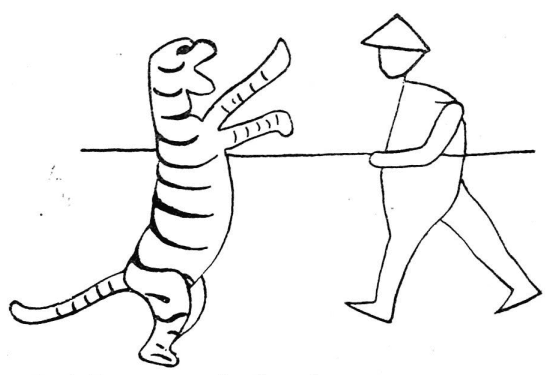
The method employed by this man was not the only way to combat a tiger. A mural inside a Kazakh mausoleum dating back to the first half of the 19th century and located in a tract along the lower reaches of the Syr Darya depicts a scene in which a heroic figure drives a pike into the belly of a large tiger that has reared up on its hind legs.
More systematic efforts to deal with the tiger population in the XIXth century emerged following the incorporation of Central Asia into the Russian Empire. As late as the 1860s-1880s, tigers in certain regions occasionally posed a significant threat to poorly armed local inhabitants.
For instance, in the Chirchik Valley during the harsh winter of 1882-1883, a pair of tigers took up residence along a path through the reed beds in the Sadyrkul tract. According to official statistics from the Russian administration, these animals killed twenty people from nearby villages as they traveled along this path toward neighboring settlements or local markets.
The attacks ceased only with the arrival of spring. To eliminate these predators as well as wild boars military units organized special hunting squads that tracked the beasts with dogs and shot them using Berdan rifles. Private initiative was also encouraged: anyone who killed a tiger regardless of who they were received a reward of 25 rubles, with the bounty increasing by five rubles for each subsequent animal killed.
Among the young Ural Cossacks who had resettled in Turkestan, some daring individuals, eager to prove their mettle, would even challenge a tiger to single combat, armed only with a long-handled axe and a knife. In the mid-XIXth century, along the so-called "Syr-Darya line" of military fortifications, a private in the Orenburg Cossack Host named Mantyk became exceptionally well-known as a tiger hunter.
Ultimately, in 1858, he was mauled to death near Fort Perovsky (formerly the Kokand fortress of Ak-Mechet, now Kyzylorda) while hunting what would have been his thirteenth tiger. In later times, there were individuals who, over the course of their lives, killed several tigers some even accounting for more than a dozen.
A man who gained particular renown in this regard in Tashkent during the late 19th century was a retired soldier named Gamov. Though short, lean, and modest in appearance, he managed to kill several dozen tigers; on one occasion, he even fell into the clutches of a wounded beast, which left him severely maimed in its terrifying embrace.
By the XXth century, the population of Central Asian tigers had plummeted. In the Syr Darya region, only eight tigers were killed over the six-year period from 1910 to 1915. Most of the areas they once inhabited were now entirely devoid of them.
They remained primarily in the upper reaches of the Amu Darya, along the Panj and Vakhsh rivers. Elsewhere for instance, in Khorezm only the occasional, solitary individual could be found, and even then, only sporadically. In the Akhangaran valley, the last tiger was killed in the early 1920s, following the revolution; its bullet-riddled hide was kept for many years as a rare trophy at the Pskent branch of the Hunters' Union.
In the Chirchik valley, a pair of tigers was sighted as late as the mid-1920s. It is also worth noting that, in the past, tigers played a somewhat positive role in the agricultural economy of Central Asia a fact linked, to a certain extent, to the shifting attitudes toward wild boar hunting that prevailed in the region during different eras.
In the countries of the Middle East, prior to the Arab conquest, the perilous pursuit of wild boars was considered a fitting activity even for royalty; indeed, artifacts of so-called "Sassanid art" preserve numerous depictions of high-stakes encounters between monarchs, princes, heroes, and wild boars.
In the XIth and XIIth centuries, Turkic rulers in Central Asia such as those of the Seljuk dynasty did not consider such hunts beneath their station, and the Karakhanids even permitted wild boars to roam within their royal hunting parks. However, the perspective that took root across the Islamic world viewing swine as "unclean" and strictly forbidden for consumption eventually altered this tradition and the gradual introduction of the principles of Sharia which regulated every aspect of a devout Muslim’s life among the population led, little by little, to a shift in the prevailing attitude toward this animal.
According to the *Hidaya*, a compendium compiled in the XIIth century by a theologian from Fergana, the first rule of Sharia regarding the hunting of wild boar imposes an absolute prohibition, classifying the animal as impermissible game for a Muslim due to its inherent "loathsomeness."
By the XVIIIth century, as conditions in Central Asia became increasingly favorable for the spread of bigotry and obscurantism fostered by a highly reactionary Muslim clergy local hunters (*mergens*) began to strictly avoid hunting these "unclean swine."
Meanwhile, the wild boar population proliferated, ravaging vegetable gardens and fields and becoming a genuine scourge to agriculture in many areas. At that time prior to the incorporation of Central Asia into Russia tigers served as the sole natural check on the unchecked reproduction of wild boars; without them, agriculture might have become entirely impossible in certain regions, much as was observed in parts of India.
In Khorezm, for instance, tigers once provided a distinct benefit in this regard. Under the hunting regulations of the Tsarist era, tigers were classified as "harmful animals" subject to extermination by any means and during any season including the breeding period, which spans from late winter through early spring.
Under Soviet nature conservation laws, the hunting of tigers is strictly prohibited to prevent their total extinction; anyone who kills such an animal unless in self-defense is treated as a malicious poacher and is subject to legal liability.
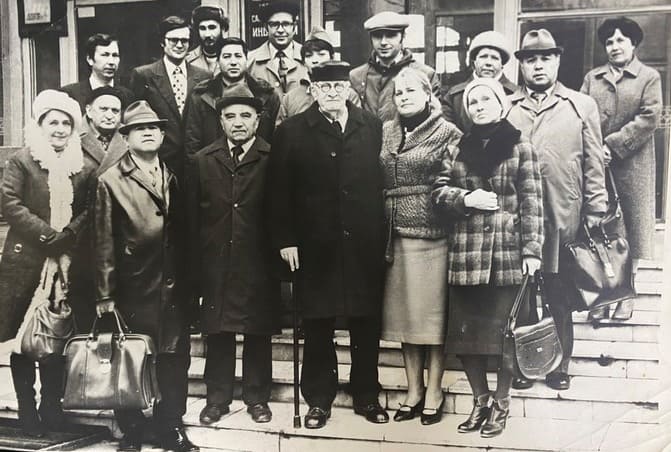
Authority:
M. E. Masson. "From Past of Tigers in Central Asia." Proceedings of the V. I. Lenin Tashkent State University, Issue 200, 1963.