




You are here
Origins of Samarkand.
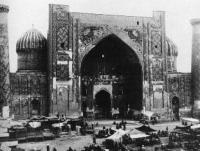
History of Samarkand.
"The (main) city is Samarkand, and the entire region is called Maverannahr. Since no enemy has captured Samarkand by force or victory, it is called, 'Protected (by Allah).'" Samarkand became Muslim during the time of the most worthy commander of the faithful, Osman. Among the Prophet's companions, Kusam ibn Abbas died there. His tomb is located outside the Akhani Gate, now known as Mazar Shah. Samarkand was built by Iskander; the Mughal and Turkic peoples call it Simizkend. Timur Beg made Samarkand the capital; before Timur Beg, no ruler as great as Timur Beg had declared Samarkand the capital. I ordered the inner wall of the fortress to be measured in steps from top to bottom—it came out to ten thousand six hundred steps. All the inhabitants of Samarkand are Sunnis, people of pure faith, observing the law and pious. Since the time of the Holy Messenger (Muhammad), no country has produced as many Imams of Islam as Transoxiana.”
Babur-Nameh. Events of the Year 903. Babur's Notes.
Tours of Samarkand's Unique Sights.
Samarkand (Marakanda) is one of the most ancient cities in the world, the center of the historical region and state of Sogdiana. The city's modern name, Samarkand, derives from Sm'rknδh. In ancient literature, the city is also known as Sogdiana (Sogdian) and Marakanda (Greek).
The Herat historian and geographer Hafizi Abru (XVth century) explained the city's name as Shamarkand, meaning "Shamar's village." Modern etymologists, recognizing the second part of the name as kand - "village, city," explain the first part from asmara - "stone."
It is believed that the word "Samarkand" derives from the Turkic "Semiz kent," meaning "rich settlement." This is supported by medieval Chinese sources (which refer to Samarkand as "Si-mi-se-kan" and also explain that this means "fat city"). This version was also supported by the scholar and encyclopedist Abu Rayhan al-Beruni.
The XIIIth-century Armenian chronicler Sumbat reported that "Samarkand" means "fat or fat city." The Spanish ambassador to the court of Timur, Ruy González de Clavijo, famous for his description of his travels, writes of Samarkand as "Samarkand," but stipulates that its real name is "Simeskint," which means "rich settlement."
Samarkand is one of the oldest surviving cities in the world, founded approximately in the VIIIth century BC. It is the same age as ancient Rome. In ancient history, Samarkand is known as the capital of the ancient state of Sogdiana, described as early as the VIth century BC in the sacred book of Zoroastrianism, the Avesta.
It was first mentioned under the name Marakanda in the works of Roman and Greek historians - biographers of Alexander the Great, who conquered Samarkand, by then a well-developed and fortified city, in 329 BC. In the 4th-5th centuries, Samarkand was under the rule of the Chionites and Kidarites.
At the beginning of the 6th century, it was captured by the Hephthalites. From 567-658, Samarkand, the center of the Sogdian domain, was dependent on the Turkic and Western Turkic Khaganates. Close Turkic-Sogdian ties facilitated borrowings from Turkic into Sogdian and vice versa.
In the early epigraphic inscriptions of the ancient Turkic khagans, Sogdian was the official language. Sogdian texts of Mugh documents contain borrowings from Turkic. For example, "yttuku" - "to send," "embassy," "bediz" - "carving, ornament," and others.
In 712, the city was captured by Arab conquerors led by Qutayba ibn Muslim. From 875 to 999, Samarkand was one of the largest political and cultural centers of the Samanid state. From 875 to 892, Samarkand was the capital of this state. Under the rule of the Turkic dynasty of Karakhanids, or Ilek Khans, the first madrassas were built in Samarkand.
The most famous was the Ibrahim Tamgach Khan Madrasah (1040-1068). During the reign of Ibrahim Hussein Karakhanid (1178-1200), a monumental palace decorated with paintings was built. In 1212, after the suppression of the rebellion of the Karakhanid Osman, Samarkand became part of the Khorezmshah state.
In 1220, it was plundered and almost completely destroyed by Genghis Khan. It was reborn on the territory of residential and rural areas - on the site of modern Samarkand. During the reign of Timur and the Timurids (1370-499), it was the capital of his empire.
The overwhelming majority of the city's architectural masterpieces were built during this era. This was the period of Samarkand's highest development in the post-Mongol period. Timur zealously cared for the prosperity of his capital, which he wanted to see as the capital of the world.
Crafts and trade developed largely due to the forcible importation of artisans from conquered countries. Majestic palaces, mosques, Muslim schools (madrasas), and tombs were erected in the city. Samarkand's buildings were constructed as monuments glorifying the state and its founder, hence their enormous scale and luxurious decoration.
To emphasize the capital's grandeur, Timur named the surrounding villages after the largest cities of the East - Baghdad, Shiraz. Samarkand is located and very deep moats. Outside the city, many houses were built, adjoining it on various sides like suburbs.
The entire city is surrounded by gardens and vineyards. These suburban gardens contain many large and famous buildings, and the lord himself (referring to Timur) has palaces and cellars there. The lord greatly desired to make this city great, and whenever he conquered lands, he brought people from everywhere to populate the city and the surrounding lands.
He especially gathered masters of various crafts. From Damascus, he sent as many craftsmen as he could find: weavers, bowsmiths, gunsmiths, glassmakers, and claysmiths, and these craftsmen are considered the best in the world. From Turkey, he brought crossbowmen and other skilled workers he could find: stonemasons, goldsmiths - as many as he could find, and he brought so many back that the city boasted all kinds of craftsmen and artisans.
During the reign of Mirzo Ulugh Beg, Samarkand became one of the centers of world science. New institutions of higher education - madrassas and observatories - were built here. The best scientific minds of the Muslim East worked in the city.
Samarkand remained the capital of the Shaybanid Empire under the reigns of Shaybani Khan and Kuchkuji Khan. During this period, architectural development continued in Samarkand. Madrassas for Shaybani Khan and his daughter-in-law, Mihr Sultan Khanum, were erected.
During the colonial period, they were all completely destroyed. The city lost its importance as a capital with the rise to power of the Shaybanid ruler Ubaydullah (1533-1540), who moved the capital to Bukhara. During the Bukhara Khanate, it was a princely center (bekstvo).
It experienced a new revival during the Bukhara Khanate from 1612 to 1656, when Yalangtush Bahadur was appointed ruler of Samarkand. In the 19th century, the Tatar educator Sharab ad-Din Marjani studied at the madrasahs of Samarkand.
In 1868, it was occupied by Russian troops and annexed to Russia, becoming the center of the Zeravshan District (since 1887, the Samarkand Region). That same year, the Samarkand garrison, under the command of Major Baron F.K. von Stempel (1829-1891), repelled an attempt by Samarkand residents to overthrow Russian rule.
In 1888, the Trans-Caspian Railway was built to the city. After the October Revolution, the city became part of the Turkestan ASSR. From 1925 to 1930, it was the capital of the Uzbek SSR, and since 1938, the center of the Samarkand region.
Authority:
Anatoly Perminov. "Pre-Islamic Development of Central Asia. Zoroastrianism."
https://ok.ru/dinibehi/topic/64359609259299