




You are here
Tulips in Kazakhstan.
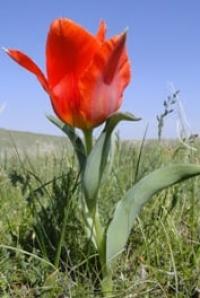
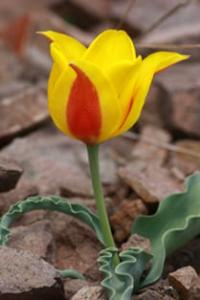
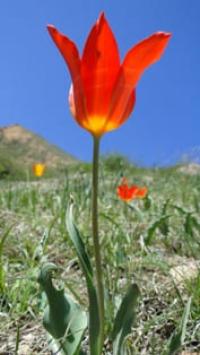
Group tours to see tulips of Kazakhstan.
"From the tulip, you took your crimson hue,
The lily gave you the essence of youth.
Once there was a rose, which resembled you
Having passed its life to you, it shyly slipped away."
Omar Khayyam. "Rubaiyat" ("Tarab-khaneh"), XVth century; "Bodleian Manuscript" (1460 AD), dating from 1070–1110 AD; Samarkand, Isfahan, Nishapur.
Exploratory routes to discover tulips of Southern Kazakhstan.
Tulips of Kazakhstan are a natural heritage and a treasure of Central Asian flora.
Kazakhstan holds a unique place in the natural world of Central Asia. Its territory encompasses a diverse landscape of high mountain ranges, intermontane valleys, vast steppes, semi-deserts, sandy tracts, and clay plains. This variety of natural conditions has fostered a rich and distinctive flora, a significant component of which consists of wild tulips members of the genus Tulipa within the lily family (Liliaceae).
The richness of Kazakhstan’s flora and botanical taxonomy in general is not a static list of names. As new field observations, herbarium specimens, and molecular-genetic research emerge, our understanding of plant species composition and distribution continues to evolve.
The spring blooming of tulips is one of the most striking natural phenomena in the steppes and mountain foothills of Kazakhstan. For a brief period, hillsides, rocky scree slopes, clay plains, and sandy expanses are blanketed in flowers of every imaginable shade from white and yellow to pink, red, and purple.
However, the significance of tulips extends far beyond their ornamental value. They are of great scientific interest as a component of the ancient flora of Central Asia, reflecting the complex history of the region’s vegetation cover, and serve as an important subject for both botanical research and conservation efforts.
Kazakhstan is considered one of the countries with the richest diversity of tulip species in the world. According to a modern taxonomic revision of the genus Tulipa -based on field observations, the study of herbarium collections, and an analysis of scientific literature 41 taxa, including one hybrid, have been identified within the country.
In the currently accepted classification, 13 species are recognized as endemic to Kazakhstan, meaning that in their natural state, they are found exclusively within its borders. Seven of these Kazakhstani species are classified as globally threatened according to the criteria established by the International Union for Conservation of Nature (IUCN).
Central Asia is one of primary centers of tulip diversity.
The genus *Tulipa* has an extensive range, spanning Eurasia and adjacent regions. The number of recognized species varies across different taxonomic studies; depending on the classification approach used, researchers identify approximately 90 to 120 taxa.
This discrepancy arises from the complexity of the genus, the significant variability of certain traits, the existence of closely related forms, and differing interpretations regarding the boundaries between species. Central Asia holds a unique position in the distribution and evolutionary history of tulips.
Many botanists consider this region to be one of the primary centers of origin and the development of the genus's modern-day diversity. Of particular importance are the areas between the Pamir-Alay and Tian Shan mountain systems, which feature a diverse array of altitudinal zones, climatic conditions, and soil types.
The understanding of Central Asia as one of the most important centers of tulip diversity was developed in the works of A. I. Vvedensky, Z. P. Bochantseva, V. I. Kovalevskaya, and other researchers. In subsequent decades, these concepts were further expanded through the study of plant morphology, geographical distribution, biology, cytology, and genetic characteristics.
The high level of tulip diversity is explained not only by the region’s natural history but also by the exceptional heterogeneity of its landscapes. Arid plains, foothill steppes, mountain gorges, and high-altitude areas are found in relatively close proximity to one another.
At different elevations, there are variations in temperature regimes, the length of the growing season, moisture levels, soil characteristics, and light conditions. As a result, numerous ecological niches are formed, to which various plant species have adapted.
The seasonality of the climate plays a crucial role. Many parts of Central Asia are characterized by cold or relatively cold winters, a rapid warming in the spring, and a long, dry period during the summer. Tulips are adapted to this rhythm: they survive the unfavorable season
They survive the year in the form of bulbs, while their above-ground shoots develop primarily in the spring, utilizing moisture accumulated in the soil from winter precipitation. Following flowering and seed maturation, the above-ground parts gradually die back, and the plant enters a dormant state once again.
This strategy allows tulips to thrive in environments where summer heat and a lack of moisture limit the growth of many other plants. However, this adaptation to an arid climate does not mean that individual species can easily withstand any environmental change.
Some have very limited geographic ranges and depend on the preservation of specific types of habitats.
Kazakhstan is one of the world’s richest countries in terms of tulip diversity.
In terms of the number of known taxa, Kazakhstan ranks among the leading nations where wild tulips grow. Contemporary research on the genus identifies 41 taxa, including the hybrid form (Tulipa tschimganica). For comparison, Uzbekistan is home to approximately 34 taxa, and Turkey to about 20 species - though these figures can vary depending on the taxonomic system used and when the research was conducted.
Kyrgyzstan is home to 33 species of wild tulips, representing about one-third of the entire global diversity of this genus. Regarding rare species, 10 types of wild tulips are listed in the Red Book of Kyrgyzstan due to the threat of extinction. As for endemics, approximately 8 species are strictly endemic to Kyrgyzstan; they grow in the wild exclusively within the Tian-Shan and Pamir-Alay mountain ranges specifically within the borders of Kyrgyzstan and are found nowhere else in the world. One such example is the Talas tulip (Tulipa talassica).
The richness of Kazakhstan’s flora is primarily due to the country’s diverse natural regions. The distribution areas for tulips encompass the mountainous regions of the south and southeast including the foothills of the Tien-Shan and the Dzungarskiy Alatau as well as the low mountain ranges of Central Kazakhstan, desert and semi-desert landscapes, and certain parts of Eastern Kazakhstan.
In the southern part of the country, the Western Tien-Shan and its adjacent mountainous territories are particularly significant. This area features a mosaic of foothill plains, rocky slopes, gorges, and patches of mountain steppe. Variations in altitude and slope exposure lead to differences in soil moisture and temperature, which in turn influence the composition of plant communities.
The Trans-Ili Alatau, Kungei Alatau, Dzungarian Alatau, and the Karatau Range also exhibit remarkable diversity. Within these mountain systems, tulips can be found on rocky and gravelly slopes, in the foothills, among sparse shrubbery, and in open mountain steppe areas.
Some species are confined to relatively low, dry slopes, while others thrive in cooler, high-altitude environments. The low mountain massifs and uplands of Central Kazakhstan hold a unique position. In regions such as the Betpak-Dala desert, the Chu-Ili Mountains, the Balkhash-Alakol Basin, and the Moyynkum sands, dry steppe and desert landscapes prevail.
Here, tulips have adapted to rocky, gravelly, and clay-rich substrates, as well as to sharp seasonal fluctuations in temperature and moisture. The eastern regions of the country - including the Altai, the Tarbagatai, and the Zaysan Basin - constitute yet another important area for the distribution of specific tulip species.
Variations in topography and climate create conditions here that support both mountainous and steppe-dwelling forms. Consequently, tulips in Kazakhstan do not constitute a single, unified natural community confined to one specific type of landscape.
Instead, they have adapted to a wide range of habitats from dry, rocky slopes and foothills to steppe plains and certain desert regions.
History of Study of Tulips in Kazakhstan.
The study of Kazakhstan’s wild flora spans more than two centuries, ranging from the initial academic expeditions of the Russian Empire to contemporary molecular-genetic analyses. The first accounts of these plants appeared in the works of XVIIIth-century travelers and naturalists who explored the natural wealth of the Russian Empire and the adjacent territories of Central Asia.
Pyotr Simon Pallas was among the first scientists to collect and describe plants within the territory of present-day Kazakhstan. In the late XVIIIth century, he conducted natural history research across Western Siberia, the Altai, and surrounding regions.
The herbarium specimens he collected became part of the early scientific documentation of the region’s flora. Notably, it was Pallas who first brought the Altai tulip later classified as (Tulipa altaica) - to the attention of the scientific community. A more systematic study of the plant world of Kazakhstan began in the XIXth century.
Significant contributions were made by Alexander Lehmann, Ivan Kirilov, Ivan Borshchov, Leopold Schrenk, Semyon Karelin, and other researchers. Their expeditions traversed steppes, deserts, foothills, and mountainous regions; the herbarium specimens they collected subsequently became essential material for identifying species and refining our understanding of their geographical distribution.
The work of these travelers was of great importance, and not only to the field of botany. It facilitated the creation of the first scientific descriptions of Kazakhstan’s natural regions, the accumulation of data on its vegetation, and the development of herbarium collections that are still used today in the study of the flora of Central Asia.
Many plant species tulips among them were named in honor of the researchers who collected or described them. Specifically, the names (Tulipa schrenkii) and (Tulipa borszczowii) have become established in scientific nomenclature. Such names preserve the memory of the early stages of botanical exploration in the region.
Era of discoverers of tulips in Kazakhstan.
Late XVIIIth century: Peter Simon Pallas conducted the first botanical surveys of the steppe and semi-desert zones, collecting the earliest herbarium specimens of Kazakhstani tulips.Initial herbarium collections in Western Siberia and Kazakhstan.
XVIIIth–XIXth centuries.
The first wave of researchers A. Lehmann, I. Kirilov, I. Borshchov, L. Schrenk, and G. S. Karelin laid a foundational herbarium base. Iconic species such as (Tulipa schrenkii Regel) and (Tulipa borszczowii) Regel are named in their honor.
XXth century. Fundamental Systematics:
A. I. Vvedensky and Z. P. Botschantzeva: Systematization of the flora of the USSR, cytology, and karyology.
XXth-XXIst centuries: A. A. Ivashchenko and O. V. Belyalov international botanical research, discovery of new species, and phylogeny.
Alexei Ivanovich Vvedensky described 17 new species from Central Asia (6 of which are found within the territory of Kazakhstan). He conducted monographic studies of the genus Tulipa for “Flora of the USSR” (1935), “Flora of Uzbekistan” (1941), “Flora of Tajikistan” (1963), and “Conspectus Florae Asiae Mediae” (1971), in the process establishing the monotypic sections “Spiranthera” Vved. and “Lophophylon” Vved.
Zinaida Petrovna Botschantzeva dedicated her life to comprehensive research on the genus, publishing the major monograph “Tulips: Morphology, Cytology, and Biology” (1962), in which she provided detailed descriptions of 61 Central Asian tulip species. Her name is commemorated in the species names (Tulipa zenaidae) Vved. and (T. botschantzevae) S. N. Abramova & Zakal.
The Contemporary Stage and the Contribution of A. A. Ivashchenko
Anna Andreyevna Ivashchenko has been researching the bulbous plants of Kazakhstan since 1963. Her works, including the monographs “Tulips and Other Bulbous Plants of Kazakhstan” (2005) and “Kazakhstan The Homeland of Tulips” (co-authored with O. V. Belyalov, 2019), summarized years of observation, systematizing data on the ecology, distribution, and conservation of 42 species.
Eduard Regel and Development of Taxonomy of Kazakhstani Tulips.
Eduard Ludwigovich Regel:
The German botanist Eduard Ludwigovich Regel holds a special place in the history of the study of the genus Tulipa. In the second half of the XIXth century, he conducted extensive work on the systematization of plants from Central Asia including tulips utilizing materials from expeditions and herbarium collections.
Regel described a significant number of tulip species associated with the flora of Kazakhstan and neighboring regions. One of the most notable representatives of the genus is (Tulipa regelii) Krasn., named in his honor. This species is distinguished by the unusual shape of its leaves and occupies a unique position among the wild tulips of Central Asia.
An eminent botanist, he described 17 species of tulips. Regel was the first to propose using the pubescence (hairiness) of the inner perianth segments and the bases of the stamen filaments as diagnostic characteristics. One of the most morphologically distinctive tulips (Tulipa regelii) Krasn., which features corrugated leaves is named after him.
Second half of the XIXth century: E. L. Regel described 17 new species and introduced key morphological diagnostic traits. The use of more detailed morphological characteristics marked an important stage in the development of taxonomy. Regel focused on the structural features of the perianth, the presence or absence of pubescence on the inner tepals, and characteristics related to the base of the stamens.
Such traits made it possible to compare superficially similar plants and clarify their taxonomic position.
Alexey Vvedensky and study of flora of Central Asia.
In the XXth century, the study of tulips was further advanced by the work of Alexey Ivanovich Vvedensky, one of the most prominent botanists specializing in the flora of Central Asia. Vvedensky described 17 new species of tulips, six of which are native to the territory of Kazakhstan.
He contributed to the systematic treatment of the genus for major botanical publications, including “Flora of the USSR” (1935), “Flora of Uzbekistan” (1941), “Flora of Tajikistan” (1963), and the comprehensive work “Conspectus Florae Asiae Mediae” (1971, co-authored with V. I. Kovalevskaya).
His research was instrumental in shaping the understanding of the taxonomy and geographical distribution of tulips. Vvedensky proposed revisions to the classification of the genus including the establishment of distinct sections and sought to account not only for the external morphological traits of the plants but also for their origins, evolutionary relationships, and distribution.
Zinaida Bochantseva: A Researcher of Tulip Biology and Morphology.
The research of Zinaida Petrovna Bochantseva was of particular significance to the study of the genus Tulipa. She dedicated a substantial portion of her scientific career to the tulips of Central Asia, publishing the seminal monograph “Tulips: Morphology, Cytology, and Biology” (1962).
This monograph provides a detailed examination of 61 species of wild-growing tulips from Central Asia. The author investigated their geographical distribution, morphological characteristics, developmental biology, cytological features, and cariosystematics.
This comprehensive approach significantly broadened the understanding of the genus's diversity and the specific traits of its individual species. Bochantseva described five new species and made a substantial contribution to the development of tulip taxonomy.
Her name has been immortalized in the names of the plants (Tulipa zenaidae) and (Tulipa botschantzevae). Botschantzeva’s monograph remains a significant scientific work, frequently consulted in the study of wild tulips native to Central Asia.
Contemporary research on Kazakhstani tulips.
Since the 1960s, botanist Anna Alexandrovna Ivashchenko has made a substantial contribution to the study of bulbous plants in Kazakhstan. Her research encompasses the country’s floristic diversity, the distribution patterns of wild bulbous plants, their ecology, and conservation issues.
In 2005, she published the book “Tulips and Other Bulbous Plants of Kazakhstan”, which examines the morphological and ecological characteristics, geographical distribution, practical significance, and conservation measures for 50 species of bulbous plants, including 34 species of tulips.
In 2019, she co-authored the book “Kazakhstan - The Homeland of Tulips” with Oleg Belyalov. This work provides information on 42 species, accompanied by illustrations and distribution maps, serving as an important synthesis of accumulated data on Kazakhstani tulips.
In recent decades, research into the genus Tulipa has become increasingly comprehensive. In addition to traditional field observations and the study of herbarium specimens, researchers now employ molecular-genetic methods, analyze morphological traits, map known locations, and model potential ranges.
These approaches help refine species boundaries, identify new populations, and assess the vulnerability of specific plant groups.
Species diversity and endemics of Kazakhstan.
In scientific literature, the number of tulip species in Kazakhstan has ranged from 32 to 42. These discrepancies are due to revisions in taxonomy, the inclusion of newly described species, refined data on geographical distribution, and differing interpretations of specific taxa.
The “Flora of Kazakhstan” recognized 32 species. Subsequent accounts increased this figure: a checklist of the flora of Kazakhstan compiled by R. V. Abdulina listed 34 species, while an overview of the genera within Kazakhstan’s flora by M. S. Baitenov cited 33. A 2019 book by Ivashchenko and Belyalov presented 42 species.
A contemporary study on tulips, published in 2024, confirmed the presence of 41 taxa in Kazakhstan, including one hybrid (Tulipa tschimganica). Consequently, when comparing various publications, it is essential to consider not only the date of the work’s release but also the taxonomic framework adopted by the authors.
In recent decades, the list of tulips found in Kazakhstan has expanded to include several species new to science.
These include:
(Tulipa kolbintsevii) - described in 2012;
(Tulipa lemmersii) - published in 2012;
(Tulipa ivasczenkoae) - described in 2013;
(Tulipa auliekolica) and (Tulipa turgaica) - published in 2013;
(Tulipa annae) and (Tulipa dianaeverettiae) - described in 2020;
(Tulipa Salsola) - published in 2022;
(Tulipa jansii) and (Tulipa kujukense) - described in 2024.
The emergence of new names does not necessarily mean that these plants have only recently come into existence or appeared in nature for the first time. More often, it indicates that previously known populations have been studied in greater detail, and their distinct characteristics have allowed researchers to justify classifying them as separate species.
The issue of endemism is of particular importance. Endemic species are those whose natural distribution is restricted to a specific geographic area. This is especially significant for Kazakhstan: the limited range of certain tulips makes them vulnerable, even to relatively minor changes in their habitat conditions.
A 2024 study identified 13 species as endemics of Kazakhstan. However, subsequent research on tulips has refined this list. Specifically, (Tulipa annae) was removed from the list of endemics, as it has also been found to occur in China. (Tulipa berkariensis) was reclassified as a synonym for (Tulipa kaufmanniana).
At the same time, (Tulipa jansii) and (Tulipa kujukense) were added to the updated list. These changes underscore the importance of ongoing, systematic research. The geographical range of a plant may prove to be broader than previously assumed, and two distinct names once their characteristics are compared may be found to refer to the same species.
New discoveries and refinement of geographical distribution of tulips in Kazakhstan.
Field research continues to yield new information regarding the distribution of tulips in Kazakhstan. Even well-known species are occasionally discovered in areas where their presence had not been previously recorded. Recent research has identified a new location for the Altai tulip (Tulipa altaica) in the Western Highlands and the Betpak-Dala desert.
This discovery has significantly expanded our understanding of the species' distribution within Kazakhstan. New locations for the Auliekol tulip (Tulipa auliekolica) have also been identified in Northern Kazakhstan. Previously, this species was known from only two sites, including its type locality approximately 15 km from Karamendy.
Also of interest is a report of (Tulipa annae) in the Taskora Gorge, located in the Dzungarskiy Alatau. This observation was based on photographic evidence published by V. Kolbintsev in 2016. Such data are valuable for further study of a species' range, although it should be noted that photographic records and herbarium specimens carry different levels of scientific evidentiary weight.
A recent taxonomic revision of the genus incorporates 1,942 occurrence records for 41 taxa. Spatial analysis of these data has identified 22 areas with high tulip diversity, predominantly in the southern part of Kazakhstan. The floristic regions of the Western Tien-Shan and the Zailiskiy and Kungei Alatau ranges are of particular significance.
Such research helps identify areas with a high concentration of species, as well as regions that require priority study and conservation measures.
Conservation of wild tulips in Kazakhstan.
The beauty of tulips is often the very reason for their vulnerability. During their peak flowering period, these plants attract the attention of both travelers and local residents. However, picking the flowers, digging up the bulbs, and disturbing the soil can cause significant harm to natural populations.
Many species are also threatened by land cultivation, the construction of roads and infrastructure, overgrazing by livestock, alterations to hydrological regimes, and the degradation of natural habitats. Species with limited geographic ranges those that grow only in specific foothill areas or on particular mountain slopes are especially sensitive to such pressures.
According to the data provided in the 2024 study, 18 species of tulips in Kazakhstan are included in the country's Red Book. In the publication they are divided into three categories of protection status. At the same time, the authors believe that some species require additional assessment: some may not require such strict protection measures, while others, not previously included in the Red Book, deserve special attention.
The species that are proposed to be considered for inclusion in subsequent editions of the Red Book of Kazakhstan are Tulipa dubia, Tulipa iliensis, Tulipa ivasczenkoae, Tulipa lemmersii and Tulipa orthopoda. In addition, the authors indicate the need to reassess the conservation status of nine additional taxa.
At the global level, a 2024 study assessed the status of 27 species of Kazakhstan tulips. Seven of them are classified as endangered species:
Critically Endangered (CR): Tulipa dianaeverettiae and Tulipa ivasczenkoae.
Endangered (EN): Tulipa regelii and Tulipa kolbintsevii.
Vulnerable species (VU): Tulipa lemmersii, Tulipa orthopoda and Tulipa zenaidae.
The remaining 20 species assessed are classified as Near Threatened (NT) and Least Concern (LC). This does not mean that they do not require monitoring: conservation status reflects an assessment of extinction risk on a global scale and
oes not replace the need to conserve specific local populations.
It is important to consider that global assessment and inclusion in the national Red Book are different procedures. A species may have a relatively favorable status at the global level, but need protection within a particular country or region. Conversely, an endemic species of Kazakhstan may be especially vulnerable precisely because there are no natural populations of it outside the country.
Tulips as part of natural heritage of Kazakhstan.
Wild tulips are an integral part of the natural appearance of Kazakhstan. They are connected with the history of the formation of the plant world of Central Asia, reflect the diversity of the natural conditions of the country and preserve evidence of the long evolution of plants in conditions of a sharply continental climate.
The scientific study of tulips has been going on for more than two centuries. From the first herbarium collections of Pallas and the expeditions of XIXth-century researchers, botany has progressed to fundamental systematic monographs, molecular genetic studies and modern mapping of habitats. At the same time, many questions remain open: the boundaries of individual species are being clarified, new locations are being discovered, and assessments of conservation status are being revised.
Of particular value is the fact that Kazakhstan preserves a significant diversity of wild tulips, from widespread steppe species to rare endemics with limited habitats. Their conservation requires not only legislative protection, but also continued scientific research, monitoring the state of populations and careful treatment of natural habitats.
Spring flowering of tulips is a short but expressive period in the life of Kazakhstan’s nature. It serves as a reminder of how closely linked the beauty of the landscape, biodiversity and scientific heritage of a country are. Preserving these plants means preserving part of the natural history of Kazakhstan, which has been formed over thousands of years.
The most important modern work on tulips of Kazakhstan and Central Asia:
Revisiting the genus Tulipa (Liliaceae) in Kazakhstan, the country with the richest tulip diversity worldwide. Journal of PhytoKeys, volume 250, 2024, pages 95–163. DOI: 10.3897/phytokeys.250.136736.
Authority and photos by:
Alexander Petrov.