



You are here
Cistanches flava, salsa, fissa in Kazakhstan.
Botanical tour to Altyn-Emel national park.
"Happy is he who has passed through torments,
Through the anxieties and passions of a clamorous life,
Like a rose that blooms without a care,
Lighter even than a shadow skimming across the water."
Russian Symbolist poet Innokenty Annensky, "Old Barrel Organ" (1906). Later included in his renowned collection, “The Cypress Chest”.
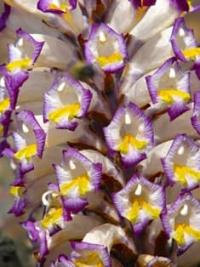
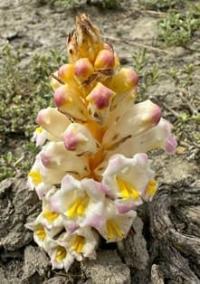
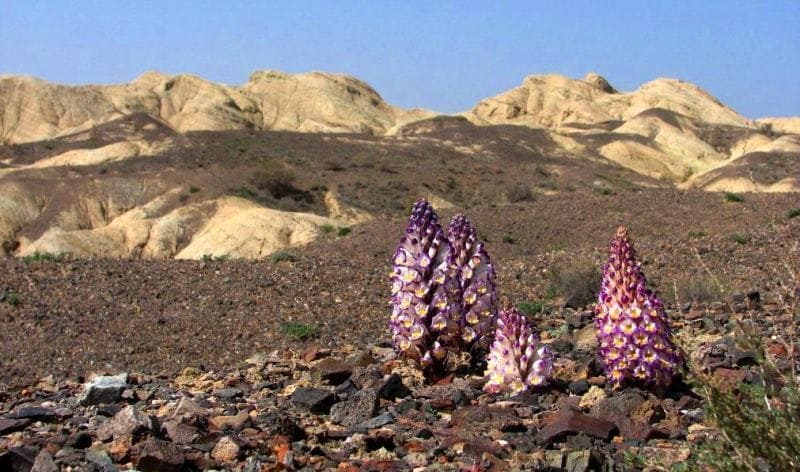
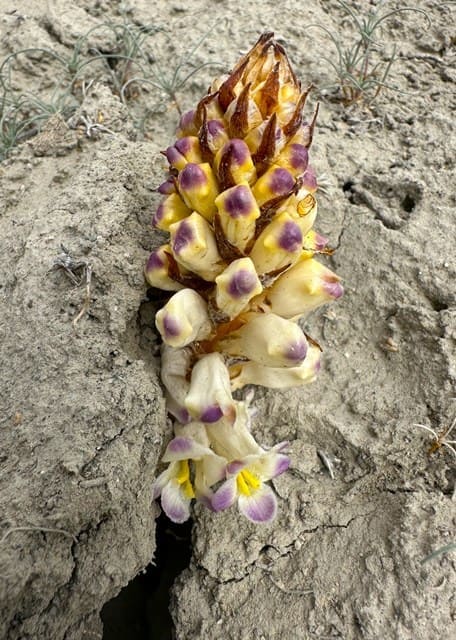
Cistanche salsa in Altyn-Emel national park.
Cistanche are remarkable plants they deserve far more attention than they typically receive in descriptions of the desert flora of Kazakhstan. Most intriguing is that these species employ a unique life strategy: they have almost entirely abandoned independent nourishment via photosynthesis, subsisting instead on other plants.
Yet, their vibrant inflorescences emerge from the desert soil like unexpected spring candles. Cistanche: extraordinary plants of the Kazakh deserts. Cistanche flava, Cistanche salsa, and Cistanche fissa. In the spring desert, some plants remain hidden until they bloom.
They do not form the familiar green clumps, nor do they spread leaves across the sands; they simply do not stand out from the surrounding vegetation. But then, suddenly, robust, fleshy stalks rise from the earth, crowned with dense clusters of yellow, golden, cream, or yellowish-violet flowers.
It is as if the desert has unexpectedly sent forth a collection of peculiar, living candles. Cistanche plants - members of the Orobanchaceae (broomrape) family - are remarkable perennials that have adapted to survive by drawing sustenance from other plants.
Several species of this genus are found in Kazakhstan, with Cistanche flava and Cistanche salsa being of particular interest. Both species are known to occur in the country’s desert and semi-desert regions, including within the Altyn-Emel National Park.
However, despite belonging to the same genus, they differ significantly in their ecological preferences and physical appearance. In Kazakhstan, Cistanche plants have abandoned the green coloration typical of most vegetation. Cistanche species are highly specialized parasitic plants.
Unlike most flowering plants, they are almost entirely devoid of chlorophyll and are incapable of producing their own organic compounds through photosynthesis. Their existence is inextricably linked to the roots of other plants, known as hosts. Underground, Cistanche develops specialized attachment organs that connect to the host plant’s root system, allowing it to extract water and essential nutrients.
This mode of existence is called holoparasitism one of the most specialized nutritional strategies found among flowering plants. Most of a Cistanche plant’s life is spent underground, where its fleshy, subterranean structures remain connected to the host’s roots.
The plant’s aerial shoot emerges only briefly during the flowering and subsequent fruiting stages. Once the seeds have matured, the shoot dries up, and the plant once again becomes nearly invisible. The tiny seeds are dispersed into the environment, but for further development, they must land in a suitable habitat and establish a connection with the roots of a host plant.
Consequently, the presence of Cistanche in any given area depends not only on soil and climate conditions but also on the composition of the surrounding vegetation. It is precisely this dependency that makes Cistanche particularly interesting for the study of desert ecosystems: their distribution is closely linked to the condition of the plant communities in which they reside.
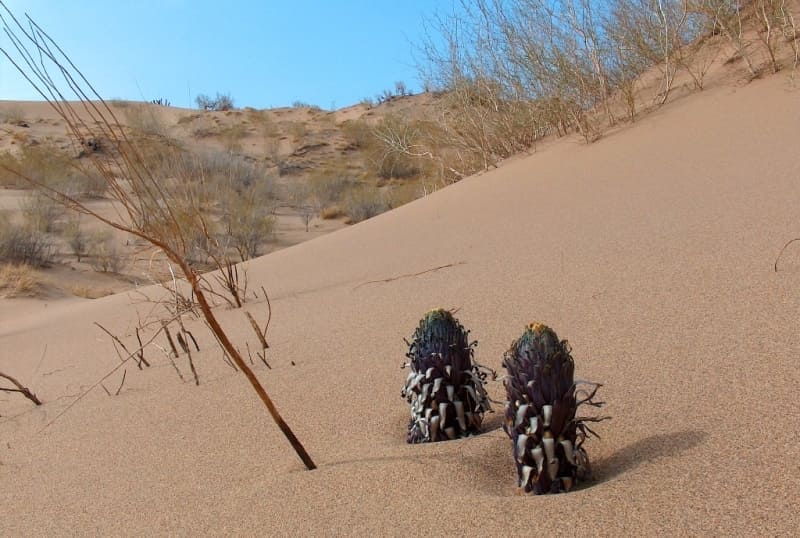
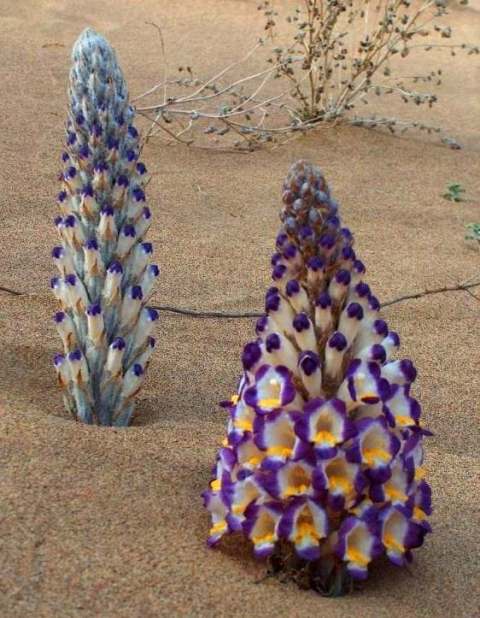
Cistanche flava in Kazakhstan is a golden-hued plant of the sandy deserts.
Cistanche flava (C.A.Mey.) Korsh.
Cistanche flava is one of the most notable representatives of the genus. Its natural range encompasses Central Asia including Kazakhstan, Uzbekistan, Turkmenistan, and Tajikistan and extends into Iran. In Kazakhstan, Cistanche flava is primarily found in the desert regions of the southern Balkhash area and the Kyzylkum Desert.
Botanical literature records its presence in the Almaty and Zhetysu regions, as well as in the southern parts of the country. Unlike Cistanche salsa, which favors saline soils, Cistanche flava is typically associated with sandy habitats, such as dune fields and shifting sand dunes.
It has a particularly close association with shrubs of the genus Calligonum as zhuzgun or kandym. Botanical literature also notes that it can parasitize the roots of saxaul trees. Cistanche flava is a relatively large plant; descriptions indicate that its above-ground shoots can reach heights of 60-100 cm, with some botanical sources citing even greater heights of 100-150 cm.
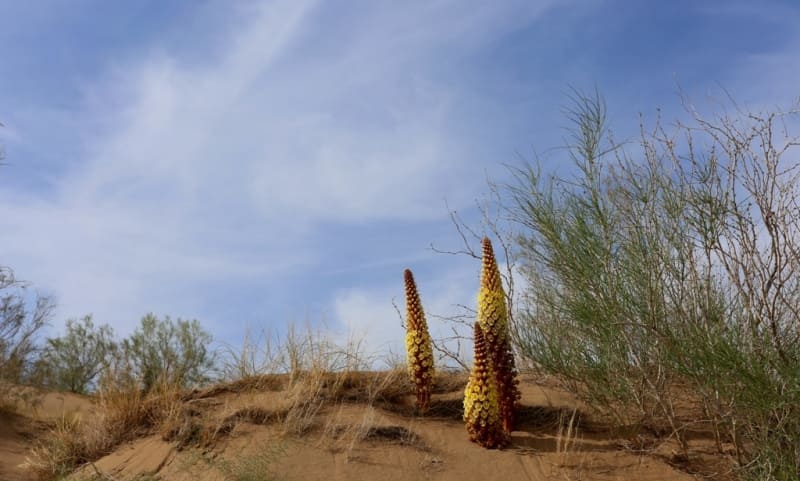
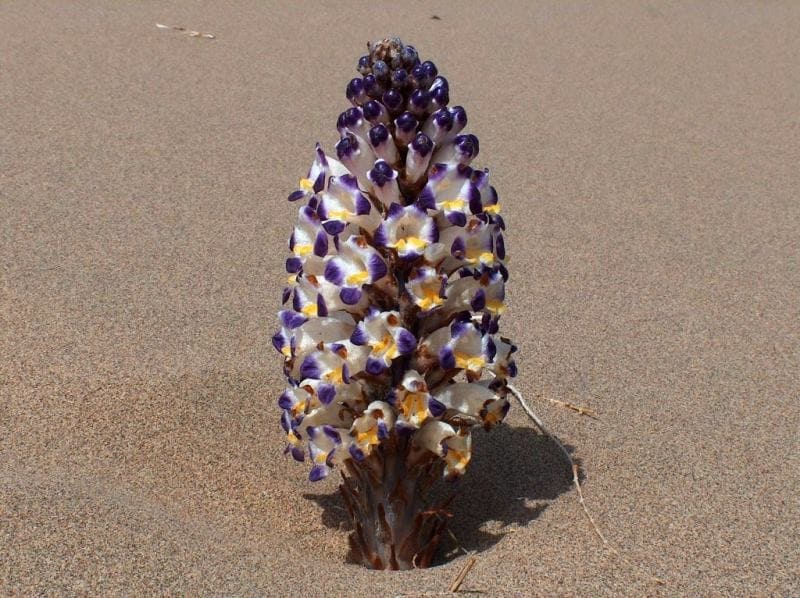
The stem is robust, fleshy, and generally unbranched, covered in numerous scale-like leaves. These leaves lack the typical green coloration and lie pressed tightly against the stem. The flowers are arranged in an elongated, spike-like inflorescence. The corolla is predominantly yellow, sometimes featuring darker or bluish-tinged areas.
As the dense inflorescence emerges above the sandy surface, the plant becomes clearly visible amidst the low-growing desert vegetation. Flowering across its range typically occurs in the spring, though the timing may shift depending on weather conditions, whether spring arrives early or late, and specific local environmental factors.
Cistanche flava in Altyn-Emel National Park.
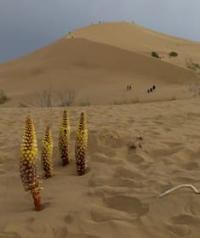
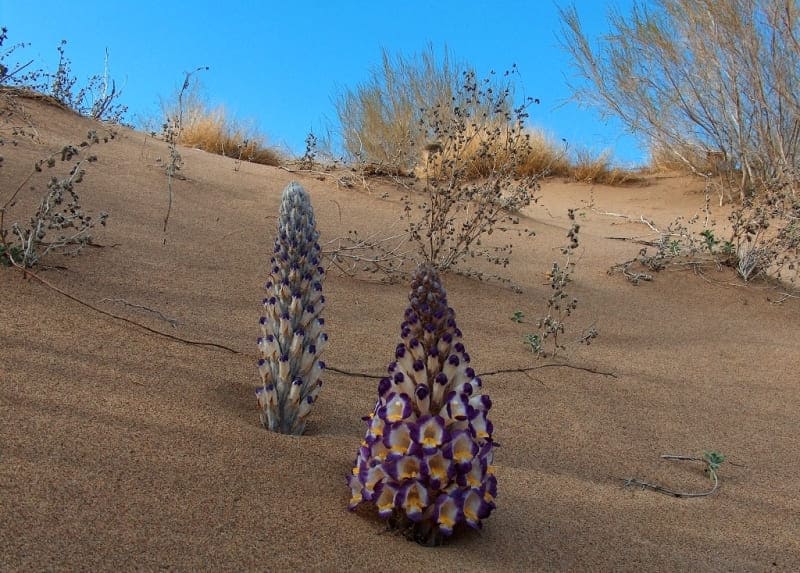
Discoveries of this plant in Altyn-Emel National Park are particularly noteworthy. Photographic and botanical records confirm the presence of Cistanche flava in the vicinity of the "Singing Dune" (Aygaykum). Plants with flower buds were photographed there on April 23, 2016, and a specimen in bloom was documented on May 4, 2024.
These observations allow us to confidently include the Singing Dune among the documented locations for Cistanche flava in Kazakhstan. The sandy terrain surrounding Aygaykum provides a suitable habitat for the plant. Desert shrubs, including Calligonum species (known locally as zhuzgun, are common here; the Cistanche relies on the roots of these shrubs to survive.
In the spring when the sands still retain moisture from the cold season and desert vegetation begins to stir the plant’s robust inflorescences emerge above the surface. At this time, the plant stands out quite clearly against the backdrop of the sandy slopes.
Cistanche salsa is found in Kazakhstan, where it inhabits saline deserts.
Cistanche salsa (C.A. Mey.) Beck.
This second species, Cistanche salsa, has somewhat different ecological preferences. Its range is significantly broader, extending from southeastern European Russia and the Caucasus, through Central Asia, all the way to Mongolia and northern China.
In Kazakhstan, this species is found in desert and semi-desert regions, including the Lake Balkhash area (Pribalkhashye), Moyynkum, Betpak-Dala, Kyzylkum, and other territories. Within the country, its distribution is associated with saline clay, sandy-loam, and sandy soils.
As the name suggests, Cistanche salsa is particularly characteristic of salt marshes and saline soils, though it also occurs on saline sands, clayey areas, and, in some places, on chalk or limestone substrates. The plant is a parasite that grows on the roots of various desert shrubs and subshrubs.
Botanical descriptions identify members of the genera Anabasis, Atriplex, and Kalidium as its host plants. More recent studies also link Cistanche salsa Haloxylon), Tamarix, and Calligonum (zhuzgun). The above-ground portion of this species is generally much shorter than that of Cistanche flava; according to botanical descriptions, the plant reaches a height of approximately 10-40 cm.
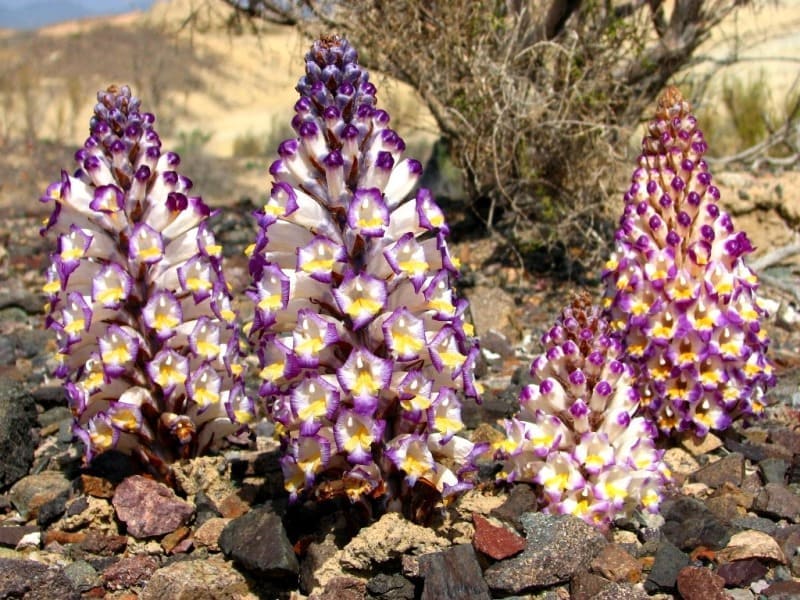
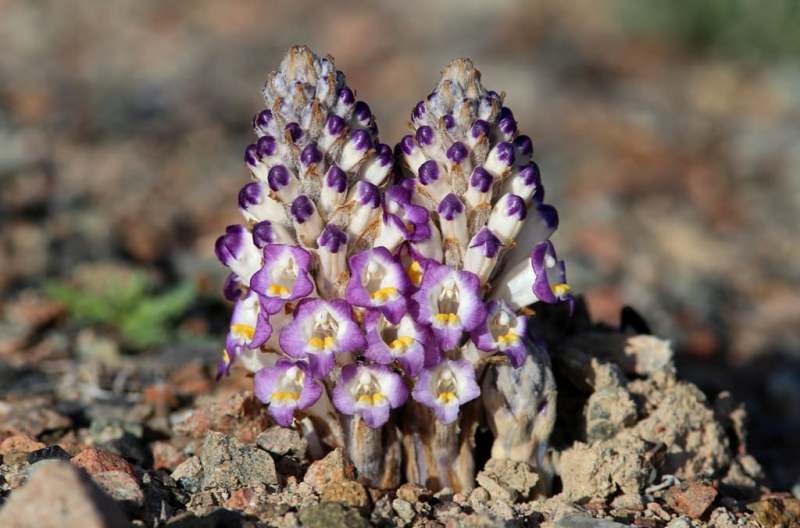
The stem is thick and fleshy noticeably enlarged at the base and covered with alternate, oblong scales. The inflorescence is dense and cylindrical or short-cylindrical, sometimes appearing significantly shortened. The flowers are sessile (stalkless) or nearly sessile and are packed very closely together.
The coloration of the corolla is particularly interesting. In typical specimens, the corolla tube is light yellow, while the limb (the expanded part of the corolla) may have a violet hue. Other specimens exist in which the entire corolla is light yellow. Therefore, the epithet salsa should not be interpreted as an indication that a uniform, solid color of the flowers.
Cistanche salsa blooms primarily in April and May. The above-ground portion is short-lived: within a relatively brief period, the plant manages to flower and produce fruit, after which the shoot withers.
The history of the scientific discovery and naming of Cistanche.
The study of Cistanche is linked to botanical research conducted in Central Asia and the Caspian region during the first half of the XIXth century. It is particularly noteworthy that both species in question were introduced to botanical science under the genus name Phelypaea before receiving their current, accepted genus name Cistanche.
Cistanche salsa was described by Carl Anton von Meyer in 1830 as Phelypaea salsa. This description was published in Carl Friedrich Ledebour’s “Flora Altaica”. In the original account, the plant’s habitat was identified as the clayey, saline soils of the Dzungarian-Kyrgyz desert, east of the Kurchum River.
This area corresponds to present-day Eastern Kazakhstan, in the vicinity of the Irtysh River and the Zaysan Basin. Thus, the historical geography of the original description of Cistanche salsa is directly connected to Kazakhstan a highly significant detail in the botanical history of our country.
Subsequently, the species was assigned its current name, Cistanche salsa. This combination is credited to the German botanist Günther Beck von Mannagetta und Lerchen, who transferred the plant into the genus Cistanche. The history of Cistanche flava also begins with Carl Anton von Meyer.
In 1831, he published the name Phelypaea flava in his work “Verzeichniss der Pflanzen des Caspischen Meeres”. The current name, Cistanche flava (C.A.Mey.) Korsh., was published by Sergei Ivanovich Korzhinsky in 1896. Thus, in terms of the earliest researchers, Karl Antonovich Meyer is the figure associated with both species.
However, a distinction should be made between the initial description of a plant and the subsequent formalization of its modern botanical name. The term discoverer is not entirely accurate here; the plants were, of course, known to the local population long before any scientific descriptions appeared.
The discussion concerns the introduction of these species into European botanical taxonomy.
Two species of Cistanche - two distinct desert habitats.
A comparison between Cistanche flava and Cistanche salsa clearly illustrates the ecological diversity found within the deserts of Kazakhstan. Cistanche flava favors sandy areas, including hummocky sands and dunes. Calligonum shrubs play a crucial role in its survival, as their root systems serve as hosts for the plant.
Cistanche salsa is more commonly associated with saline clay or sandy-loam soils. Its ecological associations are more varied, with various types of desert vegetation serving as hosts. In Altyn-Emel National Park, these two species are particularly noteworthy: while they both occur within the same national park, they are confined to different types of habitats.
Cistanche flava has been documented near the Singing Dune, a landscape dominated by sand. Cistanche salsa has also been recorded in the vicinity of Aigaikum at the base of a dune on shifting sands as well as in the Aktau Mountains. This last point is particularly interesting: the name of the species does not imply that it can exist exclusively in true salt marshes (solonchaks).
Its ecological range is somewhat broader than what its Russian name alone might suggest.
The brief above-ground life of Cistanche.
One of the most remarkable features of Cistanche is the short-lived nature of its above-ground portion. The plant spends the greater part of its life cycle underground, remaining connected to the root system of its host plant. A flowering shoot emerges only during a specific season.
In a desert environment, this strategy is highly effective. The plant does not need to develop a large leaf surface area, nor does it expend its own resources on creating an elaborate system of green shoots. Its above-ground part serves primarily the function of reproduction.
After flowering, a capsule-like fruit forms, containing numerous tiny seeds. As these seeds mature, the above-ground shoot gradually dries out. Consequently, spotting Cistanche outside of its flowering period flowering is not easy to spot. Even in areas where it occurs regularly, the plant may remain virtually undetectable during other times of the year.
In Altyn-Emel National Park, the spring season offers the best opportunity for observation. Cistanche salsa typically blooms in April and May, while Cistanche flava has been documented in the vicinity of the "Singing Dune" in late April and early May.
However, the exact timing depends on the weather conditions of a given year.
Cistanche and humans: botanical significance and need for conservation.
Certain species of the genus Cistanche have long been known in the traditional medicine of East and Central Asian countries, receiving particular attention within the Chinese herbal medicine tradition. It is precisely this interest in the subterranean parts of these plants that has led to their commercial exploitation and harvesting in various regions of Asia.
In Kazakhstan, Cistanche salsa has been studied by specialists from the Institute of Botany and Phytointroduction. Research conducted by Nadezhda Gennadyevna Gemedzhiyeva and Zhanna Zhumabekovna Karzhaubekova focused on the plant’s biology, distribution, and resource potential in the southern Balkhash region.
Specifically, their publications examined populations of the plant within the saxaul forests of the Balkhash area, as well as in the Panfilov District of the Zhetysu Region and the Moyynkum sands. The chemical composition of the subterranean parts was analyzed, including the presence of various groups of biologically active compounds, amino acids, and fatty acids.
These studies are significant primarily as an example of a comprehensive investigation into a little-known component of the desert flora of Kazakhstan. However, the presence of biologically active substances does not, in itself, constitute proof of a specific plant's therapeutic efficacy.
Furthermore, one should not extrapolate research findings from one Cistanche species to another; the chemical composition and biological properties can vary significantly between different members of the genus. From a nature conservation perspective, it is particularly significant that Cistanche depends on the health of its host plant populations.
The destruction of shrubs, excessive disturbance of the soil cover, and alterations to the hydrological regime can affect not only individual specimens of this parasite but also the conditions necessary for the survival of its entire populations. In Altyn-Emel National Park, the preservation of such plants is part of the broader objective of protecting desert ecosystems.
Cistanche in Altyn-Emel National Park.
Altyn-Emel National Park is primarily known for its prominent natural landmarks the Singing Dune, the Aktau and Katu-Tau mountains, the Ili River valley, saxaul forests, and diverse desert landscapes. However, the park’s botanical richness is just as compelling as its famous geological features.
The area encompasses a mosaic of sandy deserts, clay plains, saline patches, rocky slopes, and foothills. Each of these landscapes supports a unique assemblage of plants, adapted to specific conditions of moisture, soil salinity, and soil texture.
Cistanche flava and Cistanche salsa serve as excellent examples of this ecological diversity. The official flora inventory for the national park lists Cistanche salsa as a characteristic species of clay-based saline deserts and salt-affected sandy areas.
The Singing Dune and the Aktau mountains are identified as habitats for this species. As for Cistanche flava, there are documented photographic records of its presence near the Singing Dune. Thus, both species are represented within the park, although the level of detail regarding their specific locations and the extent to which their populations have been studied varies.
Perhaps it is precisely these small, seemingly inconspicuous plants that best reveal the true richness of Altyn-Emel. Beyond the well-known landscapes lies a complex world of ecological interconnections, in which even a plant devoid of green leaves occupies its own distinct place within the natural community.
Cistanche plants with an extraordinary destiny seem to defy conventional notions of what a flowering plant should be: they lack typical green foliage, are incapable of producing organic matter on their own, and spend a significant portion of their lives hidden underground.
Yet, it is this very, unconventional strategy that has enabled them to occupy a unique ecological niche within the arid landscapes of Central Asia. The Cistanche flava has linked its existence to sandy deserts and Calligonum shrublands. Cistanche salsa has adapted to saline soils and desert plant communities dominated by saltworts.
Both plants emerge above ground only briefly just long enough to bloom and produce seeds. When their dense, golden inflorescences rise from the sands of Altyn-Emel in the spring, it feels as though the desert itself is briefly revealing one of its best-kept secrets.
These plants remind us that even in the harshest natural environments, life finds extraordinary ways to persist, and that the biological diversity of the desert is far richer and more complex than it might appear at first glance.
Who discovered Cistanche?
A rather interesting historical sequence has been established:
Species | Original Scientific Name | Author and Year | Current Accepted Name
Cistanche salsa |Phelypaea salsa | C. A. Meyer, 1830 |Cistanche salsa (C.A.Mey.) Beck
Cistanche flava |Phelypaea flava. | C. A. Meyer, 1831 | Cistanche flava (C.A.Mey.) Korsh.
Carl Anton von Meyer was a German botanist who worked in Russia. It is particularly noteworthy that the original description of Cistanche salsa is linked to Eastern Kazakhstan - specifically, the area east of the Kurchum River. This is not merely a general geographical range, but a precise historical record of the location where the specimens used for the original description were collected.
In older Russian-language botanical literature, the genus Cistanche is typically represented by three species found in Kazakhstan: C. flava, C. salsa, and C. dubia. More recent publications have expanded this list to include five species. Furthermore, recent molecular-phylogenetic studies have once again highlighted the complexity of defining the boundaries between certain species within the genus.
Literature and sources:
Carl Anton von Meyer, “Flora Altaica*, Vol. 2, 1830 original description of “Phelypaea salsa.
C. A. Meyer, “Verzeichniss der Pflanzen des Caspischen Meeres”, 1831 original description of “Phelypaea flava”.
N. G. Gemedzhieva and Zh. Zh. Karzhaubekova, “Life Characteristic of Cistanche salsa” (C.A. Mey.) G. Beck – Perspective Medicinal Plant of the South Peri-Balkhash Lake Saxaul Forests, 2015.
Zh. Zh. Karzhaubekova, N. G. Gemedzhieva, and Zh. S. Nabieva, "On Phytochemical Studies of *Cistanche salsa” (Orobanchaceae)," 2016.
“Flora of the USSR”, Vol. 23 – botanical description and distribution data for Cistanche salsa.
“Plants of the World Online”, Royal Botanic Gardens, Kew – current nomenclatural information regarding Cistanche flava and Cistanche salsa.
List of vascular plants of the "Altyn-Emel" State National Natural Park: https://www.plantarium.ru/page/flora/id/1151/display/lat.html
Cistanche fissa (cistanche with dissected ft parts) is another enigma of deserts of Eastern Kazakhstan.
Cistanche fissa is a distinct, recognized species, not a variety of Cistanche salsa. Its range encompasses the Caucasus, Central Asia, and Afghanistan; Kazakhstan is among the countries where it occurs naturally. The plant was first described by Carl Anton von Meyer in 1831 under the name Phelypaea fissa.
The current combination, Cistanche fissa, was published by Günther Beck in the late 19th century. Originally, the species was described based on specimens collected in the vicinity of Baku, rather than in Kazakhstan. This clarification helps to properly distinguish the history of the plant’s scientific description from the history of the study of its populations in Kazakhstan.
Cistanche fissa (C.A. Mey.) Beck.
A third noteworthy member of the genus Cistanche one that deserves special attention in any discussion of the desert flora of Kazakhstan is Cistanche fissa. This species is particularly significant in Eastern Kazakhstan, where it can be found in the area surrounding the Zaysan Basin, including on the saline, sandy terrain along both the right and left banks of the Black Irtysh River.
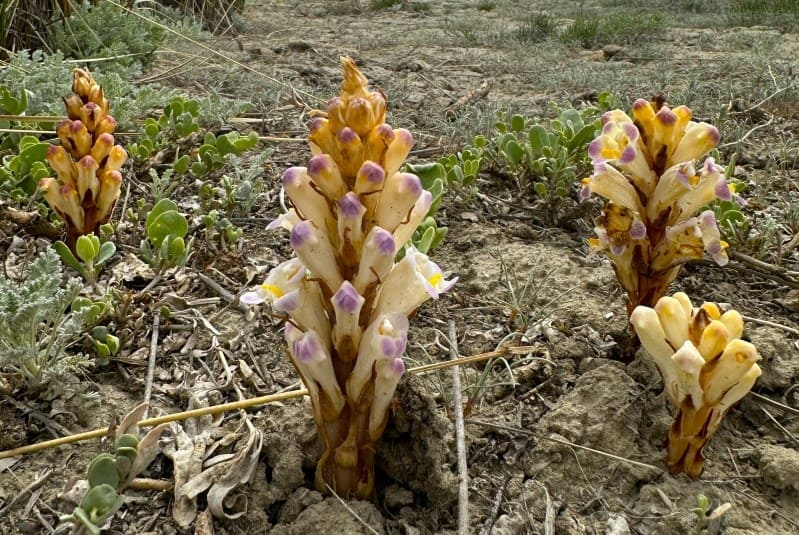
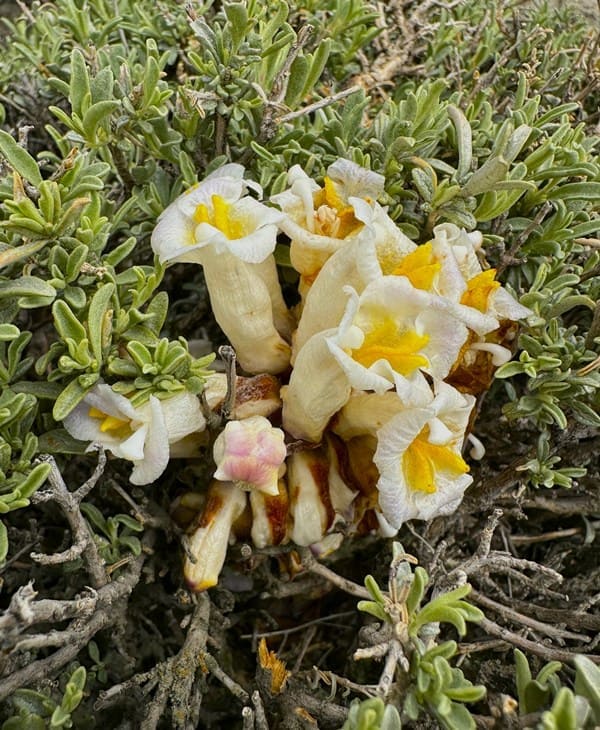
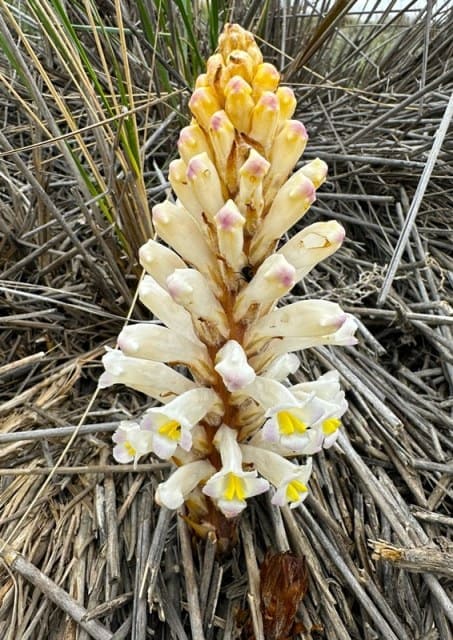
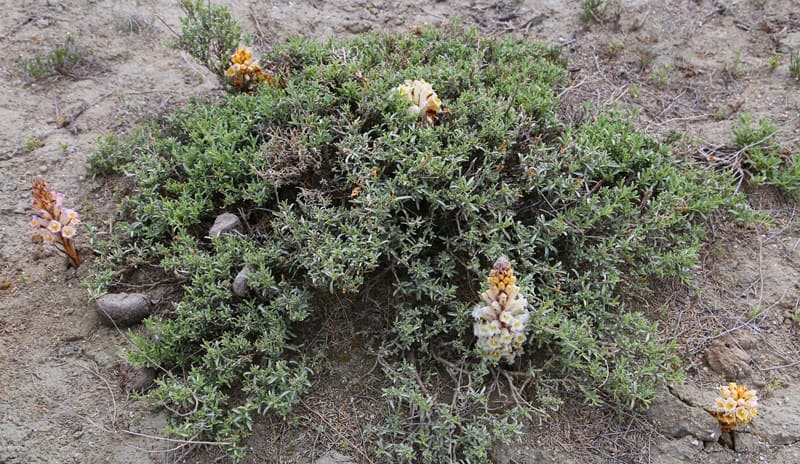
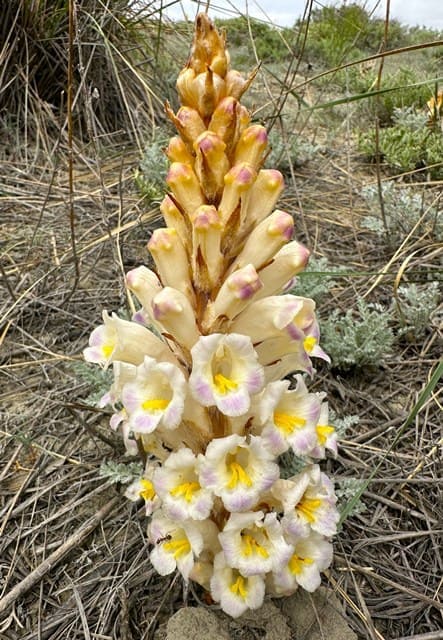
In May 2026, flowering specimens of Cistanche fissa were discovered and photographed in the western part of the Akzhan sands, on the left bank of the Black Irtysh River. The observation took place on May 11, 2026. This field discovery is of particular interest: it adds to the existing knowledge regarding the species' distribution within Eastern Kazakhstan and establishes the Akzhan sands as a documented site where it grows.
History of the scientific description of Cistanche fissa (C.A.Mey.) Beck.
The history of Cistanche fissa, much like that of the two species discussed earlier, is linked to the botanical research of Carl Anton von Meyer (Karl Antonovich Meyer). In 1831, Meyer described the plant under the original name Phelypaea fissa. Subsequently, following a re-evaluation of its taxonomic position, it was reassigned to the genus Cistanche.
The current scientific name, Cistanche fissa (C.A.Mey.) Beck, was published by the German botanist Günther Beck in 1893. The original description was based on specimens collected in the vicinity of Baku, in the Caucasus. Thus, the history of the species' scientific discovery is tied to the Caspian region, although its contemporary natural range is significantly broader, encompassing the Caucasus, Central Asia, and Afghanistan.
The epithet fissa is derived from a Latin word meaning cleft or divided. It refers to the structural characteristics of the flower specifically, the way the calyx is cleft. This is an important morphological feature used in the identification of the species.
Appearance and structural characteristics of Cistanche fissa.Cistanche incisa is a perennial herbaceous parasitic plant belonging to the broomrape family (Orobanchaceae). Like other members of the genus, it lacks typical green foliage and chlorophyll, and is therefore unable to produce its own organic nutrients through photosynthesis.
The bulk of the plant develops underground, where it remains connected to the roots of a host plant. A fleshy, flowering shoot covered in spirally arranged, scale-like leaves emerges above the soil surface.
The flowers are organized into a dense, spike-like inflorescence.
When identifying Cistanche incisa, the specific structural characteristics of the calyx and corolla are particularly important. Because it can closely resemble other species within the same genus, it is advisable when conducting field observations to examine not only the color and size of the inflorescence but also the structure of the individual flowers.
As with other Cistanche species, the above-ground shoot is relatively short-lived. Once flowering and fruit maturation are complete, the shoot withers, while the subterranean portion of the plant persists, remaining attached to the host's roots.
Habitats and Host Plants of Cistanche fissa.
Cistanche fissa occurs in arid regions, inhabiting sandy, clayey, and saline soils. Its ecological range is not limited strictly to true salt flats (solonchaks); in the eastern part of the Zaysan Basin, the species has been recorded on saline sands. Specifically, observations have been documented on the right bank of the Black Irtysh River, near the village of Buran.
A description accompanying one of the photographs identifies the saltbush Atriplex cana as the host plant. This detail is particularly significant: like other members of the genus, Cistanche fissa is closely associated with desert shrubs and subshrubs, and its distribution is determined not only by soil properties but also by the presence of suitable host plants.
Cistanche fissa in the Akzhan Sands.
The Akzhan Sands, located on the left bank of the Black Irtysh River, hold a distinct place in the species' geographical distribution. On May 11, 2026, flowering specimens of Cistanche fissa were discovered there. This site, in the western part of the Akzhan Sands, is of interest for the botanical characterization of the area, as it adds to our understanding of the distribution of parasitic plants of the genus Cistanche within the eastern Zaysan Basin.
In the vicinity of the Black Irtysh River, various types of desert habitats coexist sandy areas, saline depressions, clay plains, and shrub-dominated plant communities. This diversity creates conditions that support several Cistanche species, each linked to specific host plants and particular soil characteristics.
Spring flowering makes these plants visible only for a short time. During the rest of the year, their presence may remain virtually unnoticeable to the observer. The discovery of a cistanche dissected in the sands of Akzhan once again shows how unique and insufficiently known the flora of the desert territories of Eastern Kazakhstan is.
Even among familiar sandy and saline landscapes, there are plants with unusual biology, whose life is almost completely hidden from human eyes.
Three types - in comparison.
Sign Cistanche flava Cistanche salsa and Cistanche fissa.
Latin name C. flava C. salsa C. fissa
Original description by C. A. Meyer, 1831 C. A. Meyer, 1830 C. A. Meyer, 1831
Modern combination Korsh., 1896 Beck, 19th century Beck, 1893
Characteristic habitats Sands, dunes Salt marshes, saline soils and sands Sands, clayey and saline areas Kazakhstani finds Southern deserts, Altyn-Emel Southern and south-eastern deserts, Altyn-Emel Eastern Kazakhstan, Zaisan basin, Akzhan sands
A 2013 article on the genus Cistanche in the flora of Kazakhstan already mentioned five species, including C. fissa. This is important: Cistanche dissectata is not a new species for science or the country, but its individual locations deserve documentation.
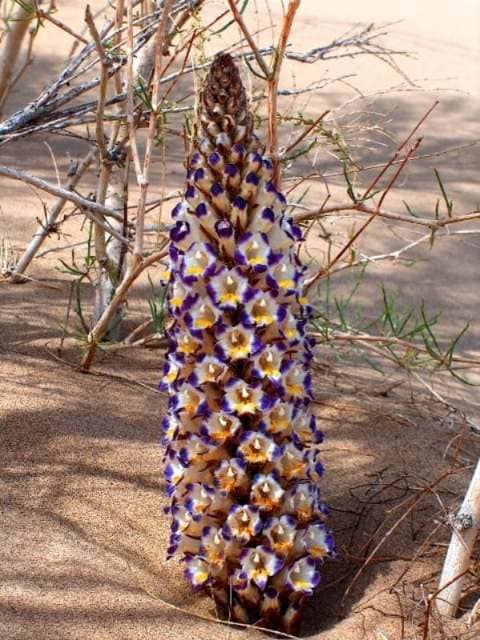
In the Akzhan sands, flowering shoots of Cistanche fissa were found among the branches of a large grayish-green shrub, presumably gray quinoa, or Atriplex cana. This species is known as one of the host plants of Cistanche. Thus, the observation suggests that in this locality Cistanche fissa is associated with Kokpek.



Authority and photos by:
Alexander Petrov.