




You are here
Botanist and explorer Vladimir Lipsky.
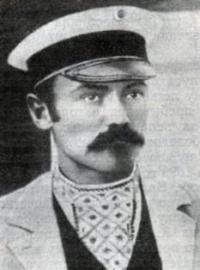
V.I. Lipsky, explorer of Semirechye.
"I decided the next morning to visit the upper reaches of this river and see the lake I'd heard about from P. P. Ivanov. Below me, not far from the Kul River, I could see a campsite, where my caravan was already approaching. It was a large campsite, located about 1/2 mile before the Tien Shan. There were some nice grassy areas here, but nothing like Aksai. True, there were absolutely no bushes here that could serve as firewood, and the only fuel was dung. Having completed my inspection, I descended to the campsite. In the evening it began to rain, then snow. The night was cool. In the morning (July 23rd) it was even cooler. The higher parts of the hills and mountains were covered with fresh snow. Accompanied by two local Kirghiz, we made the journey to the lake."
"Across the Mountainous Regions of Russian Turkestan." V. I. Lipsky. 1906.
V. I. Lipsky's Travels in Central Asia.
Vladimir Ippolitovich Lipsky (1863-1937) was a prominent botanist and explorer of the flora of various regions of the Russian Empire, including Semirechye. V. I. Lipsky can be considered one of the most active and prolific researchers of the flora of Central Asia, where he traveled repeatedly in 1899, 1903, 1909, and 1916.
His work on Mountainous Bukhara, as the southwestern Pamirs were then called, is especially significant. In terms of the length of his routes through Turkestan, perhaps only A. Regel can compare with V. I. Lipsky. In 1903, during his largest expedition through Russian In Turkestan, he visited the mountainous regions of Semirechye, traveling along the following route: Tashkent, Chimkent, Taraz, Merke, the Susamyr Valley, the village of Belovodskoye, Tokmak, Verny, Iliysk, the Asy Plateau, the Shaty Pass, Przhevalsk, the Zauka Pass, the Arabel Valley, the Naryn Fortress, the Aksai Valley, Lake Chatyr-Kol, and Arpa.
The trip resulted in a huge collection of botanical specimens (approximately 1,000 specimens), numerous general geographical observations, and, finally, the book "Across the Mountainous Regions of Russian Turkestan" (Izvestia of the Russian Geographical Society, Volume XIII, 1906).
Lipsky made his next trip through Semirechye in the summer of 1909, this time visiting the northern districts of the Semirechye region and traveling along the following route: Tashkent, Verny, and Kopal. He also explored a number of gorges in the Dzungarskiy Ala-Tau, he reached Semipalatinsk, from where he returned to St. Petersburg.
Lipsky authored several works on the flora of Semirechye, notably "A Brief Essay on the Vegetation of Kopal," "Journey to the Dzungariskiy Mountains in 1909," and "Forest Vegetation of Turkestan." V.I. Lipsky was one of the first scientists to raise the issue of establishing nature reserves in Russia.
He described over 200 new plant species. Among his many works, notable is his research into reconstructing the biography of the botanist Karelin, which resulted in the work "Grigory Silych Karelin, His Life and Travels," St. Petersburg, 1905. From 1919, Lipsky held the title of academician, and from 1922 to 1928, he headed the Ukrainian Academy of Sciences.
The importance of V.I. Lipsky's work in the study of the flora of Central Asia and Kazakhstan is difficult to overestimate. He wrote the monumental work "Flora of Central Asia," published in 1902 - 1905. It does not include a list of plants, but it does list all literary works and provides a history of botanical research in Turkestan, expedition routes, and a list of collections.
The work was the result of a critical analysis of the herbarium materials of the Turkestan Department of the St. Petersburg Botanical Garden. It is difficult to find another similar work in the scientific literature that was written with such scrupulousness, thoroughness, and detail.
This work included a summary of all botanical research (including that of non-botanists) across the vast territory of Central Asia and Kazakhstan in the XIXth century. It is still used by scientists, not only botanists, but also zoologists, geographers, and historians of geography.
Two new genera (Lipskia of the family Apiaceae and Lipskiyella of the family Asteraceae) and 54 plant species (such as Stipa lipskyi, Thyme lipskyi, Euphorbia lipskyi, Maple lipskyi, Tulipa lipskyi, etc.), which have been included in floral collections around the world.
Vladimir Lipsky was a passionate photographer and one of the first floral scientists to accompany his scientific research with photographic illustrations. In 1933, Vladimir Ippolitovich resigned, having worked as a simple scientific consultant at the Odessa Institute of Floriculture until his death. Botanical Garden.
In 1936, the scientist undertook another expedition – to Uzbekistan and Turkmenistan. Vladimir Ippolitovich Lipsky had a large family – his wife, Yulia, whom he met in Zhitomir, and six children. In 1918, his wife died. He was called the most modest president of the Ukrainian Academy of Sciences – he sawed and chopped firewood himself, grew vegetables in his garden and cooked his own dinner, wore an old demi-season coat all winter, and donated the dacha he was entitled to to the Odessa Botanical Garden.
Academician Vladimir Lipsky died in Odessa on February 24, 1937. In the 1950s, the scientist's grave and the tombstone erected by his children were destroyed, and his burial site was lost. Only at the request of the Presidium of the Academy of Sciences of Ukraine in 1990 did the Executive Committee of the Odessa City Council adopt a resolution "On perpetuating the memory of Academician Vladimir Lipsky."
Some plant species discovered by V. I. Lipsky or named in his honor:
Milk thistle (Astragalus angreni Lipsky).
New milk thistle (Astragalus neolipskyanus M.Pop.).
Bellevalia lipskyi (Miscz.) E.Wulff.
Hawthorn (Crataegus lipskyi Klokov).
Oriental beech (Fagus orientalis Lipsky).
Elecampane (Inula magnifica Lipsky).
Galagania fragrantissima Lipsky.
Sisymbrium lipskyi N. Busch.
Feather Grass (Stipa lipskyi Roshev.).
Catnip (Nepeta lipskyi Kudr.).
Allium lipskyanum Vved.
Euphorbia chimaera Lipsky.
Euphorbia lipskyi Prokh.
Echinops lipskyi Iljin.
Oxytropis lipskyi Gontsch.
Wormwood (Artemisia lipskyi Poljakov.).
Prangos lipskyi Korov.
Tulipa lipskyi Grossh.
Woodruff (Asperula lipskyana V.I. Krecz.).
Authority:
A. Lukhtanov. "The City of Verny and the Semirechensk Region." Almaty, 2014.