




You are here
Steppe and semi-desert Kazakh Uplands.
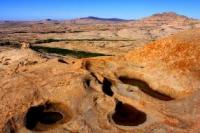
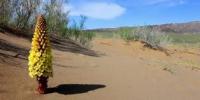
Journey through Kazakh Uplands.
"The picturesque natural landscape, satisfying both nomads and sedentary residents, as well as the combination of diverse mineral resources such as iron, copper, and gold, could not fail to attract people here from ancient times, as evidenced by the numerous graves, stone babas, burial mounds constructed from fragments of nearby rocks, and stone embankments left, as if in memory, for generations by ancient inhabitants."
I. Ya. Slovtsov. "Travel notes kept during a trip to Kokchetav district of Akmola region in 1878."
Sights of Kazakh Uplands.
Physical and geographical position of Kazakh Uplands.
Kazakh Uplands (Hills) is a vast upland located between the Turgai Plain and the Altai Mountains. In the south, the upland slopes toward a depression occupied by lakes Balkhash, Sasyk-Kol, and Alakol, and the desert plain of Betpak-Dala, while in the north, it descends toward the West Siberian Plain.
The upland is characterized by a large number of hills and ridges, usually separated by closed depressions of varying sizes and shapes. The hills have dome-shaped or cone-shaped peaks, rising above the surrounding terrain to heights ranging from a few meters to 80-100 meters.
However, the terrain of the Uplands is complex, and it cannot be characterized solely by its numerous hills. The central, elevated part of the Melkosopochnik contains mountains extending from west to east. Ulytau (1,137 m), Karkaraly with the highest peak, Kyzyl-Aray (Aksoran mount 1,565,5 m), and Chingiz-Tau (1,301 m).
In the northern part, on the border with the West Siberian Lowland, the Kokchetau Mountains stand apart, rising to almost 900 m. In the eastern part, above the Zaisan Depression, rise the Tarbagatai and Saur ranges, with peaks reaching up to 3,000 m, bearing glaciers but not reaching the snow line.
Rivers and lakes of Kazakh Uplands.
The watersheds feature flat areas composed of horizontally lying Tertiary rocks. The central, elevated band of mountains serves as the watershed between the Aral Sea and Lake Balkhash basins in the south and the basin with Lake Tengiz and the Irtysh River in the north.
From the upland, the Sarysu River and the drying northern tributaries of Lake Balkhash flow south in all directions. Several rivers flow north to the Irtysh, and the Nura River flows into Lake Tengiz and does not leave the upland. The Ishim, Nura, Selety, and Shiderty rivers have permanent streams.
Wide, dry, flat-bottomed valleys are typical of the entire arid steppe and semi-desert belt. They are also characteristic of the low-hills. In spring, they contain temporary streams. These valleys can extend for up to 700 km; for example, the Mointy Valley is up to 15 km wide.
The completely flat, sometimes rocky, valley bottoms, overgrown with wormwood and saltwort, stand in stark contrast to the surrounding low-hills. The clearly defined modern dry riverbeds, up to 60 meters wide, are inconsistent with the large dimensions of the ancient relict valleys.
In the dry steppe and semi-desert zone, erosion in modern times is sporadic and has little significance in shaping the modern relief of the upland. Relict river valleys are modified and eroded by physical weathering and aeolian processes. Erosional dissection is observed in the valley margins.
The Kazakh Upland belongs to the Ural-Tien Shan geosynclinal zone. The upland, with its Uplands, is a Paleozoic platform shield surrounded by basins. Within the basins, the Paleozoic basement subsided to varying depths. To the west of the shield lies the Turgai Depression, to the north is the West Siberian Depression, to the north is the Irtysh Syneclise, to the northeast is the Irtysh Syneclise, and to the south is the Chuya Depression.
Within the shield, Precambrian massifs are distinguished: the Kokchetav massif in the north and the Ulutau massif in the west. The central part of the shield includes the Tengiz trough and the Karaganda synclinorium, known for its coal deposits.
The shield is composed of a variety of rocks, primarily of Paleozoic age.
Geology of Kazakh Uplands.
Archean rocks are primarily composed of gneisses, amphibolites, schists, and marbles, overlain unconformably by schists (chlorite and sericite) and Proterozoic quartzites. Lower Paleozoic deposits - quartzites, sandstones, shales, and limestones - lay unconformably.
The coal-bearing strata of Karaganda, Ekibastuz, and Korzhunkul date back to the Lower Carboniferous. The well-known copper deposit of Dzhezkazgan is confined to Upper Carboniferous and Lower Permian sandstones. Lacustrine deposits with lenses of brown coal and brown iron ore are associated with the Lower Jurassic.
The Caledonian folding played a significant role in the development of the Kazakh Uplands. The Caledonian orogeny was accompanied by the intrusion of ultramafic and felsic rocks - granites. Following the Caledonian orogeny, the region was uplifted and subjected to denudation.
As a result of denudation and subsequent uplifts, Caledonian intrusions of granitic magma were brought to the surface. At the end of the Lower Devonian, marine sedimentation began again. During the Upper Paleozoic, the Hercynian orogeny occurred, encompassing the entire Ural-Tien-Shan geosynclinal zone.
During the two phases of the Hercynian orogeny in the Carboniferous and Permian, high mountains arose over a vast area. The deposited Lower and Middle Paleozoic sediments were folded, intruded by magmatic intrusions, and heavily metamorphosed.
The resulting folds, nearly longitudinally striking, were disrupted by faults and vertical displacements - faults and thrusts. Rock fragmentation and fractures occurred along the contact lines. Platinum, nickel, chromium, and iron are associated with the main intrusions, while iron, copper, zinc, silver, and gold are associated with the felsic granitic intrusions.
Due to uplift, the Carboniferous Sea retreated and became shallow, forming shallow lagoons, lakes, and swamps with rich vegetation, and forests spread. This plant material subsequently served as the basis for coal formation. During the subsequent Mesozoic and Paleogene periods, the Hercynian mountain ranges eroded, and the area acquired a platform-like character.
The emerging Paleozoic platform experienced oscillatory movements; individual large sections of it sank to varying depths and were inundated by the waters of shallow seas. North of the shield - the Kazakh Uplands - the West Siberian Plain, which had been subsiding, was inundated by the sea during the Tertiary. In its place was a strait connecting the seas that were then located on the Turan and West Siberian Plains.
The Turan Lowland was inundated by the sea several times - in the Upper Jurassic, Upper Cretaceous, Paleogene, and Neogene times. Thus, the Paleozoic basement of the platform in the subsided basins is overlain by a series of horizontal layers of sedimentary rocks, both marine and continental.
The Kazakh Uplands are bordered by normal faults. These formed during the Mesozoic orogeny, the New Cimmerian phase, and the Upper Jurassic. The Alpine orogeny manifested itself primarily in disjunctive dislocations. The normal faults and vertical displacements of the land resulted in the formation of modern mountains and basins.
It should be noted that during the Quaternary, the mountains were lowered by denudation, and the basins were filled with clastic material. Quaternary deposits are widespread. These are deluvial sandy-clayey deposits, often coarsely detrital - rocky, eluvial sandy loams and loams, and alluvial deposits along the valleys.
The modern relief of the Kazakh Uplands arose as a result of the prolonged denudation of the Hercynian Mountains to the peneplain stage - a plain with residual mountains and countless hills. The hills formed where more resistant rocks exposed themselves to the surface.
Thus, very dense quartzites form the highest hills, pointed and sharply defined; dome-shaped hills are formed by granites; and even smoother and lower ones are formed by porphyry. Devonian and Carboniferous sandstones typically lie in the depressions separating the hills.
The depressions, like the hills, are arranged in no apparent order. They have a depth relative to the watersheds of 20-40 meters, and diameters ranging from tens of meters to many kilometers. The formation of the depressions was facilitated by erosion processes.
The large number of depressions contributes to the formation of temporary and permanent lakes. The Kazakh Uplands contain a large number of lakes, including freshwater, brackish, and saltwater lakes. The largest lakes in the upland - Tengiz and Kurgaldzhin - are located at the bottom of the central depression and form a single lake-river system.
Lake Zaysan reaches its greatest extent, the fourth largest in the Asian part of our country: its water level is 288 meters above sea level. The lake lies in a graben separating the Tarbagatai-Saur and Altai ranges. The lake's typical depth is 4-6 meters, and its water is fresh.
The low banks are swampy, with marshes covered with reed beds. The lake is a flow-through lake: the Black Irtysh River flows into it from the east, and the Irtysh River flows out from the north. The lake will be converted into a large reservoir, intended for use in regulating the flow of the Irtysh and for irrigating the surrounding semi-desert areas.
Climate of Kazakh Uplands.
Most of the Kazakh Uplands are located in the semi-desert zone, while the smaller northern part is in the steppe zone. The northern part of the Kazakh Uplands, like almost the entire Turgai Plain, is part of the West Siberian Plain in terms of climate.
The southern part of the uplands is characterized by a strong similarity to the climate of the Turan Lowland. The island mountains - Ulutau, Karkaraly, Chingiz-Tau, and others - are distinguished by altitudinal climatic zonation. Throughout the year, temperate latitude (polar) air prevails in the area.
This air borders on arctic air in the north and tropical air in the south. The arctic and polar fronts separating these air masses shift, and the uplands can be exposed to invading masses of cold, arctic air and warm, tropical air from the south. This results in frequent and rapid weather changes - a typical feature of the mid-latitude climate.
The predominance of a particular weather type during certain seasons determines the climate of the region. The complete dominance of temperate continental air throughout the year is due to the region's great distance from the oceans and determines the continental climate of all of Kazakhstan.
The climate of the low-hills is characterized not only by large daily and annual temperature swings, cold winters, and hot summers, but also by low precipitation. The coldest month is January. The average January temperature ranges from -16 to -19°C, with absolute lows reaching -45°C.
The warmest month is July. The average July temperature is +22°C, with absolute highs reaching +45°C. Annual precipitation is approximately 250 mm. Most precipitation falls in the summer. For example, in the Karkaralinsk region, about half of the annual precipitation - 132 mm - falls in the summer, while only 10% of the annual precipitation - 31 mm - falls in the winter.
The mountain ranges within the Uplands receive more precipitation than the surrounding areas – approximately 300 mm. Annual precipitation can fluctuate greatly, with some years receiving approximately half of the annual precipitation. Frequent, significant winds (5-6 m/sec) enhance evaporation, with surface evaporation reaching 2000 mm per year.
Cloud cover is highest in winter (December), and lowest in summer (August). Average annual cloud cover is approximately 50%. Relative humidity is highest in winter (reaching 83% in January), and lowest in summer, in July (approximately 35%).
Winter is cold, with strong winds and harsh. Air temperatures in the eastern part of the Uplands can drop to almost -50°C. Northeasterly winds from the Siberian anticyclone intensify the effects of low temperatures on living organisms. The relatively thin snow cover is blown by the winds into depressions. Snow dunes are formed.
The shallow snow cover (up to 30 cm) allows for livestock grazing even in winter, but this is hampered by fairly frequent thaws, followed by ice formations, and livestock suffer from the inability to reach forage from under the ice crust. Snow lasts up to 120 days and poorly protects the soil from freezing; frosts usually occur before snowfall.
Spring is short and uniform. This is facilitated by a thin snow cover, which does not require much heat to melt. The exposed soil warms quickly, and the ground layer of air also warms. Air temperatures rise very quickly, and spring often lasts about two weeks.
Frosts are common. In spring, vegetation is provided with moisture in low-lying areas, since snow compacted by thaws and winds melts more slowly there. Rain falls in spring; air temperatures are relatively low; evaporation is low. In spring, ephemerals experience extremely rapid growth and flowering.
Summer begins as early as May. May is typically sunny and hot, with average temperatures of 16 to 17°C. In June, temperatures reach 40°C, but night frosts can occur in both May and June. The area heats up significantly because there is no dense vegetation, the soil is dry, and heat is not lost to evaporation.
Due to low cloud cover, sunshine lasts long, and there are no bodies of water to moderate the temperature. In summer, precipitation falls in the form of heavy rainfall; these provide little soil moisture, as vegetation retains little water, and water flows down gullies.
Northern winds also prevail in summer; they are dry and increase evaporation. Autumn is a longer period than spring; the decrease in temperatures occurs more slowly than their increase in spring. Just as in spring, meridional circulation of air masses intensifies in autumn. Invading Arctic air creates anticyclonic conditions with clear, windless weather and low nighttime temperatures.
The soils of the Kazakh Uplands are zonal. North of the upper latitudinal course of the Ishim River, common and southern chernozems are common, forming part of the steppe zone. Most of the uplands are occupied by semi-arid soils. The climate is unfavorable for humus formation in the soil layer.
This is also facilitated by the sparse, poor vegetation of the zone.
Soils of Kazakh Uplands.
Climatic conditions determine the weak leaching of the soil layer, the accumulation of salts, the formation of a horizon containing soluble salts, the relative attenuation of chemical processes in the soil, the enrichment of the soil layer with coarse detrital material, and, in general, the soil's high dependence on the parent rock and its properties, which contribute to the formation of numerous varieties of the same soils.
Along with parent rock, topography also influences the formation of the soil layer, creating microclimatic changes that influence soil formation and lead to the formation of azonal soils. Azonal soils include mountain-steppe soils on the Karkaraly and Chingiz-Tau mountains.
Climatic conditions also determine the seasonality of the soil formation process, with its attenuation during the summer months. They also determine the transition from saline land with increased alkalinity, caused by the large amount of alkaline carbonates, to saline land, which are more saline, with a high content of water-soluble salts in the upper horizontal soils.
These changes in the soil layer are observed from north to south. Researchers of semi-desert soils note another characteristic feature: complexity. The essence of complexity lies in the fact that, under the influence of microrelief, fairly abrupt changes in soil-forming conditions (moisture, heating, evaporation, salinization, vegetation) occur, resulting in multiple changes in different combinations of soil types within a small area - steppe, semi-desert, and desert.
In the Kazakh Upland, large areas are occupied by stony soils. The eastern, elevated and mountainous part, which makes up about half of the upland, is occupied predominantly by gravelly soils. These light chestnut and brown soils are characterized by shallow depth, underdevelopment, and a small amount of fine earth.
The soil composition is fine-grained sandy loam. The areas occupied by these soils are used for pastures. In numerous depressions, a soil complex with a predominance of saline soils - salt marshes and solonetz - develops. Meadow alluvial and even bog soils develop in the valleys, as the soil-forming conditions there are different.
Fine-grained soil accumulates in the valleys and is periodically well-watered; vegetation develops significantly better in the valleys. The vegetation of the Kazakh Uplands is transitional in nature from steppe to desert. In the northern part of the uplands, in the Kokchetav region, steppes are widespread, dominated by tussock grasses.
The steppes are feather-grass-fescue; they are often disturbed and modified by the rugged topography, mountains, and bedrock outcrops.
Flora of Kazakh Uplands.
Fescue-wormwood semi-desert steppes are common across most of the uplands region. Grasses predominate in the northern zone, while wormwoods predominate in the southern zone. This general vegetation pattern is often modified by meso- and microrelief, creating banding and patchiness in the vegetation cover.
Thus, patches of rocky semi-deserts of varying sizes are distinguished, where black wormwood (kara-dzhusan) predominates. Black wormwoods are associated with solonetz soils. Wormwood stems reach up to 10 cm in height; after rain, their leaves usually straighten out, and their root system is very powerful, reaching a depth of over a meter.
White wormwood (ak-dzhusan) and other wormwoods occupy slightly saline areas. Wormwood steppes have a distinctive wormwood aroma associated with the essential oils found in wormwoods, especially black wormwood. Black wormwood is usually accompanied by Anabasis sals, Atriplex ana, Kocia prostrata, Camphorosma monspeliacum, Ceratocarpus arenarins, and others.
Saltworts, such as Halocnemum strobilaceum, Statice suffruticosa, tamarisk, and black wormwood grow in salt marshes. Common turf grasses include Festuca sulcata, F. beckeri, Koeleria gracilis, and feather grasses. In spring, ephemerals develop rapidly: tulips (Tulipa biebersteiniana, T. schrenkii), rhubarb (Rheum tataricum), camel grass, and buttercup (Ranunculus polyrhisus).
In the mountains, altitudinal vegetation zones develop. The entire elevated central belt of the Uplands with its island mountains is occupied by feather-grass-fescue and wormwood rocky steppes, where thickets of Karaganda shrub (Tatagana tratex) and small birch groves are widespread.
At the foot of the mountains, these steppes give way to wormwood-fescue rocky steppes. Birch, aspen, bird cherry, willow, hawthorn, and buckthorn grow in the narrow, fairly deep valleys that cut through the lower parts of the slopes. Pine trees grow on the mountains.
Pine forests. In the northern part, pine-birch forests with aspen occupy the northern slopes of the hills. Pine on the sands extends as far as Semipalatinsk.
Fauna of Kazakh Uplands.
The fauna of the Uplands consists of forest, steppe, and desert animals. Forest animals include the red fox (Vulpes vulpes), wolf, Siberian squirrel, badger (Meles meles), and lynx; birds include black grouse, gray partridge, and willow grouse. Among the steppe representatives we will point out the yellow souslik (Citellus fulvus), jerboa - great ground hare (Alactaga jaculus), lesser jerboa (Alactaga elater), brown hare (Lepus europneus), saiga antelope (Saiga tatarica), ermine, weasel, steppe polecat, corsac fox (Vulpes corsak), among the birds - great bustard (Otis tarda), kite (Milvus korschun), little bustard (Otis tetrax), pallid harrier (Circus marcourus), great black lark (Melanocorypha veltoniensis), little lark (Calandrella), white-winged lark (Melanocorypha leucoptera), horned lark (Eremophila alpestris brandti), sadzha, or hoofed lark (Syrrhaptes paradoxa), and of the sandgrouse, the sociable lapwing (Vanellus gregarius). Lakes are home to ducks, geese, gulls, waders, and swans. Reptiles include the takyr lizard (Phrynocephalus helioscopus), the boa constrictor (Eryx miliaris), the shield-faced snake (Ancistrodon halys caraganus), the swift lizard (Eremias velax), and the turtle (Testudo horsfieldi).
Geographic coordinates of Kazakh Uplands: N49°17'22 E69°39'26
Authority:
Davydova, M.I. "Physical Geography of the USSR." M.I. Davydova et al. Moscow: Prosveshchenie. 1966, 847 p.
https://big-archive.ru/geography/physical_geography_of_the_Soviet_Union/175.php
Photos by:
Alexander Petrov.