




Вы здесь
Village of Baiseit.


Trip from Almaty to village of Baiseit.
"Then, after the Eastern War, Russian consulates were established in the cities of Kuldzha and Chebuchak (Chuguchak, according to the latest maps), along with house churches and priests. But soon the Kashgar Mohammedans attacked this Chinese country and began to put everyone to the sword and fire; they destroyed the cities of Kuldzha and Chebuchak themselves, and destroyed the consulates and churches there. As a result, the entire people fled to the mountains and forests, and Russia declared war on the Kashgarians. An army was sent, the cities of Kuldzha and Chebuchak were captured, and the entire country was annexed to Russia. But the Russian government found it unprofitable to keep this country in its possession, and so they notified the governor of Kuldzha to inform the local residents that if any of them wished to go to Russia, they were to leave immediately with all their belongings, as Kuldzha would become the property of China along with the entire country. Upon hearing this news, the entire people were thrown into a terrible uproar. Not to mention the Russians, Albazinians, Chinese, Kyrgyz, Kashgarians themselves, and even Indians all began gathering in large groups with their livestock and all their belongings. They all flocked to Russia's Semirechye region, settled there in special settlements, adopted baptism, the Russian language, and clothing, and joined the Cossacks”.
"First News of Russians in Kuldzha and Annexation of Kirghiz Steppe to Russia." Manuscript of monk Parthenius, reported by D. F. Kositsyn. Russian Herald, 1878, No. 9.
Excursion to village of Baiseit in Almaty region.
Village of Bayseit (Kazakh: Bayseit. Bay means rich, influential; seit means descendant) is located on the old steppe and mountain road, at an altitude of 692 meters above sea level. It is 444 meters from the right bank of the wide Shelek River valley, one of the key waterways in the foothills of the Trans-Ili Alatau.
It is 8 kilometers southeast of the village of Shelek, 10 kilometers northwest of the village of Malybai, and 15 kilometers east and slightly north of the village of Koram. It is part of the Bartogay rural district (until 2010, the Oktyabrsky rural district), in the Enbekshikazakh district of the Almaty region.
Village of Baiseit is a stone's throw from the eastern edge of the Ili Valley and the roads that lead to the Kolsai Lakes, the Bartogai Reservoir, and further across the Asy Plateau, the Turgen Gorge in Almaty, the Charyn Canyon, the villages of Chundzha, Zharkent, and Kolzhat, and the border with the People's Republic of China.
According to one local oral tradition, the name "Baiseit" is associated with a wealthy cattle breeder and clan elder named Baiseit, who wintered on the banks of the Shelek River, and a village gradually developed around it. Almaty-Kegen-Narynkol highway runs through the village of Baiseit along its main street, named after Abay Kunanbayev, dividing the settlement into eastern and western parts.
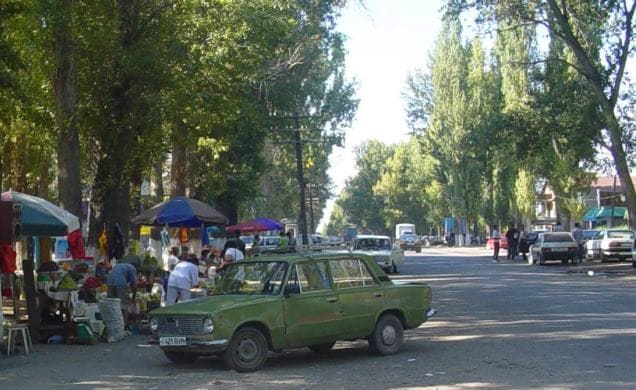
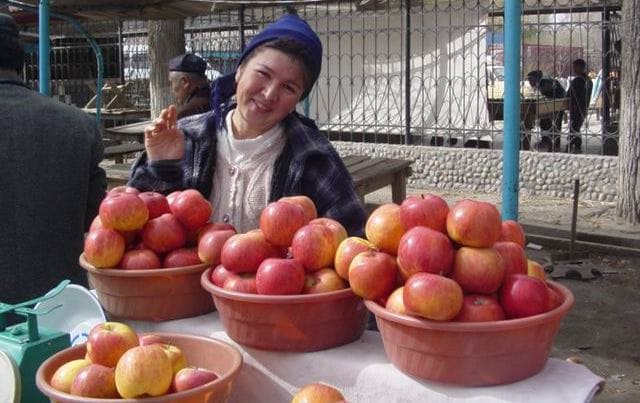
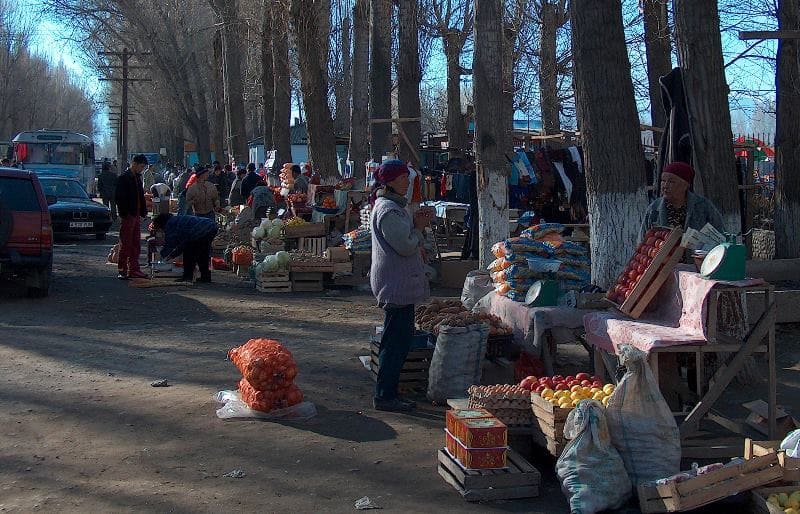
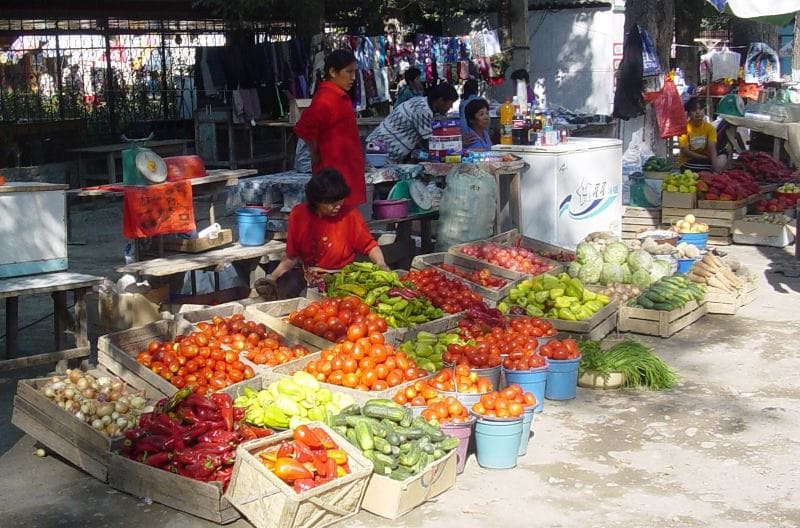
Today, Baiseit is a large rural settlement with a vast bazaar that stretches for almost 2.5 kilometers, along the entire length of the central street named after Abay Kunanbayev, serving as an important transit point for travelers.
Distances from Baiseit to settlements and natural and architectural landmarks of Almaty region:
Baiseit – Chundzha – 105 km.
Baiseit – Bartogay Reservoir – 50 km
Baiseit – Almaty (along new highway) – 136 km
Baiseit – Almaty (along Kuldzha highway) – 123 km
Baiseit – beginning of Kokpek Gorge – 24 km
Baiseit – turnoff to Chundzha – 42 km
Baiseit – turnoff to Charyn – 59 km
Baiseit – Valley of Castles (Charyn Canyon) – 70 km
Baiseit – Kurtogay valley on Charyn River (road bridge over river of same name) – 84 km.
Baiseit – Kegen settlement – 103 km.
Baiseit – Narynkol settlement – 196 km.
Baiseit – Saty settlement – 154 km.
Baiseit – Kolsay Lake – 168 km.
Baiseit – Zharkent – 199 km.
Along the main street, on both sides, are a bazaar, shops, canteens, cafes, and barbecue joints. The bazaar bustles here year-round, and trade is brisk. In 2023, the settlement had 837 households, a population of 4,011, and a secondary school named after Ismail Tairov for 600 students, a preschool education center where up to 100 children can receive preschool education, and a rural outpatient clinic.
There are two gas stations in the village. The majority of the population is engaged in agriculture - growing vegetables and fruits, forage grasses, and grain crops. A small portion is engaged in entrepreneurial activity, and the remainder is involved in providing services and supporting the rural community.
The nearest settlement is the village of Khusain Bizhan (formerly Oktyabrskoye village), located 1.5 kilometers to the southeast. It should be noted that the village of Baiseit retained its original name and has never been renamed. On March 22, 2008, the unique Ayurvedic center "Kairali-Baiseit" was built in Baiseit.
This is the first health facility in Kazakhstan. It is difficult to say whether it is currently operational. On March 26, 2018, the Akim of the Bartogay Rural District, Enbekshikazakh District, taking into account public opinion, renamed Novostroyka-1 Street to Dostyk Street, Sadovaya Street to Beibitshilik Street, Klubnaya Street to Tauelsizdyk Street, and Novostroyka-2 Street to Zhastar Street in the village of Baiseit, Bartogay Rural District.
In the 1930s, collective and state farms, along with shearing stations focused on sheep farming and agriculture, were established in the valley. In the 1980s, vegetable and forage crops were actively grown here, with some fields irrigated by numerous canals in the district, including the Mulushechny, Kokterek, Syugatinsky, Kainuksky, Konakbay, and Baiseitsky canals, fed by the Shelek River.
Baiseit is located in a dry foothill steppe zone, but the proximity of the river provides fertile soil, fertile horticulture, and large pasture areas. In spring and early summer, the surrounding area is particularly beautiful. The slopes of the Zailiyskiy Alatau are covered with flowering trees and foothill and alpine vegetation.
Old pyramidal poplars and willow thickets grow along the river floodplain, and apple trees and apricots bloom in the orchards.
Geographical coordinates of village of Baiseit: N43°34'24 E78°20'51
Historical information about village of Baiseit.
The Shelek Valley has long been a transition zone between the high-mountain summer pastures (zhailau) and the lowland wintering grounds (kystau) of semi-nomadic Kazakh tribes. Baiseit, a Taranchi (Uyghur) village in the Vernensky district of the Malybai volost, was founded in 1881 on the right bank of the Chilik River, 8 miles southeast of the village of Zaitsevskogo (Chilik).
"Baiseit is a Taranchi (Uyghur) village in the Vernensky district of the Malybai volost, founded in 1881 on the right bank of the Chilik River, 8 miles southeast of the village of Zaitsevskogo (Chilik). In 1881, 10 Uyghur families settled here, and settlement continued until 1885.
In 1883, there were 367 households. In 1906, the village of Barbosun arose nearby, forming one with Baiseit. As of January 1, 1913, there were 317 households in Baiseit with 1,438 residents, of whom 879 were men and 559 women. They owned 3,421 horses, 395 cows, 430 sheep and goats.
The village had 4 prayer houses, 2 madrassas with 40 boys and 10 girls studying, and One Russian-native school. At the same time, Barbosun had 155 households with 710 residents, including 437 men and 273 women. They owned 434 horses, 216 cows, and 5,017 sheep. The village had two prayer houses and one madrasah with 30 boys and 10 girls.
(A. Lukhtanov. "City of Verny and Semirechensk Region". Almaty, 2014.)
Settlement of Baiseit itself was formed later – in the late 19th and early 20th centuries, during the period of active settlement of the valley by immigrants from Xinjiang, the western regions of China (the Ili District), after the signing of the Treaty of Kuldzha between Russia and China in 1851.
The treaty was necessary for establishing diplomatic relations and regulating trade with China in the region of eastern Kazakhstan. In July 1851, a diplomatic mission led by E.P. Kovalevsky was sent to Kuldzha. The delegation included A. Vlangali, A. Tatarinov, and I. Zakharov.
The mission was accompanied by a detachment of the military elder Kazachinin, dispatched from the 10th Regiment in Kopal, consisting of five non-commissioned officers and 153 Cossacks. As a result, the 17-point Treaty of Kuldzha was signed on July 25, granting Russian merchants the right to travel to China annually from March 25 to December 10.
Duty-free barter was introduced, and trading posts were opened in Kuldzha and Chuguchak, as well as Russian consulates in these cities. The Treaty of Kuldzha facilitated the development of political and economic ties between Russia and China.
The Russians' development of the Trans-Ili region accelerated, facilitating the normalization of relations with the Great Horde and the Kirghiz of the Tien Shan, as trade caravans to China passed through their nomadic camps. Furthermore, the mission had scientific significance. Mining engineer A. Vlangali made a geological description of the route taken through the Dzungarian Ala-Tau (Uygentas Pass) to Gulja.
Sights of Baiseit.
Monument to Seyit Muhammad Kashi.
"Wealthy people experience no hardship there,
They build houses, plant groves, orchards, and vegetable gardens.
Poor, however, are constrained by lack of means,
They are tormented by boundless grief.
Heavy thoughts weigh upon their minds."
Seyit Muhammad Kashi.
Northwest of the bazaar rows, next to the monument to Victory in the Great Patriotic War (1941 - 1945), stands a monument to Seyit Muhammad Kashgari, a Uyghur poet and thinker, author of the poetic chronicle "Sharkhi Shikaste Name," written in classical Chagatai Turkic. (Sometimes written as Seyit Muhammad Kashgari or Seyit Muhammad Kashgari)
Historical and cultural background of Seyit Muhammad Kashgari.
In oral tradition, Seyit Muhammad Kashgari is remembered as a teacher of writing and spiritual culture, one of those who contributed to the preservation of the literary language of the Chagatai Turkic tradition in the new conditions of the nomadic and agricultural life of the Uyghur communities in Semirechye.
His poetic texts and teachings were transmitted primarily orally, while later writings record his poems and aphoristic sayings related to themes of hard work, moral fortitude, and communal unity. He belongs to the Uyghur literary and social tradition of Semirechye in the late XIXth and early XXth centuries.
Seyit Muhammad Kashgari (c. 1840 – 1915) is considered one of the most significant representatives of the folk poetic culture of the Uyghurs, who migrated from the Ili region to Semirechye between 1881 and 1884 following the conclusion of the Treaty of St. Petersburg between the Russian Empire and the Qing Dynasty.
The social and cultural context of his work was linked to the formation of stable Uyghur agricultural and artisan settlements along the Shelek River valley. During this period, many families faced shortages of land, housing, food, and livestock. In his poetry, Kashgari expressed deep sympathy for the plight of the poor and landless settlers, capturing the everyday and emotional aspects of these processes in poetic form.
His poetry was distinguished by a clear, conversational style, making it accessible to a wide audience. He became a chronicler of the community's transition, expressing the voice of those experiencing social change without protection and support.
Through oral transmission, his poems were preserved and entered the local cultural memory of the Uyghur population of Semirechye. The installation of the monument in Baiseit reflects the value of preserving historical continuity and cultural identity, as well as recognition of the poet as an exponent of the collective destiny of the region's settlers.
No photographs of the poet survive from his lifetime. Modern images, including this monument, are artistic reconstructions based on oral descriptions and local cultural memory.
Legend of Seyit Muhammad Kashi.
It is said that Seyit Muhammad often sat on a hill near the settlement, overlooking the Shelek Valley. He said that a person arriving in a new land must "root their heart before their hands take up the plow."
According to the oral tradition of elders, Seyit Muhammad Kashgari often repeated:
"A house is built with hands, and a community with words."
When people came to him with complaints, he didn't offer advice - he listened. And then he composed poems in which each voice sounded like part of a single shared story.
People said:
"If you want to understand what we've been through, listen to him." This phrase is still cited in Baiseit today as a reminder that preserving the language and mutual support played a key role in the lives of the Semirechye settlers.
Geographical coordinates of monument to Seyit Muhammad Kashi: N43°34'20 E78°20'52
Monument to participants in Great Patriotic War in village of Baiseit.
Also located on the southern side of the small square is a monument to the Victory in the Great Patriotic War (1941-1945) and to those who did not return from the war. Such monuments are often seen in villages across Kazakhstan. The monument's bas-reliefs symbolically complement the tragedy of war.
Geographical coordinates of Victory Monument: N43°34'19 E78°20'50
Rural Community Center in village of Baiseit.
A two-story Community Center still stands in the central square of the village of Baiseit. It is a typical example of mid-XXth-century public architecture, shaped in the spirit of Soviet cultural policy. The building retains the characteristics of typical club architecture of the 1960s and 1970s: strict geometric forms, minimalist facades, and an emphasis on functionality.
Culture centers were the center of social life in the village, hosting festivals, meetings, courses, concerts, film screenings, and a venue for amateur performances and national ensembles representing Uyghur, Kazakh, and Russian cultural traditions.
Today, the building retains its historical symbolism and serves as an important cultural landmark for the village, even if its functional role has diminished over time. However, two monumental bas-relief panels located on the sides of the façade are of particular artistic value.
They are executed in the style of Soviet monumental art, where decorativeness combines with ideological imagery. The bas-reliefs depict "an allegory of collective farm happiness in the form of marching peasant women." In Soviet symbolism, such an image often signified the joy of labor, the achievements of science and technology, and the well-being of rural life.
The women walk together, their raised arms or gestures can signify a call to action, a celebration, an achievement. Old residents of Baiseit say that the House of Culture stood for more than just a building:
During the long winters, dastans and songs accompaniment to the dutar resounded here, children learned to dance here,
poetry was recited here - sometimes quietly, sometimes loudly, but always about home and the land.
And the monument in the square reminds us that people do not live by bread alone - they live by the memory of words.
Geographical coordinates of House of Culture are: N43°34'19 E78°20'49
Monument to Ismail Tairov in village of Baiseit.
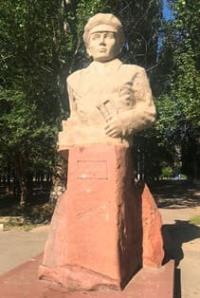
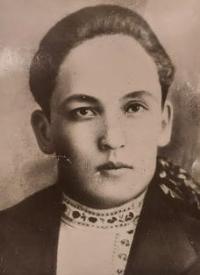
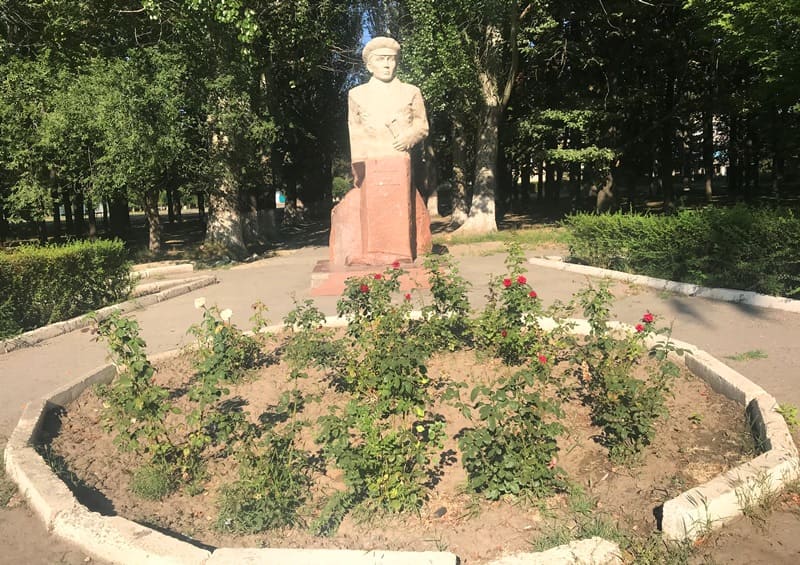
Across the road, a bust of Ismail Tairov (1900 – 1938) stands among the poplars. Ismail Tairov was born in the village of Chilik in the Semirechye region (now the Chilik district of the Almaty region). He is Uyghur. He graduated from a higher primary school (6 years), a 3-month short-term pedagogical course, a 4-month pedagogical course, a 3-month instructor course, and a 1-year course for workers' and peasants' inspection.
He was a member of the Communist Party since August 1918. From 1917 to 1920, he was a teacher and instructor at the People's Commissariat of Education of the Turkestan ASSR. From 1920 to 1921, he was a member of the Presidium of the Uyghur Revolutionary Union. In 1921, he was a delegate to the 3rd Congress of the Comintern.
From 1921 to 1924, he was Chairman of the Jetysu Regional Control Commission of the All-Union Communist Party (Bolsheviks). From August 1925 to 1926, he was Chairman of the Syr Darya Provincial Control Committee of the All-Union Communist Party (Bolsheviks).
From December 1926, he was a member of the Party Collegium of the Regional Control Commission. On March 24, 1927, he was seconded as an authorized representative of the Regional Control Commission to "conduct a campaign to redistribute arable and hayfield lands."
From July to October 1928, he was Head of the Department for Work in Villages of the Jetysu District Committee of the All-Union Communist Party (Bolsheviks). From November 1928, he was an instructor in the Department for Work in Villages and Auls of the Kazakhstan Regional Committee of the All-Union Communist Party (Bolsheviks).
In December 1929, he was appointed Prosecutor of the Petropavlovsk District (he did not have time to assume the post due to a new appointment). From December 1929 to 1930, he was Head of the Department of Agitation, Propaganda, and Press of the Pavlodar District Committee of the All-Union Communist Party (Bolsheviks).
From February to mid-1930, he was Head of the Department of Culture and Propaganda of Leninism of the Pavlodar District Committee of the All-Union Communist Party (Bolsheviks). From May 1934 to May 1935, he was Head of the Fruit Department of the People's Commissariat of Agriculture of the Karelia ASSR.
From August 1935, he was Party organizer of the Karelia Regional Committee of the All-Union Communist Party (Bolsheviks) in the Special Construction Department under the Council of People's Commissars of the Karelia ASSR. From July 1936 to 1937, he was Head of the Alma-Ata Regional Department of Public Education.
Geographic coordinates of monument to Ismail Tairov are: N43°34'21 E78°20'55
Authority:
Alexander Petrov.
Lukhtanov. "City of Verny and Semirechensk Region." Almaty, 2014.
Photos by:
Alexander Petrov.