




You are here
V. Masalsky on Syr Darya.
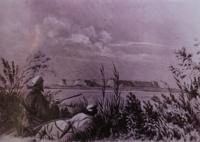
Syrdarya's sources in Tien-Shan mountains.
"In the Ak-Gerik valley, we found truly vast fields covered with almost ripening grain, whereas on the banks of the Syr, there wasn't a single patch of pure meadow grass, unmixed with reeds. Near the Syr, only here and there were dry spots with small reeds and a few grasses, but for the most part, we had to wade through water on horseback, sometimes up to a horse's belly, through reeds two horsemen high. However, I will discuss arable farming and haymaking on the Syr when, based on my accumulated experience, I examine the local lands near Raim in 1851 in more detail."
A. I. Maksheyev "Travels in the Kirghiz Steppes and the Turkestan Region." 1896.
Vacation on Syrdarya River in Kazakhstan.
Syr Darya (Yaxart to the ancients, Seykhun to the Arabs) is one of the most important rivers in Turkestan, consisting of two sources, the Naryn and Karadarya, and flowing into the Aral Sea. The length of the Syr Darya, including the Naryn, is 2,370 versts (2,863 km); the surface area of the basin is 398,357 square versts (453,347 km), i.e., slightly larger than Sweden.
The Naryn originates in the southeastern part of the Semirechye region from glaciers and lakes on the high plateaus (syrts) of the Tien-Shan (at 78° east longitude and slightly south of 42° north latitude), at an altitude of approximately 12,500 feet.
The Naryn's sources can be considered to be rivers originating on one side from the glaciers (L. Petrov) of the Akshiyryak Range, and on the other from high mountain lakes and glaciers on the southern slope of the Terskey-Alatau Range. Of these rivers - the Yaak-tas (Dzhak-tash), fed by six glaciers (Petrov and others) descending from the Akshiyryak Range, the Barskoon River, flowing from the Terskey-Alatau glaciers, and the Kara-sai River, also flowing from the Akshiyryak glaciers - represent the three main sources, which, upon joining, take the name Taragai River, heading west through a wild gorge and taking the name Naryn from the mouth of a small tributary, the Kurmenty.
The river retains this name until joining the Karadarya in the Fergana Valley, from where it takes the name Syr Darya. The first significant tributary of the Naryn is the Small Naryn (110 miles), which flows from the southern slope of Terskey Alatau and joins the Naryn from the right, 35 miles above the Naryn fortification (6,900 feet); the Small Naryn carries almost as much water as the main river.
From the mouth of the Maly Naryn, the river emerges from a gorge into a fairly wide valley and, continuing to flow west, receives the Ottuk (50 miles, road to Tokmak) from the right and the At-bash (130 miles) from the left, after which it enters an even wider area (the Kurtka natural landmark 6,520 feet) and splits into several branches overgrown with reeds and bushes.
Traces of a former culture in the form of abandoned arable lands and irrigation ditches are visible from the Naryn fortification, and below the confluence of the At-bash, the Kyrgyz practice agriculture wherever terrain permits. The relatively wide Naryn Valley continues beyond the Kurtka tract for another 20 miles to the confluence of the Alabuga River on the left, after which the river enters a narrow gorge, beyond which the valley widens again, forming the Toguz-turau natural landmark (4,250 feet).
Here, receiving the Kyl-duo and Kaldama rivers from the left, the Naryn turns northwest and again enters a narrow gorge about 80 miles long, where it receives the full-flowing Dzumgol-Susamyr tributary from the right. Emerging from the gorge, the Naryn passes through several full-flowing branches of the wide Ketmen-Tyube Valley (2,800 feet), receives the Uzun-akhmat tributary from the right (60-70 meters), and turns sharply southwest, maintaining this direction until its confluence with the Kara-darya.
Beyond Ketmen-Tyube, the Naryn again enters a rocky, wild gorge, which, after flowing for about 120 miles, emerges at Uch-kurgan into the Fergana Valley. About 50 miles to the west, almost on the meridian of Namangan (1340 feet), the Naryn merges with the Karadarya and takes the name Syr Darya.
The Naryn, from its source to its confluence with the Karadarya, is approximately 700 miles long. Thus, the upper and middle reaches of the Naryn are a series of high basins separated by narrow gorges, believed by some to be the beds of former lakes.
Despite the altitude of these basins, they are suitable for agriculture. Forest vegetation, with the exception of willows, poplars, sea buckthorn, and occasional birch, lining the river's course, is almost nonexistent. Only in the Uzun-Akhmat gorge is there coniferous timber forest.
In winter, at its lowest level, the Naryn River carries about 20 cubic fathoms per second. After temporary. After early spring floods, the summer rise in water levels begins in late May, reaching its peak in June-July, when the level rises to 1.7 fathoms above the winter level.
Starting from its outlet in the mountains, the Naryn River gives rise to several irrigation canals, some of which (the Yangi-aryk) are among the largest ditches in Fergana and irrigate vast fertile oases. The Kara Darya, which flows into the Naryn from the left, carries about 10 cubic fathoms per second at low water, and almost ten times more at high water (in May 1892, 33,392 cubic feet per second).
Before joining the Naryn, the Karadarya flows along the valley for about 120 miles and supplies water to more than 50 irrigation canals, including the Sharikhan-say, the most abundant (2,540 cubic feet per second in June-July) ditch in the Fergana region.
The combined waters of the Naryn and Karadarya flow under the name Syr Darya through the northern part of the Fergana Valley in a southwesterly direction to the village of Kosh-tegermen, 25 miles west of Khujand. Here, bending around the Mogl-tau ridge, the Syr Darya forms the Bigovat rapids and, emerging from the Fergana basin, turns sharply to the northwest, a direction that remains predominant until the Aral Sea.
Throughout this section of the Syr Darya's course, the river receives no tributaries and does not provide a single significant irrigation canal; Its width is at least 80 fathoms, and its greatest depth at low water is 7.5 arshins. The volume of water, according to measurements at the Khujand Bridge, at low water is 29-37 cubic fathoms, with a velocity of 2.87-3.3 feet per second.
At high water, with the water rising by 1.5 fathoms, the flow reaches 128 cubic fathoms. The river is so full-flowing that it allows timber rafting to Khujand in the summer. In 1868, an attempt was made to reach Khujand by steamboat, but the steamboat only reached the village of Khas (50 miles downriver), as further movement was blocked by the Bigovata Rapids.
Beyond the rapids, the Syr Darya widens and flows northwest in a relatively wide valley, forming numerous meanders, backwaters, lakes, and old riverbeds formed by the river's wanderings within its valley and particularly noticeable at low tide.
The riverbed is filled with portable shallows, while meadows and tugai (thickets of shrubs and reeds) stretch along the banks, following the river to its mouth and often very large. Slightly above the village of Bigovat, a canal (Dalverzin) leads out of the Syr Darya, irrigating approximately 19,000 dessiatines (1,500 acres) on the right bank of the river.
Near the village itself is the Emperor Nicholas I Canal, constructed by Grand Duchess Nicholas Konstantinovich far into the Hungry Steppe, almost to Murza-Rabat station on the old postal road from Samarkand to Tashkent. It has now been handed over to the Ministry of Agriculture for repair and completion.
This canal crosses the Central Asian Railway at the Golodnaya Steppe station and is intended to irrigate the southeastern part of the vast steppe expanse known as the Golodnaya Steppe, which stretches along the left bank of the Syr. In the region of Chinaz, where the river is crossed by a railway bridge, three tributaries flow into the Syr Darya from the right, originating in the western spurs of the Tien-Shan: the Angren, the Chirchik, and the Keles.
The Chirchik, the most abundant and of great irrigation importance, supplies water to 42 irrigation canals and flows for 150 miles. About 300 miles below, the Syr Darya receives its last tributaries (Arys, Bugun, Karaichik) from the right, originating from the Karatau ridge, along which it flows for almost 250 miles and, emerging into the boundless steppe desert, heads in wide bends past Dzhulek, Perovsk, Karmakchi and Kazalinsk to the sea.
In this middle and lower part of its course, the river has a width from 130 fathoms (Chinaz, Perovsk) to 200 (Kazalinsk), 250 and even 400 fathoms, with a very significant depth (2.5 - 5 fathoms), velocity and volume of water; at Perovsk in September 1877, when the water was significantly higher than in winter, 70.2 cubic fathoms per second were recorded.
In many places, the river forms vast islands, channels, and branches overgrown with reeds, and is full of shallows and riffles. During the summer flood, which occurs in June, the low-lying banks are flooded for a considerable distance. Of the Syr Darya branches, the old channels of the Yana Darya and Kuvan Darya are particularly remarkable.
The Yana Darya branches off a few miles from the town of Perovsk and flows westward through the Kyzyl-Kum sands toward the Aral Sea; in places, the Yana Darya is up to 80 fathoms wide and has a noticeable current. The Yana Darya formerly flowed into the southeastern part of the Aral Sea, but now, increasingly shallow, it flows for about 300 miles, ending in spills and lakes.
During flood season, the Yana Darya spreads over a vast expanse. Not far from the source of the Yana Darya, a tributary, the Kuvan Darya, branches off from it, also heading toward the Aral Sea and having a similar character to the Yana Darya. According to legend, these branches.
They were artificially formed at the end of the XVIIIth century, when the Karakalpaks constructed irrigation canals. Between Perovsk and Karmakchi (Fort No. 2), on the right bank, for over 100 miles, stretches the vast, almost impassable Bakaly-Kopa swamp, skirted by the postal route from Tashkent to Orenburg, which departs here from the Syr Darya.
The river's mouth is cluttered with shallows and sheltered by Kos-aral Island, formed by the mass of sand and silt carried by the Syr Darya into the sea. Of the three branches, the middle one is more or less accessible, but its fairway is no more than 2.5 feet wide at low water and 4 feet at high water.
The irrigation significance of the lower reaches of the Syr Darya is negligible: in the Kazalinsky and Perovsky districts, no more than 30-40,000 dessiatines are irrigated. In total, the Syr Darya basin irrigates approximately 1,050,000 dessiatines in the Fergana and Syr Darya regions, or two-thirds of the total irrigated area in Turkestan.
The Syr Darya freezes near Kazalinsk in late November and breaks up in late March; near Chinaz, it freezes from mid-January to mid-February; and near Khujand, it often doesn't freeze at all. In 1877-1878, with temperatures reaching -25°C, the Syr Darya near Khujand and above froze on December 3 and broke up in late January.
The water in the Syr Darya is yellowish, turbid from suspended sand and loess particles, but quite tasty and healthy. The riverbanks are lifeless and deserted for most of the year; Myriads of midges, horseflies, and mosquitoes prompt nomads to migrate to the steppe in the spring, returning to the Syr Darya only in October.
The reeds and thickets along the riverbanks are home to countless pheasants, wild boars, geese, ducks, and other animals; tigers are also frequently encountered. Navigation on the Syr Darya currently consists almost exclusively of timber rafting. From the 1850s to the mid-1880s, a state-owned steamship company (the Aral Flotilla) operated on the river, established for military purposes, transporting government cargo between the forts as far as Chinaz.
The steamship company was founded in 1853, when the first two steamships - the 40-horsepower "Perovsky" and the 12-horsepower "Obruchev" - were launched at the Raime fortification. In 1878, the Aral Flotilla consisted of six tugboats, nine iron barges, ten launches, sixteen other rowboats, eight iron ferries, and one floating dock.
The steamboats and barges were armed with artillery. Due to significant maintenance costs, the difficulty of navigating the Syr Darya, and the changing conditions following the pacification of the region, the Aral Flotilla was disbanded, and some of its vessels were transferred to the newly formed Amu Darya Flotilla.
Authority:
Masal'skiy, V. I. "Syr Darya." Brockhaus and Efron Encyclopedic Dictionary: in 86 volumes (82 volumes and 4 supplements). St. Petersburg, 1890–1907.
https://ru.wikisource.org/wiki/%D0%AD%D0%A1%D0%91%D0%95/%D0%A1%D1%8B%D1%80-%D0%B4%D0%B0%D1%80%D1%8C%D1%8F