




You are here
History of Big Almaty Gorge Hydroelectric Power Station.
Catalog - Kazakhstan tours.
"Knowledge is such a precious thing that it is not shameful to obtain it from any source."
Tourist Places in Kazakhstan.
Big Almaty Gorge, located at an altitude of 984 to 3503.3 m. a. s. l. (Ozerny Pass), is located in bed of Big Almaty River, on northern slope of Zailiskiy Alatau, within Ile-Alatau Nature Park in Bostandyk District of Almaty.
We pass Al-Farabi Avenue and head south along the road leading to the upper reaches of the gorge. The street along which the road runs, up to the dam in the gorge, is lined with numerous cafes and restaurants to suit every taste. We pass the dam in the Big Almaty Gorge, construction of which began in 1976 and was completed in 1980.
The structure is 40 meters high and 422 meters long. The dam held back a catastrophic mudflow that threatened the city on August 3, 1977. The mudflow originated from the Kumbel-Su River, a right tributary of the Big Almaty Gorge. 920 meters after the dam, one of the roads turns left into the Kazashka Gorge, where, after the "Kumbel" Hotel, a hiking trail begins to the Kok-Zhailyau natural landmark and further into the Small Almaty Gorge, a 12-kilometer stretch.
2,700 meters after the dam, we enter the vicinity of the Second Hydroelectric Power Station. From here, one road turns right into the Prokhodnoye Gorge, while the other goes straight into the main gorge.
General information about Big Almaty gorge hydroelectric cascade.
The cascade consists of 10 currently operating small hydroelectric power plants, nine of which belong to Almaty Electric Power Plants JSC, and one (an experimental hydroelectric power plant) to the Kazakh Research Institute of Energy named after Academician Sh. Ch. Chokin.
All hydroelectric power plants are built using a diversion system, some of which utilize significant pressure. The cascade's operating principle involves the sequential use of water from the upper stage by the lower stage. All stations are equipped with bypass pipelines and spillways, allowing lower stages to continue operating when one or more stations are shut down.
The main water source is Big Almaty Lake; the runoff from the Big Almaty tributaries - the Kumbel-Su, Prokhodnaya, and Kazachka rivers, and the Mramorny Stream - is also used. Hydroelectric Power Plants Nos. 6, 7, and 8, as well as Hydroelectric Power Plants Nos. 9, 10, and 11, are identical in design.
Construction of a cascade of hydroelectric power plants on Big Almaty River.
Construction of a cascade of hydroelectric power plants on the Big Almaty River was envisaged in the GOELRO plan as early as 1920, but work did not begin before the start of World War II. With the outbreak of the Great Patriotic War, the USSR State Defense Committee decided to build a cascade of hydroelectric power plants on the Big Almaty River to provide electricity to factories and enterprises evacuated from the European part of the USSR.
Design and preparatory work began in 1942 by the Leningrad branch of the Hydroproject Institute, and construction of the first power plants began in April 1943. Construction of the hydroelectric power plants was carried out under difficult conditions by city residents, military personnel, and prisoners, primarily by hand. In April 1944, the first hydroelectric power plant in the cascade, No. 11, was launched.
On September 5 and September 17 of the same year, Hydroelectric Power Plants No. 5 and No. 9 were launched. In 1944, construction began on Hydroelectric Power Plants No. 6 and No. 7, which were completed in 1946. In March 1948, Hydroelectric Power Plant No. 8 was launched, completing the first stage of the cascade.
The largest hydroelectric power plants in the complex (Verkhne-Almatinskaya and No. 2) were commissioned in October 1953 and July 1959, respectively, and No. 8a in 1954. The Almaty Cascade of Hydroelectric Power Plants was formed as an organization on August 9, 1948.
Until the 1960s, the hydroelectric cascade accounted for up to 60% of the total output of the Almaty power system's power plants. Currently, this share has dropped to 5-6%. At the same time, the cascade's power plants, thanks to their high flexibility, play a vital role in ensuring the reliability of the power system and providing water supply to Almaty.
Since its construction, the hydroelectric cascade belonged to the state-owned enterprise Almatyenergo (Kazakhenergo). In 1996, the hydroelectric cascade, like other Almatyenergo power plants, was privatized and transferred to the control of the Belgian company "Tractebel".
In 2000, the plants were purchased and transferred to the control of KazTransGas CJSC. In 2001, they were purchased by the Almaty City Akimat. The hydroelectric power plants then became the property of the Government of Kazakhstan, becoming part of the state-owned JSC Almaty Electric Stations in 2007.
As is well known, the village of Kazashka (now Kokshoky) has been inhabited primarily by Balkars evacuated from the Caucasus since the early 1940s. In particular, one Balkar family arrived here in 1942, and the young man, who was 16 at the time, told an Italian journalist extensively about Japanese prisoners and details of the construction of the First and Second Hydroelectric Power Plants in the Big Almaty Gorge.
Verkhne-Almaty Hydroelectric Power Plant, the First Hydroelectric Power Plant, Ozernaya, and Almaty.
Hydroelectric Power Plant No. 1 in Big Almaty Gorge.
In March 1953, the First Ozernaya Hydroelectric Power Station, located at an altitude of 1,938 m. a. s. l., was commissioned. It is the head station of the cascade, drawing water from the Big Almaty Lake and supporting the operation of all other stages.
It is the most powerful hydroelectric power station in the cascade and the highest-pressure hydroelectric power station in Kazakhstan. Three Italian "Ansaldo San Giorgio" turbines, manufactured in Italy in 1948, were installed in the hydroelectric power station building; the equipment remains in operation to this day.
The First Ozernaya Hydroelectric Power Station was the highest-pressure hydroelectric power station in the former USSR. Construction of the hydroelectric power station cascade was poorly mechanized, and all labor-intensive operations were performed almost entirely manually.
It should be noted that a narrow-gauge railway was built along the pipe that ascends southward from the First Ozernaya Hydroelectric Power Station to transport pipes up the slope. The installed capacity of the hydroelectric power plant is 15.6 MW, with an average annual electricity output of 67 or 55 million kWh, according to various sources.
The hydroelectric power plant facilities include:
a 12-meter-high hydraulic dam built on a natural landslide dam; operational and emergency spillways; an intake; a diversion tunnel; a 21-meter-high tower-type surge tank; a safety spillway with a flume and stilling basin; a throttle gate building; a 3,117-meter-long metal pressure pipeline with a diameter of 1.32 - 0.95 meters, designed for a maximum flow rate of 3.6 m³/s; a hydroelectric power plant building; a tailrace canal; and an emergency spillway.
The hydroelectric power plant building contains three horizontal 5.2 MW hydroelectric units with single-nozzle Pelton turbines (runner diameter 1.57 meters) operating at a design head of 560 meters (maximum head 581 meters). The turbines drive AT-850/10-80 hydrogenerators.
The hydroelectric power plant's pressure structures form a reservoir - Big Almaty Lake. The reservoir covers an area of 0.42 square kilometers, with a gross and usable capacity of 13.2 million and 6.5 million cubic meters, respectively, allowing for seasonal and, to some extent, long-term flow regulation.
The reservoir's normal headwater level is 2,507.5 meters, and its dead water level is 2,495 meters. Along the serpentine road leading up to the lake, a beautiful panorama of the gorge and the First Hydroelectric Power Plant opens up.
Geographic coordinates of First Almaty Hydroelectric Power Station in Big Almaty Gorge are: N43°04'58 E76°58'34
Geographic coordinates of punishment cell on former territory of penal colony in Big Almaty Gorge are: N43°04'56 E76°58'38
Second Almaty Hydroelectric Power Station in Big Almaty Gorge.
The commissioning of the Second Hydroelectric Power Station, located at an altitude of 1,422 m. a. s. l. and with a capacity of 14.3 MW, in July 1959 marked the completion of the construction of hydroelectric power stations utilizing the energy potential of the Big Almaty River. A 940-meter-long pipeline was laid from the western slope of the Big Almaty Gorge near the Second Hydroelectric Power Station, supplying water to the turbine blades of the power station. The same narrow-gauge railway also runs from the Second Hydroelectric Power Plant to the end of an underground tunnel along the western (right) slope of the gorge, from where a pipeline descends to the hydroelectric power plant. The Second Hydroelectric Power Plant is the second stage and the second most powerful hydroelectric power plant in the cascade.
The installed capacity of the hydroelectric power plant is 14.4 MW, with an average annual electricity output of 85 million kWh.
The hydroelectric power plant facilities include:
A water intake on the Kumbel-Su River, a two-chamber settling tank, each chamber 76 meters long and 2.8 meters wide, a double-line siphon under the Big Almaty River, a switch between hydroelectric power plants No. 1 and No. 2, with a water intake from the Mramorny Stream, also functions as a pressure tower.
The switch is a well into which water from the Verkhne-Almatinskaya Hydroelectric Power Plant is supplied on one side, and on the other, water can be drawn into the tunnel of hydroelectric power plant No. 2 or discharged into the Big Almaty River.
The switch also receives water from the Mramorny Stream; A 5.8-kilometer-long, 2-meter-diameter pressure tunnel, a surge shaft, a throttle valve building, a 1,174-meter-long, 1.32-0.97-meter-diameter metal pressure pipeline designed for a maximum flow rate of 3.75 m³/s; a hydroelectric power plant building, and a tailrace canal.
The hydroelectric power plant building is equipped with three horizontal hydroelectric units, each with a capacity of 5.2 MW, equipped with KVG 179 x 16.4-1 single-nozzle bucket-type hydroturbines (runner diameter 1.79 meters), operating at a design head of 499 m (maximum head 516.5 m).
The hydroturbines are manufactured by Uralgidromash. The turbines drive GS-260/54-12 hydrogenerators manufactured by Uralelectroapparat.
Geographic coordinates of Almaty Second Hydroelectric Power Plant in Big Almaty Gorge are: N43°06'56 E76°54'59
Almaty Hydroelectric Power Plant No. 5 in Big Almaty Gorge.
Commissioned in 1944. The installed capacity of the hydroelectric power plant is 3.8 MW, with an average annual electricity generation of 18 million kWh.
The hydroelectric power plant facilities include:
a water intake on the Prokhodnaya River; a settling pond, a pressure basin, a backup pipeline, a 1,484-meter-long metal pressure pipeline, a hydroelectric power plant building, and an idle spillway. The hydroelectric power plant building contains one vertical hydroelectric unit with a RO 638-VM-100 radial-axial turbine manufactured by Uralgidromash, operating at a design head of 90 m (maximum head 95 m).
VGSA-260/44-10 generator, manufactured by the Uralelektroapparat plant.
Geographic coordinates of Almaty Hydroelectric Power Plant No. 5 in Big Almaty Gorge: 43°07′40″ 76°54′33″
Almaty Hydroelectric Power Plant No. 6 in Big Almaty Gorge.
Commissioned in 1946. The installed capacity of the hydroelectric power plant is 2.5 MW, with an average annual electricity generation of 15 million kWh.
The hydroelectric power plant facilities include:
The hydroelectric power plant building contains one horizontal hydroelectric unit with a radial-axial turbine manufactured by the American company Leffel, operating at a design head of 55 m. The turbine drives a General Electric AT-1-10 hydrogenerator.
The 740-meter-long metal, twin-strand pressure pipeline was replaced in 1992. Almaty Hydroelectric Power Plant No. 7. Commissioned in 1948. The installed capacity of the hydroelectric power plant is 2.5 MW, with an average annual electricity generation of 15 million kWh.
The hydroelectric power plant facilities include:
The power plant building contains one horizontal hydroelectric unit with a radial-axial turbine manufactured by the American company Leffel, operating at a design head of 56 meters. The turbine drives a General Electric AT-1-10 hydrogenerator.
The turbine drives a General Electric AT-1-10 hydrogenerator. The 611-meter-long metal, twin-strand pressure pipeline was replaced in 1992.
Geographic coordinates of Almaty Hydroelectric Power Plant No. 7 in Big Almaty Gorge are: 43°09′51″ 76°53′43″
Almaty Hydroelectric Power Plant No. 8 in Big Almaty Gorge.
Commissioned in 1948. The installed capacity of the hydroelectric power plant is 2.5 MW, with an average annual electricity generation of 16 million kWh.
The hydroelectric power plant facilities include:
a water intake structure on the Kazachka River, a siphon, a gravity pipeline, a pressure basin, an idle discharge pit, and a valve house, as well as a 1,067-meter-long pressure pipeline (formerly A wooden pipeline was used, replaced in 1984), the power plant building, and the tailrace canal.
The power plant building contains a single horizontal hydroelectric unit with a radial-axial turbine manufactured by the American company Leffel, operating at a design head of 61 m (maximum head 64 m). The turbine drives a General Electric AT-1-10 hydrogenerator.
Almaty Hydroelectric Power Plant No. 8a in Big Almaty Gorge.
The power plant was commissioned in 1954 and is currently decommissioned. The installed capacity of the power plant is 0.8 MW, with an average annual electricity generation of 6.4 million kWh.
The hydroelectric power plant facilities include:
The power plant building houses one horizontal hydroelectric unit with a RO-300GF84 radial-axial turbine, operating at a design head of 25 m. It was manufactured by TMZ in Riga. The generator is an MS323-6/12, manufactured by the Kharkov Electromechanical Plant.
Almaty Hydroelectric Power Plant No. 9 in Big Almaty Gorge.
Commissioned in 1944. The installed capacity of the hydroelectric power plant is 0.84 MW, with an average annual electricity output of 6.5 million kWh.
The hydroelectric power plant facilities include:
The power plant building contains one horizontal hydroelectric unit with a RO-447-GM-700 radial-axial turbine, manufactured at the S. M. Kirov Machine-Building Plant in Almaty, operating at a design head of 32 meters. The generator is a GS-140/49-10, manufactured by the Uralelectroapparat plant.
The pressure pipeline is 254 meters long and metal; it was replaced in 1994.
Almaty Hydroelectric Power Plant No. 10 in Big Almaty Gorge.
The installed capacity of the hydroelectric power plant is 0.84 MW, with an average annual electricity generation of 6.5 million kWh.
The hydroelectric power plant facilities include:
The power plant building contains one horizontal hydroelectric unit with a RO-447-GM-700 radial-axial turbine, manufactured at the S. M. Kirov Machine-Building Plant in Almaty, operating at a design head of 32 meters. The generator is a GS-140/49-10, manufactured by the Uralelectroapparat plant.
The 506-meter-long metal pressure pipeline was replaced in 1998.
Almaty Hydroelectric Power Plant No. 11 in Big Almaty Gorge.
Commissioned in 1944. The installed capacity of the hydroelectric power plant is 0.84 MW, with an average annual electricity output of 6.5 million kWh.
The hydroelectric power plant facilities include:
The power plant building contains one horizontal hydroelectric unit with a RO-447-GM-700 radial-axial turbine, manufactured at the S. M. Kirov Machine-Building Plant in Almaty, operating at a design head of 32 meters. The generator is a GS-140/49-10, manufactured by the Uralelectroapparat plant.
The 413-meter-long metal pressure pipeline was replaced in 1997.
Geographic coordinates of Almaty Hydroelectric Power Plant No. 7 in Big Almaty Gorge are: 43°11′06″ 76°53′31″
Participants in construction of hydroelectric power plant cascade in Big Almaty Gorge.
There are many different opinions about the participants in the construction of the hydroelectric power plant in the Big Almaty Gorge. Since the hydroelectric power plants were considered strategically important in the republic's energy infrastructure, it is unlikely that Japanese or German prisoners were employed in their construction.
The construction was carried out using the popular construction method, involving over 6,000 city residents, military personnel, and prisoners. Regarding prisoners involved in the construction of the hydroelectric power plant, Japanese prisoners of war did not participate in its construction, and this was strictly prohibited.
The creation of the cascade of hydroelectric power plants in the Big Almaty Gorge was one of the largest engineering projects of the Soviet era in the mountainous region of the northern slope of the Zailiskiy Alatau. The work was carried out in exceptionally challenging natural conditions – in a narrow, high-mountain gorge with steep slopes, active geodynamic processes, seasonal floods, and a harsh climate.
The construction of the cascade was carried out by workers and specialists from Almaty, as well as a contingent of prisoners who were forced to perform heavy earthworks, mining operations, and auxiliary work. The use of prisoners of war on these projects was prohibited, as the hydroelectric facilities were of strategic importance for the power supply of Almaty and the surrounding industrial areas.
In the post-war era, the security and control of energy infrastructure facilities were considered a national priority. The bulk of the work was carried out manually or with a limited amount of mechanized equipment. Diversion channels, tunnels, and pressure pipelines were laid in mountainous conditions, and dams, water intake facilities, and turbine buildings were constructed.
A significant portion of the future utility lines ran along the rocky sides of the gorge, requiring drilling and blasting operations and the construction of retaining walls. Construction in the rugged mountainous terrain presented particular challenges: landslides, rockfalls, and mudflows repeatedly destroyed temporary roads, construction sites, and auxiliary structures.
Work was carried out under tight deadlines, often year-round, given the short construction season at high altitudes. Prisoners were primarily used for unskilled and physically demanding tasks - excavation, stone transportation, construction of earthen dams, and riverbed clearing.
Engineering calculations, equipment installation, hydraulic engineering, and commissioning were performed by civilian specialists, hydraulic engineers, and power engineers. The construction of the hydroelectric cascade not only ensured a stable power supply for the city but also marked an important stage in the development of the Zailiskiy Alatau mountainous areas.
Roads, power lines, and a technical settlement were built along the gorge, further facilitating the development of infrastructure, research stations, and recreational facilities. Today, the hydroelectric power plants of the Big Almaty Gorge are perceived as an organic part of the mountain landscape, but their quiet operation conceals the labor of thousands of people who carried out their construction in conditions where engineering constantly collided with the power and unpredictability of the mountainous landscape.
Japanese prisoners of war in the Big Almaty Gorge worked near the current dam, harvesting stone. Soviet prisoners of the free settlement, commonly known as "chemists," participated in the construction of the hydroelectric cascade and associated structures.
For the prisoners, a penal colony-settlement was built 100 meters above the First Hydroelectric Power Plant. It consisted of solid brick and stone (wild stone) houses, a dining hall, kitchen, medical unit, clubhouse, and punishment cell. The punishment cell still exists today on the grounds of the former penal colony-settlement. Its premises consist of a common corridor and four 4 x 2-meter cells with massive metal doors.
Each cell has a small barred window and a stove. In the mid-1970s, the penal colony was converted first into a pioneer camp, then into the "Kommunalnik" holiday home, which began to be intensively demolished in the early 2000s. Information about this was published in the newspaper "Central Asia," published in Almaty and Bishkek in the early 1990s.
Research into the history of the Big Almaty Gorge and the construction of the hydroelectric power station was conducted by an Italian journalist in 1992, who met with residents of the village of Kazachka, located near the mouth of the Kazachka River.
Almost 150 meters south of the Second Hydroelectric Power Station was the power workers' settlement of Kokshoky.
Road construction in Big Almaty Gorge.
In 1947, a road was built from the Second to the First Hydroelectric Power Stations, carrying the first one-and-a-half-ton trucks delivering building materials and supplies for the construction of hydroelectric power stations and hydraulic structures.
Water pipeline and access road for hydroelectric power station in Big Almaty Gorge.
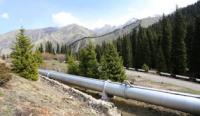
A massive metal pipe, 3 kilometers long and 2.5 meters in diameter, was laid from the Big Almaty Lake dam to the First Hydroelectric Power Station. From the First Hydroelectric Power Station, an underground water pipeline runs approximately 7 kilometers along the western slope of the gorge at an altitude of 1,900 m. a. s. l. to the beginning of the pipeline, which leads to the Second Hydroelectric Power Station.
The elevation difference from the First Hydroelectric Power Station, where the underground pipeline begins, to the beginning of the pipeline above the Second Hydroelectric Power Station is 38 - 40 meters. A 5.8-kilometer-long utility road remains along the underground water pipeline, starting from the right bank of the Big Almaty River at an altitude of 1,738 m. a. s. l.
The road traverses the western slope from southeast to northwest and reaches an altitude of 1,900 m. a. s. l., where a pipeline originating from the First Hydroelectric Power Station emerges from the western slope of the gorge. Local tourists have nicknamed this road "Japanese," apparently in memory of the Japanese prisoners of war who participated in the construction of certain buildings in Almaty.
Currently, the service road is used for walking and is very popular among tourists.
Prospects for modernization and development of Big Almaty Gorge hydroelectric cascade.
The hydroelectric cascade's power plants have been in operation for 60-70 years, and their equipment requires replacement and reconstruction. A project for the reconstruction and modernization of the cascade has been developed. This project includes the modernization of the Verkhne-Almatinskaya HPP and HPP No. 2, including a complete equipment replacement and an increase in the capacity of the stations to 19.5 MW and 18 MW, respectively.
The project also includes the construction of a new building for HPP No. 8a, the construction of a new HPP No. 12 to replace the decommissioned HPPs No. 9, No. 10, and No. 11, and the replacement of equipment at the switchgear of HPP No. 7, along with the construction of the new HPP No. 12.
Following the reconstruction, the capacity and generation of the HPP are expected to increase.
Geographical coordinates of panoramic viewpoint in Big Amaty Gorge: N43°04'47 E76°59'01
References:
E. O. Senzherliev, "Electrical Component and Automation of Hydroelectric Power Plants of the Almaty Cascade of HPPs during Parallel Operation." Almaty University of Power Engineering and Telecommunications.
"Electric Power Industry of the Commonwealth of Independent States 2007-2017." Executive Committee of the CIS Electric Power Council
"Energy Resources of the USSR, 1967," p. 536.
"Energy of Kazakhstan, 1998," pp. 169-170.
"ALES - Cascade of Hydroelectric Power Plants." JSC "Almaty Electric Stations."
http://kazhydro.com/Каскад.html
"Reconstruction and Modernization of the Cascade of Hydroelectric
Power Plants of JSC "AlES
http://www.marketcenter.ru/content/doc-0-7310.html
Dukenbaev K.D. "Energy of Kazakhstan. Moving Toward the Market." Almaty: Gylym, 1998. 584 pages. ISBN 9965-01-099-4.
"Energy Resources of the USSR." Hydropower Resources." Mostkva, Nauka, 1967, 600 pages.
Authority:
Alexander Petrov.
www.ales.kz
https://ru.wikipedia.org/wiki/%D0%90%D0%BB%D0%BC%D0%B0%D1%82%D0%B8%D0%BD%D1%81
Alexander Petrov
photos by.
Authority:
Alexander Petrov and the information from a site http: // www.ales.kz