




You are here
Ustyrt plateau.
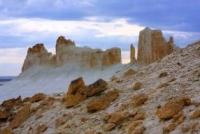
Tours to Mangyshlak peninsula.
“Having come ashore we are in the smooth, flat upland called Ustyurt in Kyrgyz. It is the name that shows the upland from the word “ast” (lowland), which means the southern lower lands where the major population karakalpaks”
Eversman’s diaries as of 13 January 1825.
Tours Ustyrt plateau in Mangyshalk and Uzbekistan.
Ustyurt Plateau is located between Caspian and Aral Seas, Kara-Bogaz-Gol Bay to west, and Amu Darya Delta to east. Absolute altitudes range from 50 to 280 meters above sea level, with individual points on cliffs reaching 340 meters above sea level. It covers an area of approximately 200,000 square kilometers and is located in Kazakhstan (Mangistau, south and southeast Atyrau, and south Aktobe regions), Uzbekistan (Republic of Karakalpakstan, western part of Aral Sea), and Turkmenistan (northern Balkan Velayat).
Ustyurt Plateau: A Stone Sea of Time.
Ustyurt Plateau is one of the most mysterious and majestic landscapes in Eurasia, where space and silence take on an almost cosmic scale. This vast limestone shield stretches between the Caspian and Aral Seas, encompassing Kazakhstan, Uzbekistan, and Turkmenistan.
For explorers, photographers, and travelers, Ustyurt offers a glimpse of the Earth in its primeval past - free from the noise of cities, roads, and human interference.
Geology of Ustyurt Plateau. Millions of years in a single horizon.
The plateau is composed of Neogene sedimentary rocks (primarily Miocene limestones), formed by repeated advances and retreats of the sea from the surface - Sarmatian limestones, beneath which lie marls, clays, limestones, sandstones, and gypsum.
The plateau was uplifted during the Pliocene. The most common physical characteristic of the Ustyurt plateau is a clayey and clayey-rocky desert with groups of outliers or isolated low-lying calcareous karst formations, as well as shallow soil fissures, grabens, localized areas of fine gravel, and, occasionally, sand.
In scientific terms, this is formulated as follows: the Ustyurt plateau is composed of Neogene sedimentary rocks, with Sarmatian limestones on the surface, underlain by marls, clays, limestones, sandstones, and gypsum. The Neogene cover forms two gently sloping syneclises (in the north and south), separated by a broad anticlinal uplift extending from west-northwest to east-southeast and rising along the continuation of the axis of the Mangyshlak anticlinal structure, which is buried here under Neogene layers.
These main structures are complicated by local uplifts and depressions, expressed in the relief as gentle rises and depressions. The Neogene cover, in a softened form, follows the dislocations of the deeper Paleogene and Mesozoic sedimentary deposits, resting on a highly dislocated Paleozoic basement.
Oil (in the south) and gas (in the north) deposits have been discovered within the ridges buried beneath the Neogene cover. On the surface, the Sarmatian limestones are mostly covered by loose clayey deposits of Quaternary age. Overall, Ustyurt is a table plateau with a number of elevations in the form of gentle ridges (Muzbel, Karabaur, etc.) and basins.
Gravitational processes play a major role in the formation of the plateau's steep cliffs, with the collapse of limestone blocks being precipitated by the opening of vertical cracks due to the force of the lateral thrust and karst processes.
Ustyurt is a unique geological feature. Its rocks are primarily composed of:
- marls,
- limestones,
- dolomites,
- siliceous concretions,
- the remains of corals and marine organisms.
These rocks formed during the era when the area was the bottom of the vast Tethys Sea. Fossils are often found in the rocks: ammonites, belemnites, mollusk shells, fish, and traces of ancient marine reptiles. Geologists subdivide the plateau into the following major structural-relief components: the North Ustyurt syneclise (a large, smooth depression), the Central Ustyurt uplift, the South Mangistau-Ustyurt depression (a system of troughs), the Kuanysh-Koskalinsky swell, part of the Aral system, which also includes the Sudochi trough and the Takhtakairsky swell located to the east.
Tectonically, Ustyurt is part of the Turan, or Scythian-Turanian, plate. During the early and mid Cenozoic era, the plateau was the floor of the ancient Tethys Ocean, which existed between the ancient supercontinents of Gondwana and Laurasia, two parts of the protocontinent Pangea that broke apart during the Mesozoic era.
The limestones of Ustyurt contain numerous shell inclusions, and some layers are truly solid shell rock. Other evidence of ancient geological processes are the so-called "stone balls," often partially eroded and resembling bitten apples - iron-manganese spherical concretions that typically form on the seafloor at great depths.
Dune fields.
In some areas, Ustyurt gives way to sandy massifs - the remains of ancient dune systems.
Rocky deserts.
Bare surfaces covered with gravel, limestone, siliceous nodules, and a dense clay crust - in places completely devoid of vegetation.
Physical and geographical description of Ustyurt Plateau.
It is bordered on almost all sides by sheer cliffs - the cliff plateau - in Kazakhstan and Uzbekistan, located between Mangyshlak and the Kara-Bogaz-Gol Bay to the west, and the Aral Sea and the Amu Darya Delta to the east. Its area is approximately 200,000 square kilometers.
The eastern chink, which drops off to the Aral Sea, has a relative elevation of almost 190 meters. The absolute elevation of the plateau in its most elevated parts is over 300 meters above sea level (up to 370 meters above sea level in the southwest).
On the plateau, travelers see clayey, clayey-salty, and sometimes (mainly in the southeast) gravelly-clayey desert of grayish or yellowish-whitish tones, with sparse wormwood and saltwort bushes, and white and gray patches of salt marshes.
Occasionally, depressions with sand deposits, salt marshes, or salt lakes are encountered.
A group of bitter-salt lakes and significant salt marshes are found in the northern part of Ustyurt. Southwest of the Aral Sea lies a vast saline land - a salt marsh with a salt crust on the surface - called Barsakelmes (in Kazakh, this means "if you go, you won't come back": the salt marsh is very boggy).
Northwest of this saline land, karst forms occur in the Sarmatian limestones. These are large sinkholes, up to 30 meters in diameter and 12 meters deep, with brackish water at the bottom. Karst forms are also common in other areas, and are expressed not only by large sinkholes (anas), but also by basins, sinkholes, saucers, caves, and other features.
They were formed by the leaching of limestone and gypsum. According to Yu. Ya. Kuznetsov, large underground karst cavities, which caused the sinkholes on the surface, arose in the Pliocene. On the southeastern edge of Ustyurt lies the deep Assake-Audan Depression, which merges with the Sarykamysh Basin.
Gypsum karst is widespread in this depression.
Flora of Ustyurt Plateau.
Desert xerophytes dominate the Ustyurt Plateau: glaucous and black saxaul, saltwort, wormwood, calico, and kandym. These plants are adapted to saline soils, winds, and long-term drought. The clay plains of Ustyurt are covered predominantly by wormwood and sparse bushes of Anabasis aphylla.
The wormwood desert alternates with nearly bare areas of highly saline soils with sparse, low-growing cushions of Anabasis salix.
Fauna of Ustyurt Plateau. Life on Edge of Possibility.
Ustyurt is home to rare animals and endangered species typical of desert landscapes: the Ustyurt mouflon (Turkmenian sheep), the symbol of the plateau; the saiga antelope (which visits mainly in winter); the goitered gazelle; the caracal; the Pallas's cat; as well as predators such as the cheetah (listed in the Red Book); and birds such as the steppe eagle, peregrine falcon, and bearded vulture.
The region's special pride is the Ustyurt Nature Reserve, home to the last population of argali in Kazakhstan. To preserve this unique fauna, the Ustyurt State Nature Reserve was established. There used to be many kulans. Eastern sheep (Ovis orientalis) are sometimes found on the western and southern cliffs.
Modern Development of Ustyurt.
Most of Ustyurt serves as spring, summer, and autumn pastures. Livestock winter in the sands of northern Ustyurt and the sandy areas located to the west, north, and northeast of this plateau. Ustyurt is now crossed by railways, facilitating its development.
The deserted roads of Ustyurt were the routes of great migrations. However, true human development of the plateau is only just beginning.
Historical Monuments and Landmarks on Ustyurt Plateau.
Dozens of unique archaeological sites have been preserved on the plateau:
Kaishaks - ancient Saka fortifications, the remains of walls and towers standing along ancient caravan routes, Ustyurt necropolises, burial structures from the early Iron Age, mazars and stone crypts, stone labyrinths (arans), Ustyurt arrows, and ritual circles.
These mystical sites, the origins of which are still debated by scholars, are among the mystical sites. Branches of the Great Silk Road passed through here, and many caravan routes ran along the northern edge of the plateau. Archaeological sites are among the attractions of Ustyurt.
In ancient times, ancient caravan routes crossed the plateau, such as the Khorezmshahs' road, which connected Khiva with the lower reaches of the Emba and Volga rivers. The ancient city of Shahr-i-Wazir, the Beleuli caravanserai, and the Allan fortress were located along this route.
Ancient cemeteries with majestic mausoleums (mazars) are scattered throughout the plateau. Some have already been studied by archaeologists, but many more await further exploration. There are also older sites. About 60 Neolithic sites are known on Ustyurt.
In the early 1980s, strange arrow-shaped markings or structures were first spotted from an aircraft conducting aerial surveys of the Ustyurt Plateau. Archaeologists had never encountered such objects before, perhaps because these "structures" are impossible to detect during ground surveys.
Due to their gigantic size and smooth terrain, they are invisible from human height, horseback riding, or camelback. Researchers can walk or drive over these strange arrows hundreds of times, unaware of what lies beneath their feet. Vast salt basins are the dried-up remains of ancient lagoons.
White salt marshes create a wintery feeling even in summer, when temperatures reach +50°C.
Climate of Ustyurt Plateau. Life on Edge of Possibility.
The climate of is a realm of absolute continentality. It is characterized by large daily and seasonal temperature fluctuations. Summers are long and very hot (temperatures often exceed 40°C), while winters are cold, with little snow, and strong winds.
Precipitation is extremely low.
Climate of Ustyurt is one of harshest in Central Asia.
Winter. Temperatures can drop to –30°C. Strong steppe winds are frequent, raising icy dust.
Summer.
Extreme heat (45…50°C), dry, almost completely rainless.
Precipitation:
Only 80 - 150 mm per year - less than in the Sahara. These conditions determine the rarity of flora and fauna, as well as the special beauty of desert sunsets and night skies.
Hydrography of Ustyurt Plateau.
There are no permanent streams or rivers on the plateau. There are valley-like depressions, blind valleys, and numerous salt marshes. There are also depressions whose bottoms lie below sea level, such as the Karynzharyk Depression. In the northwestern part of Ustyurt lies a sandy desert massif called the Sam Sands.
Here, fresh groundwater is found at a depth of 2-3 meters. In other areas, groundwater is deeper (20 - 50 and even 70 meters), and is usually brackish or saline. There is no surface freshwater on the plateau. Due to the plateau's elevation above the surrounding areas, water supply is difficult from other sources, such as the lower reaches of the Amu Darya.
Therefore, the hydrological conditions are unfavorable for economic development.
Topography of Ustyurt Plateau.
Ustyurt is an elevated plateau, bounded on all sides by gigantic natural walls - cliffs and escarpments up to 250 – 300 meters high. These rocky "ledges" (chinks) are essentially the shores of ancient seas that existed here millions of years ago. A characteristic table-like relief, bounded by steep and precipitous slopes – cliffs - is characteristic.
These cliffs, up to several tens of meters high, were formed by erosion by sea currents during periods of transgression in the Caspian Sea.
Main landscape elements of Ustyurt Plateau.
Cliffs.
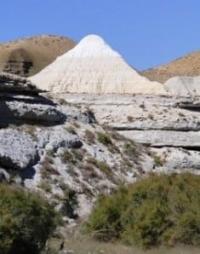
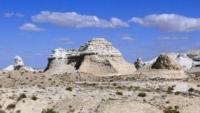
Stepped rock walls resembling giant amphitheaters. Thousands of layers of sedimentary rock are visible on their surface - a stratigraphic record spanning up to 60 – 70 million years of history.
Saline land and saucers.
One of the most impressive panoramas in Kazakhstan – jagged white chalk peaks, reminiscent of a flotilla of ships.
Karakiya Depression:
One of the deepest depressions in the CIS – 132 meters below sea level.
Kokkem and the Sarytash valley on the Caspian coast.
Valleys containing the remains of ancient sites and stone dwellings, as well as a rich paleontology.
Asmantai-Matai Saline land.
Snow-white salt marshes, photogenic in the sunset light.
Ustyurt is rich in legends, like any land where one feels the breath of antiquity.
Legend of Stone Sea of Ustyurt Plateau.
They say that this entire land was once covered by a vast sea. When the water receded, it took life, but left behind a memory - petrified waves in the form of chingils.
The elders tell us:
- "Ustyurt is a sea frozen in time."
Legend of white antelope of Ustyurt Plateau.
According to local lore, the goitered gazelle was created from a sunbeam that fell on the parched earth. Therefore, seeing one is a sign of favor from the desert spirits.
Legend of lost caravan on Ustyurt Plateau.
Travelers said that once, a caravan carrying gold and turquoise disappeared in a sandstorm. Since then, on moonless nights, lights have sometimes been seen on the plateau – supposedly lanterns of caravanners wandering in search of a way.
Tourist information for visiting Ustyurt Plateau.
How to get there:
Main access points:
Aktau, Zhanaozen (Kazakh: Жаңаөзен) (Western cliff of the Ustyurt Plateau). Nukus and Balkanabat (Eastern Ustyurt Cliff). The village of Bozoy (Northern cliff of the Ustyurt Plateau) are the nearest large cities and towns.
The village of Beyneu is a convenient starting point for routes to the central part of the plateau.
Aktau, Zhanaozen, and Fort Shevchenko are the starting points for the valleys of northwestern Ustyurt and the Western cliff of the Ustyurt Plateau.
Best places to visit:
Zheltau Mountains (northern Atyrau Region and eastern Mangystau Region),
Northern cliff of the Ustyurt Plateau (Donyztau cliff),
Karynzharyk Depression (Ustyurt Nature Reserve).
Bozzhyra valley.
When to go:
The best time is April – early May and September – October.
Summer heat is extreme, while winter weather is harsh and windy.
Important:
You need an all-terrain vehicle.
At least 5 liters of water per person per day.
There is almost no communication – autonomous navigation is required.
Sudden temperature changes are possible at night. Environmental Responsibility:
Ustyurt is a fragile environment. It is important for travelers to:
- not leave litter,
- not disturb animals,
- stay on existing trails,
- respect archaeological sites.
Ustyurt is a place where time ceases to be time. Visiting the plateau even once leaves a feeling of touching antiquity. It is a space of endless horizons, silence, stone, and light. A place where millions of years have left traces that neither wind nor time has erased.
Note:
In geography, cliff, plural cliff, from the Turkmen şınk, is a regional term used in Central Asia and Kazakhstan to refer to steep, precipitous ledges or edges of plateaus and mesas. Main characteristics of cliff topography:
Cliff topography:
- They are steep, often nearly vertical slopes or cliffs that border elevated, flat areas of the earth's surface, typically plateaus. Cliff height: They can reach considerable heights – up to 300 – 350 meters above the surrounding terrain or sea level.
- Cliff distribution:
The term is most common in geographical descriptions of the region between the Caspian and Aral Seas. The most famous examples are the cliff topography of the Ustyurt Plateau.
- Cliff origin:
- Their formation is associated with various geological processes, such as erosion, denudation, or tectonic uplift. Ustyurt cliff topography is often the result of ancient marine abrasion – the destructive action of waves on the shores of retreating seas.
They are found primarily in Kazakhstan and on the Ustyurt Plateau. The Pallas's cat, the wild cat, lives in the crevices of chink topography.
Appearance of cliffs:
- layered limestone and chalk deposits exposed on cliffs often have vibrant colors - white and red - which lends cliffs picturesque landscapes. Thus, in a geographical context, a "cliff" is a specific landscape element characteristic of the arid regions of Central Asia.
Geographic coordinates of Ustyurt Plateau in Kazakhstan are: N46°15'51 E56°41'14


Authority:
Alexander Petrov.
A.G. Isachenko, A.A. Shlyarnikov. The Nature of the World. "Landscapes," Moscow, Mysl, 1989.
Photos by:
Alexander Petrov.